8 dnevno družinsko potovanje po Barceloni, zapisano kot dnevnik po dnevih. Znamenitosti, izkušnje, nasveti in realni tempo raziskovanja mesta z otroki.
DAY 8
Departure and the feeling that the journey came together
That morning when you leave
The moment you open your eyes in the morning, the thought hits you: that’s it. It’s over. How unfair.
You slowly start to wake up. Resigned to it, you make coffee. One sip, then another, and you begin convincing yourself that we really did have a great time and that we have to go home, if only so we can set off somewhere again.
And then you remember that tomorrow is a workday. So you finish your coffee, teeth clenched, right to the last sip.
To the airport
Enough complaining, it’s time to pack. Our flight wasn’t until one in the afternoon, which meant a normal morning, a calm check-out from the hotel and an unhurried arrival at the airport.
I had already taken care of the check-in through the app a week earlier, while we were still at home airport.
Since we had been getting around mostly by taxi, I ordered one for the trip to the airport as well. The ride was short and, more importantly, cheaper than using the ride-hailing apps, so I suspect I won’t be relying on those much in the future.
Once you walk through the Departures entrance, the self-pity fades away and a different feeling takes over: we’re going home. And, truth be told, that’s not such a bad thing after all.
El Prat
The airport is clear and easy to navigate, and it doesn’t take long to figure out where you need to go.
It was fairly crowded, but despite that, everything ran smoothly.
Baggage drop for Vueling is handled through self-service machines, which was new for us. There were, however, plenty of staff nearby in case anything went wrong.
And that’s it. All that’s left now is waiting.
What stayed with us the most
We had plenty of time before our flight, so we started talking about what each of us had enjoyed the most.
Nara was fascinated by the Sagrada Família, Anja by La Pedrera and Sant Pau, Nia by the Big Fun museums, while what stayed with me the most was the view over Barcelona from that bench above Park Güell that we found by chance.
We all agreed, though, that our favourite day overall was the day trip to Tarragona and the walk along the beach in Vilanova i la Geltrú.
It’s probably that sense of spontaneity, and days without too much planning, that’s worth remembering for future trips.
One story ends, another begins
After a short delay, we were taken by bus to the middle of the airport, where our plane was already waiting for us.
Looking back at the flights we’ve taken to Brnik over the past few years, it still surprises me how they are almost always full. That’s actually good news, as it might also mean hope for a few more direct routes from Slovenia.
As the plane begins to climb above the clouds, Barcelona and Catalonia are left somewhere below us. We leave satisfied, carrying plenty of good memories and impressions, and also with a sense of relief that everything turned out well, especially considering the trip began with illness.
We didn’t have any bad experiences. People were friendly, prices reasonable, and public transport reliable. It was particularly reassuring to see how smoothly the transition into 2026 was handled, given that this was our first time celebrating the New Year outside, surrounded by such a large crowd.
After six days of travel filled with walking, impressions, and small worries that always feel bigger on the road than they truly are, we could sense that the story was slowly coming to an end. This was reflected in our late morning, when we simply couldn’t get ourselves out of bed. Still, as it was our last full day in the city, we finally managed to get going around 10 a.m.
Over these days, we had explored the city thoroughly, as we always do, wherever we go. From the wide avenues of Plaça d’Espanya and the slopes of Montjuïc, through the ever-lively La Rambla and the old town of Ciutat Vella, all the way to the seafront of Barceloneta.
We experienced the monumental Sagrada Família in Eixample, strolled along the elegant Passeig de Gràcia, and caught sweeping views near Park Güell above the Gràcia district.
And so, for the end, only one calmer part of the city remained. Parc de la Ciutadella, a large park nestled between the El Born and La Ribera neighborhoods.
Metro
Because Anja fell ill during the first days, we relied quite a bit on taxis to get around the city, mainly so she wouldn’t exhaust herself too much. Later, when she was feeling better, we had clearly grown used to the comfort and kept using them anyway. If I’m completely honest, over all those days I spent just over 100 euros on taxis. The metro would have cost us roughly half as much, but the difference simply couldn’t outweigh the convenience and the time saved.
Still, today it felt only right to take the metro instead, if only to see what it was like.
Our nearest station was Plaça d’Espanya. We bought a T-familiar ticket for 12 euros, which allows eight rides. For a family, it’s almost an ideal solution: you validate the ticket four times, and that’s it.
Arc de Triomf
You step out of the underground straight in front of the arch. But this one is not like the one in Paris. It doesn’t feel massive, and it doesn’t speak of power or victories.
It is built of brick, which gives it a softer, almost friendly character. Instead of celebrating triumph over others, it honors science, progress, and openness to the world.
And indeed, when you stand beneath the arch in Paris, on the Champs-Élysées, you feel a sense of reverence and the weight of power.
Here, everything is different.
The atmosphere is more relaxed, almost light. Toward the park stretches a long sandy promenade, where parrots and pigeons jostle for food tossed to them by passers-by.
Pari so pozirali pred uličnimi fotografi. Nekdo je spuščal milne mehurčke, drugi je papige tako navadil na ljudi, da so brez strahu priletele na iztegnjeno roko. Nia jih je imela naenkrat kar tri. Ko si na koncu te sprehajalne poti, tik pred vstopom v park, se splača obrniti nazaj proti slavoloku.
Castell dels Tres Dragons (Grad treh zmajev)
The atmosphere is more relaxed, almost light. A long sandy promenade stretches toward the park, where parrots and pigeons jostle for food tossed to them by passers-by.
As if someone had torn it from a fairy tale and placed it right in the middle of all this greenery.
Much like the area around Plaça d’Espanya and the Magic Fountain, this part of the park was also designed for a world exhibition, only a different one, held much earlier, in 1888.
The building has no connection to dragons whatsoever. It got its name from a popular stage play of the time. You almost walk past it without noticing, as it feels more like a backdrop than a landmark.
Cascada Monumental (the monumental waterfall)
As you walk along the park’s paths, low hills and trees constantly limit your view, so you never really see far ahead. Because of this, the surprise is even greater when you suddenly step out from among the trees into an open space and a lavish cascade of water, statues, and staircases unfolds before you. It’s simply not a sight you expect to encounter in the corner of a city park.
If you’re looking for a break from the city, this is the place to come. The fountain was designed to at least loosely evoke Rome’s Trevi Fountain. Whether they succeeded is something we’ll be able to say with more certainty in a month’s time, when we’ll be there ourselves. Antoni Gaudí is said to have been involved in the project to a small extent, back when he was still a completely unknown architecture student.
The girls loved it, especially Nia, who, as a swimmer, is always delighted whenever there’s water around.
Mammoth
As you leave the fountain, you first watch your step so you don’t trample a duck or trip over a goose, as they’re everywhere here, and then you walk past a mammoth… wait, what? A mammoth? Yes, a mammoth. No explanation in sight.
You go and read.
It was installed for that exhibition, and even back then it was so popular with children that they simply left it there.
Catalan Parliament
Passing palm trees from which the screeching of unseen parrots can be heard once again, and skirting a small lake where you can rent a boat in the warmer months, you suddenly find yourself in front of the only truly serious-looking building anywhere around.
This is the Catalan Parliament, once a military fortress built as a clear symbol of authority, power, and dominance, and today, ironically, the heart of Catalan democracy. It was here that tensions ran particularly high in 2017, after the Catalan independence referendum, when Madrid dissolved the parliament, took control of the region, and imprisoned or forced into exile those who had initiated the process. Images of police intervention and political collapse circled the world at the time.
Today, everything was calm. From time to time, the only sounds were the shriek of an irritated monkey or the roar of a bored lion. The Catalan Parliament stands on the edge of the park, right next to the Barcelona Zoo, and we decided to go and take a look.
Zoo
There was no meerkat in the first enclosure. Apparently, it was too cold for them. The second enclosure was for monkeys, but there were none to be seen either, no doubt because it was just as cold for them. We reached the third enclosure just in time to catch a glimpse of a bear’s backside disappearing indoors, clearly because it was cold. Winter really isn’t the time to visit zoos. The girls reminded me that we had come to the same conclusion once before, back in December in Zagreb, but had somehow forgotten about it.
Still, it wasn’t all in vain.
For the first time, we saw a Komodo dragon, which truly is enormous, and walked past wolves, orangutans, lions, and giraffes.
The animals have plenty of space, especially in the African section, which is laid out as a circular walk that really lets you see everything
After a rather empty start, it ended up being a pleasant walk after all.
The final walk through Barcelona’s old town
We continued on foot, as La Rambla isn’t really far from here. On the way, a few sights awaited us that we had skipped on the first day. As you walk, you catch sight of that street lined with palm trees. Even after a week, you still haven’t quite gotten used to them, and they manage to delight you every single time.
Well, at least me…
Santa Maria del Mar
Our path first led us to Santa Maria del Mar, the Cathedral of the Sea, as locals call this basilica.
Among Barcelona’s many Gothic churches, this one stands out precisely because it was not built as a church for kings or nobility, but as a church of the people. It was built by the residents of El Born, by fishermen, craftsmen, and above all by dockworkers, who carried the stone blocks to the construction site on their own shoulders.
Centre de Cultura i Memòria
Just a few steps away, we also stopped at this museum, where you walk through a marketplace from the early 18th century, several meters below today’s street level. It made it easier for all of us to imagine what it really means when we say that, throughout history, the city has been built again and again on top of older settlements.
Plaça del Rei
Just ten minutes earlier, we had been learning how the people of El Born once lived and what kind of church they were capable of building.
Now we were standing in front of the imposing walls of the Palau Reial Major, where the focus was no longer on community, but on power. Massive stone walls, towering arches, and the enclosed space of Plaça del Rei were not designed for strolling or everyday life, but for control, protocol, and decision-making.
This was where the rulers of the Crown of Aragon resided, where ambassadors were received, and where decisions were confirmed that reached far beyond the city’s boundaries. Today, weary tourists sat on these steps, yet it is entirely possible that this was the very place where the king and queen received Columbus upon his return from the discovery of America.
Laughter and photos to end the day
Since we still had tickets for the Big Fun Museum, we spent the evening there. Entire walls are painted and designed so you can step into the scene and take playful, fun photos.
We began the trip under stress, unsure how the illness would unfold, and ended it in good spirits and laughter.
Tomorrow, the journey home awaits us. We’ll take a look at the airport and, in the final post, write a short summary of this Catalan adventure.
Morning confusion at Barcelona Sants railway station
Yesterday’s change of plans for the day ahead left us with a few open questions, so we got up early and headed to Barcelona Sants railway station, where our train was supposed to take us south.
Right from the start, we were met with a bit of confusion. The departure boards only show final destinations, which makes it hard to get your bearings quickly. Some trains stop at every station, others do not, and I wasn’t entirely sure which one we should take.
I first tried the ticket machines, but without much success. I simply didn’t know what to choose. We then went to the first ticket counter, only to find out that we were in the wrong place.
That counter is reserved for high-speed trains, the ones that run at up to 300 km/h and can get you to Madrid in about two and a half hours. I had no idea Spain even had trains like that.
They sent us to counters 1–4, where tickets for Rodalies are sold. These are regional commuter trains that run across Catalonia.
Children’s tickets turned out to be a story of their own. Even though the kids are 8 and 10 years old, we had to buy adult tickets for them. On Rodalies trains, there are no child discounts. Only children under the age of three travel for free.
All together, I paid €30 for the tickets, which felt rather steep for a local train.
The journey took about an hour. Although the route mostly follows the coast, you don’t actually see much of the sea. There are plenty of tunnels and embankments, so the ride itself isn’t particularly memorable. Still, just before our destination, palm trees finally came into view.
The station in Tarragona is small and feels almost homely, especially after the days we spent in the bustle of a big city.
Now that we were finally there, we took our time over a coffee and calmly worked out what we actually wanted to do.
Tarragona
Tarragona is a modern coastal city where ancient heritage blends into everyday life. It is an important regional centre of Catalonia, a university city, and one of the key industrial areas, mainly because of its strong chemical industry.
When you look out toward the sea, the many cargo ships on the horizon are a quick reminder of that.
From the railway station, the path leads uphill along a pedestrian walkway above the road, leaning against a massive city wall that is more than two thousand years old. After about ten minutes of walking, you reach the top, which is in fact a natural rocky terrace some fifty metres above the sea.
This area is known as the Mediterranean Balcony, and it’s a place where you can simply slow down and take in the view of the Mediterranean Sea.
Tarraco
In Roman times, Tarragona was known as Tarraco and ranked among the most important cities on the Iberian Peninsula, serving as the capital of a Roman province. Today, the city’s archaeological complex is listed as a UNESCO World Heritage Site.
You don’t have to go far from the balcony to encounter the next structure from the ancient world. Right at the edge of the cliff, the view opens downward onto the Roman amphitheatre, once used for gladiatorial games and fights between humans and animals.
The amphitheatre in Tarragona is one of the few Roman amphitheatres located by the sea. While it is nowhere near as well preserved as the one in Pula, it once held around 15,000 spectators and had a special feature: the arena opened directly toward the Mediterranean Sea.
The view from the balcony was more than enough for us, so instead of heading down, we continued toward the Praetorium, the former seat of Roman authority. The massive walls rising high above you are reason enough on their own to walk this far.
In Roman times, the Praetorium served as a vertical link between the upper city with its main forum, the middle level with the Roman circus and chariot races, and the lower parts of the city, where the amphitheatre once stood.
Tarraco was built in terraces, thoughtfully and systematically, and that is exactly what makes it special.
Cathedral Basilica of Saint Tecla
Once you’ve had your fill of these walls, the walk continues through narrow stone streets lined with small shops and cosy cafés, where we stopped for a well-earned snack and coffee. After leaving the café, only a few more steps awaited us, climbing a steep staircase that brings the street to an end. Tarragona Cathedral stands at the highest point of the old town, on the site of a former Roman sanctuary. After climbing those final steps, its imposing entrance façade opens up in front of you.
There were few people around, nothing compared to Barcelona. In some of the streets, we were completely alone.
It is precisely this moment, when you emerge almost alone from the narrow streets, slowly climb the steps, and suddenly find yourself standing in front of powerful architecture, that gives travel its meaning. It’s not so much about the landmark itself, but about the feeling. It’s about the path, the place, and how you take it all in together. And when you experience it with your family, even more so.
Castells
On one of the walls near the cathedral, a huge image was displayed, showing celebrations during the feast of Santa Tecla.
They depict castells, the Catalan human towers. It is a tradition more than two hundred years old, originating right here.
The towers are built slowly, layer by layer, with great concentration and complete trust between those involved. The strongest stand at the base, the lightest climb higher, and at the very top a child, usually between five and ten years old, climbs up and raises a hand to signal that the tower has been successfully completed.
Castells were originally meant as an expression of community, cooperation, and perseverance. Today, there are also competitive events, held every two years, right here in Tarragona.
Circus Tarraconensis
In Roman times, Tarragona was home to a large circus, as the horse-racing stadium was known. It could hold up to 30,000 spectators, which was remarkable for a city of that era.
Today, it can only be seen underground, in the preserved tunnels and vaults. Over the centuries, houses, palaces, and streets were built above the circus, leaving most of the structure hidden from view.
During our walk, we came across just one entrance to these tunnels. It was partially closed off with a metal fence and clearly not maintained. We couldn’t find an official entrance, so we gave up and continued through the narrow streets until we reached the long, wide Plaça de la Font.
Its unusual length and flatness quickly make you realise that this was once the straight section of the circus. An inscription on the square confirms it: you are standing directly above the former racing track of the Roman circus.
The Monaco of the Roman World
In Roman times, Tarraco was truly something special. The city combined power, influence, and prestige. It had an amphitheatre with gladiatorial games and views of the Mediterranean Sea, a large circus for chariot races, and a praetorium that served as the seat of Roman authority for the province.
This was not merely a provincial town, but a political and social centre of the Roman world on the Iberian Peninsula. In terms of its role and atmosphere, the closest modern comparison would be Monaco, a place where power, entertainment, and prestige come together, only on a Roman scale.
That Tarraco held a truly exceptional status is also confirmed by the fact that the first Roman emperor, Augustus Octavian, lived here for several years.
Where to next?
On our way downhill, we passed a church that immediately catches the eye with its colour. It is Sant Agustí, whose pink façade stands out among the massive stone buildings around it.
We stopped once more at the Balcón del Mediterráneo to say our goodbyes, then made our way back toward the railway station. Since it was still early afternoon, we felt like visiting one more town. We were choosing between Sitges and Vilanova i la Geltrú.
Sitges is known for its seaside promenade and a somewhat more upscale, touristy atmosphere, or so it was written… Vilanova was said to feel calmer, more local and authentic, with a strong fishing character and a beautiful old town, at least according to what we read online. So how do you choose?
In the end, we chose Vilanova, mainly because of a single photo of the town square that caught my eye. That photo didn’t quite live up to expectations later on, but that’s fine. The town surprised us with other things instead.
Before boarding the train, we also sent off the two postcards we mail on every trip. One goes to my parents, the other to a friend in Denver, Colorado. It has become our small travel tradition, as postcards are slowly turning into an endangered species.
I don’t know how it was possible, but the train took almost an hour, even though the distance was roughly half of what it was between Barcelona and Tarragona, a journey that took the same amount of time. Apparently, alongside high-speed trains, there is also a special category of very slow ones.
Vilanova i la Geltrú
We finally arrived at the station and set off toward the square from that photo. It lies somewhere in the middle of the town, and the streets leading to it are unbelievably long. One of them, Rambla Principal, stretches for almost a kilometre.
Walking along these streets is an experience in itself, especially when you’re used to streets ending much sooner. Although, now that I think about it, Santa Catarina in Porto was also quite long, but there it was packed with tourists. While there were still some visitors in Tarragona, here it felt almost completely empty.
The square from that photo is Plaça de la Vila, the town’s main square, distinguished by its wavy mosaic and rows of palm trees. It feels like a small island in the middle of all those long, straight streets.
The square was filled with New Year’s market stalls, so the mosaic didn’t fully come into its own. Still, we had a look around before continuing along the Rambla toward the beach.
If the streets here are impressive in length, it feels only right that the beach matches them. Before you even reach it, you walk through a park almost 500 metres long, and then the beach of Ribes Roges opens up in front of you.
It’s large, and in a rough way it reminded us of Nazaré in Portugal, where we had been walking just a few months earlier. Apart from a handful of passing walkers, the beach was empty, which felt like a welcome contrast to crowded Barcelona.
The day had been genuinely pleasant. We had seen a lot, walked a lot as well, and somewhere along the way you really start to unwind… right up until the moment we began looking for a suitable place for dinner.
Dinner in the bullring
The first option was fast food, the second a fish-only restaurant, the third far too upscale. That was it. We surrendered. Back on the train to Barcelona, we’d figure something out there.
In the end, we found it where we least expected it, at the top of Arenes. The former bullfighting arena has been transformed into a shopping center. There were several restaurants up there, we chose one, and everyone found something to enjoy: Anja went for salmon, the girls had chicken, and I opted for soup and a steak.
At the top, there is also an observation deck that opens up to a beautiful view of Plaça d’Espanya in the evening, the Venetian Towers, and Montjuïc. All’s well that ends well. The timing was just right to catch one more landmark in this part of the city.
Font Màgica de Montjuïc
As we walked toward the fountain, I couldn’t resist taking a photo from almost the same spot as on New Year’s Eve. It’s hard to believe how many people were there back then.
The Magic Fountain of Montjuïc stands between Plaça d’Espanya and the Palau Nacional, in front of those four towers. It was built in 1929 for the World’s Fair and is considered one of the larger fountains of its kind in Europe.
At exactly 8:00 p.m., the water show began, with a combination of water, light, and music that draws crowds of curious visitors every evening for a free performance.
This time, we stood a little farther away, across the road, as the area around the fountain was completely packed. But in truth, we didn’t miss out on anything. Sometimes the view from a distance is even more beautiful, when you can take in those ten-metre-high water jets in their entirety. When the water dances to the rhythm of classical symphonies, it’s something that stays with you.
As we walked back to the hotel, I found myself thinking about what a perfect ending to the day it had been.
Tomorrow, our final day awaits. Park de la Ciutadella, the iconic Arc de Triomf, the Catalan Parliament, and perhaps even a visit to the zoo.
Yesterday afternoon, when we returned from wandering around the city, small bags of grapes were waiting for us in our room. We had no idea what they were for, so we left them behind when we headed to Plaça d’Espanya for the New Year’s celebration.
We waited for the clock to strike midnight and for the fireworks to begin.
That’s when we noticed that many people in the square were holding grapes. The final wave of drones faded out, rockets shot into the sky, and the clock struck midnight. With each chime that followed, the people around us ate one grape. It’s called las doce uvas de la suerte, a New Year’s tradition in which you eat twelve grapes at midnight, one for each month of good luck.
After the fireworks, the crowd dispersed calmly and in an orderly way. We didn’t hear any firecrackers, the shops were still open, and there were no incidents throughout the evening, even though more than 115,000 people had gathered.
A unanimous decision: the beach
The girls woke up surprisingly early, even though we didn’t return from the area around Plaça d’Espanya until around 1:30 a.m. We had no plans for the day. We had deliberately left it open back home, with no schedules and no obligations. We would simply do whatever felt right. And what felt right was the beach.
Through the Gothic Quarter to the sea
We started at Plaça de Catalunya and made our way down to La Rambla, which was already filling up. Before long, we turned into the side streets, Carrer de Ferran and Carrer d’Avinyó. The latter was almost empty, just a short hundred meters from Barcelona’s main pedestrian avenue.
One more thing we noticed right away when we stepped out of the taxi: everything was spotless. There was no trace of the previous day’s celebrations anywhere, as if it were just an ordinary Thursday.
No matter how you make your way from Plaça de Catalunya toward the waterfront, whether along La Rambla or through the side streets of the Gothic Quarter, you eventually end up on Passeig de Colom, that long, palm-lined avenue by the sea.
You cross it, take in the palm trees, reach the other side, and suddenly see people strolling beneath them in short sleeves. Yes, this too is Barcelona on the first of January. The thermometer read 15 degrees Celsius.
El Cap de Barcelona
Somewhere near this pop-art sculpture, installed in 1992 for the Olympic Games, you start to notice the change. You leave behind the narrow streets lined with tall buildings and an old-world feel, and as you move closer to the sea, everything opens up. The sculpture is covered in colorful ceramic tiles, though it can’t quite compare to the ones we saw on our last trip to Portugal.
We continue past the marina, which is filled with yachts.
Along the waterfront, the restaurants are busy. Most people are drinking coffee, some are having a late breakfast, while others clearly haven’t quite finished celebrating the night before and are continuing with Aperol spritzes.
Invisible parrots
We follow a stream of people who have the same idea for spending the first day of the new year at the beach. We spot a large Christmas tree, but your eyes slide past it, distracted by the backdrop of palm trees. If you’re from somewhere like the Gorenjska region, the mountainous part of Slovenia, your brain simply can’t immediately process the coexistence of a decorated Christmas tree and palm trees in the same scene.
As you walk beneath these palms, you constantly hear a kind of shrill bird noise. You’re by the sea, so naturally your first thought is seagulls. But when you look around, there are none to be seen. A white seagull on a green palm tree would be impossible to miss. Clearly, they aren’t seagulls. The chaotic screeching, which sounds like a never-ending argument, continues.
Anja had read that Barcelona is full of parrots, which you rarely see because they hide high up in the palm trees. They’re monk parakeets, which were a popular choice as pets in the last century. Many escaped, and others were simply released.
These days there are so many of them that their screeching has become part of the city’s everyday soundscape, like an upgraded version of cicadas by the sea. At first you notice them, then you tune them out. Seeing them is another story altogether.
Over the course of the entire week, we saw them only twice: once at the viewpoint above Park Güell, and once on the very last day, right in the city center, all gathered in a single tree.
Barceloneta Beach
After all the screeching in the palm trees, you soon catch sight of the beach. Shaped like an elongated triangle, Barceloneta stretches for just over a kilometer and is several hundred meters wide. Much of its modern layout is thanks to the 1992 Olympic Games.
Time and again, as we travel, we realize how much events like world expos in the early twentieth century or the Olympic Games have contributed to the look and feel of cities. Barcelona was lucky enough to host both.
The beach was busy, and considering its size, the scene was surprisingly pleasant. Some people were sitting on benches along the edge, others had found a spot on the sand, and the bravest of all decided to test the temperature of the Mediterranean Sea.
The girls ran from the waves so they wouldn’t get soaked, and were very obviously having a great time.
As you watch this beach, it feels like something is missing, and it’s precisely that absence that makes it so appealing. It feels more like part of a neighborhood and less like a tourist attraction, even though it’s crowded.
There are no hotels.
You only see the iconic sail-shaped one, known as the W, but it doesn’t feel intrusive since it sits right at the edge. Someone clearly gave real thought to the urban planning here, and that’s what makes this place feel different, better, and more beautiful.
The Aquarium
If you’re already in this part of the city, a visit to the aquarium is almost a given. With its main tank holding nearly four million liters of water, it’s one of the area’s main attractions. You start with the standard tanks filled with smaller fish, lobsters, sea stars, and whatever else you might find along the way. The aquarium is home to more than 11,000 animals.
The highlight of the visit is without a doubt the moving walkway through the underwater tunnels, with three-meter-long sharks, rays, and schools of fish gliding above you.
At the end, you can walk through a giant whale, there’s a play area for kids, and you can even feed the fish.
They’re Slovenians
On the interactive screens, you can choose a fish, color it however you like, and give it a name. There were several of these screens, and kids were creating their own fish at every one of them. Including our two.
Once they were done, they sent their fish off, and it appeared on a large screen on the wall. First, a small fish in yellow and blue shades swam across, named Nia. Then another one followed, pink and red, named Nara. At the screen next to ours, a boy had just finished his fish and sent it along as well. When it appeared, it was gray, completely colorless, with the name Jebo Jebic floating above it. *The fish appeared with a deliberately vulgar Balkan joke name, instantly understood as inappropriate by anyone from the region.
I immediately started laughing uncontrollably. Then, from behind us, we heard a mother’s horrified voice:
“Are you out of your mind? These are Slovenians, they understand you!”
Big Fun Museum
When we first walked along La Rambla, we noticed this museum and promised ourselves we’d come back one day when we had more time. Today, we had plenty of it. It turned out to be a museum of illusions, unusual art installations, clever visual effects, and playful backdrops for photos. The girls loved it, and so did we. We laughed a lot, making it a perfect way to start the new year.
A change of plans for tomorrow
Tomorrow, we were supposed to take the train to Montserrat, the famous mountain sanctuary with its Benedictine monastery, and then stop at the Colònia Güell crypt on the way back, where Gaudí experimented with his ideas.
The girls weren’t particularly excited about that plan, so I picked up my phone, and after half an hour we decided to go to Tarragona instead.
It’s a city known for its exceptionally well-preserved Roman buildings, which also fits nicely with our next trip in February, when we’ll be heading to Rome.
So tomorrow, a mini trip within the trip awaits us.
That day actually started two months earlier, on October 18, when I booked a guided tour. It might sound way too early, but since it was the last day of the year, I didn’t want to leave anything to chance.
Today, January 17, when I checked availability again, it turned out that booking just a few days ahead would’ve been more than enough. The price difference between a regular ticket and a guided tour was only a few euros, so we went with the tour. I also added access to one of the towers, which later proved to be a pretty big mistake.
Two Parks
The taxi dropped us near Plaça de la Sagrada Família. We got there early, so we had the park mostly to ourselves, aside from a handful of visitors, mostly from Asia.
I’ve done this before. Heading out at dawn to photograph a landmark. When the sun starts pushing up over the horizon, it’s usually just me, maybe one overly enthusiastic photographer, and almost always a small group of Asian tourists.
From this park, the view opens up instantly. The massive church stands right in front of you, recently crowned the tallest church in the world.
Once we’d taken it all in and that first wave of excitement settled a bit, we walked past the basilica to the park on the opposite side, Plaça de Gaudí.
If you want a truly great photo, this is the spot. There’s a small pond in the park where the Sagrada Família reflects in the water, and that reflection takes the shot to another level.
Three Façades: Nativity, Passion, and Glory
The Sagrada Família is built around three monumental façades, each facing a different point of the compass, each with its own meaning and story. Together, they tell a single narrative: from birth, through suffering, to glorification.
The Nativity Façade, facing the rising sun, was created under Gaudí’s direct influence. It’s overflowing with natural forms, animals, and biblical scenes. Everything feels alive, in motion, packed with detail.
On the opposite side stands the Passion Façade. Cold, stripped down, carved with sharp, severe lines and dramatic figures that show the final hours of Christ’s life without softening the blow.
The third one, the Glory Façade, is still under construction and will be the largest of them all. It’s meant to represent humanity’s path toward God, from death and judgment to light, and it will eventually become the basilica’s main entrance.
When you look at the church from both sides, it’s easy to fall into quick labels: one is “the beautiful one,” the other “the ugly one.” Logically, you’d think the ugly one would be the Passion Façade, right? Turns out, no. The one we thought was ugly, the side by the park with the pond, is actually the Nativity. We only realized that later, back home, while writing this post. Apparently, our sense of beauty is a little… off.
It’s not like some deep mental shift suddenly happened while we were standing there, staring at a façade filled with the Holy Family, the Three Kings, and an explosion of animals and life. That’s birth symbolism, not suffering. Obviously.
And yet, the realization never clicked. Not even when the guide clearly, and correctly, referred to it as the Nativity Façade for the umpteenth time. It just didn’t sink in.
Maybe it was the cold morning. Maybe it was the lack of coffee. Maybe it was the wind, and the way her Spanish-accented English struggled to make it cleanly through the headphones. Any excuse will do. The truth is just a little less flattering.
Now we know. The “ugly” one is actually the beautiful one, the Nativity Façade. And the “beautiful” one is the ugly one, the Passion Façade. Probably a good thing the third façade wasn’t finished when we visited, or the confusion would’ve been complete.
The one mildly comforting detail? Our daughters feel the exact opposite about it.
The Interior
Since we still had some time before the guided tour, we entered through the Nativity side, the one that symbolizes love.
The first thing that hits you are the massive columns. They instantly bring to mind giant tree trunks, rising up and holding the entire structure in place with their branching forms.
Only then do you start to register the cross-shaped floor plan. As you walk toward the far end of the nave, the colors come into play: stained glass in cool blues and greens on the left, deep reds on the opposite side. At least here, color makes it immediately clear which side stands for birth and which one represents suffering.
When you stand in the middle, it’s almost impossible not to crane your neck and stare straight up. The nave rises to an astonishing height, all the way to 75 meters. Above the altar floats a sculpture of Jesus Christ, triumphant over suffering, lifting upward toward the sky.
All of this was explained far more clearly by our guide, though I’ll admit I only half listened. I was too busy taking photos.
We exited through the Passion side. This façade feels heavier, emptier, more restrained, with stark depictions of Christ at the moment of death. What caught Naro’s attention most was the mysterious number square, an ideogram with 310 different combinations, all of them adding up to 33, Christ’s age at his death.
The Passion Tower
The elevator takes you partway up the tower, to about 60 meters. From there, you climb a bit more on foot, crossing a short open passage where the city opens up on both sides. The bridge is packed with people, so we squeeze through and step into the neighboring tower. That’s where the suffering begins.
The descent. Nearly 400 steps down. The corridor is narrow, barely a meter wide. It’s dark, with only thin slits of light every few meters. The stairs are steep, winding downward in tight spirals. If you ever want a hands-on definition of “claustrophobic,” this is it.
Nia isn’t feeling well. She starts shaking, and it’s immediately clear that the only goal now is to get down as fast as possible. At first, it’s manageable. Walls on both sides, unpleasant but at least you know there’s nowhere to fall. Then, just when you think it can’t get any worse, about a hundred steps in, you hit a narrow spiral staircase with a hole in the middle that drops all the way to the ground.
We’re moving down in a line. I go first, my right arm stretched back so Nia doesn’t accidentally step into the center. Behind her is Nara, with Anja bringing up the rear. The stairs keep twisting, the sense of height never really fading. You stare into that hole and just wish you were already at the bottom. Through the narrow slits, you can tell you’re still high up. More than 300 steps in this section alone.
At least there are other people ahead of us. It helps, knowing you’re not alone. Nia is holding on, we try to distract her, but the tension is building for all of us. I honestly don’t know how long we were walking. To me, it felt like a full hour.
And then, finally, solid ground. Relief. We step out through the Passion Façade exit and just stand there for a while, letting things settle. Once we’ve caught our breath, we leave the Sagrada with mixed feelings and a quick, unanimous decision: no more towers in the future.
On the corner, we find a café. We sit down, order coffee, and just… breathe.
Sant Pau Modernist Complex
After everything we’d just been through inside the Sagrada, we needed ground under our feet, open space, and air. So we walked along Avinguda de Gaudí toward the former hospital complex of Sant Pau, a place that feels like the complete opposite of the heavy, overwhelming basilica.
Even from the outside, it looked beautiful. The only regret is that we didn’t go in. Judging by the photos, the interior is even more impressive and would’ve been the perfect balm after what we’d just been through. A true counterweight to the Sagrada. Anja even said she liked Sant Pau more.
Park Güell
From here, we were closest to another of Gaudí’s creations, one he designed for the Güell family, one of Barcelona’s wealthiest and most influential families at the start of the last century. The project was originally meant to be an exclusive garden neighborhood, but it never took off. The land later became public property and was turned into a public park.
Since the park sits on a hill, we opted for a taxi, easily the most practical choice. There’s no nearby metro, unless you’re in the mood for a roughly twenty-minute uphill walk. Our plan was to enter from the top, near Carretera del Carmel, and then slowly work our way down, avoiding the ticketed section of the park. At least, that was the idea. When we arrived, we ran into lines and quickly realized that the area was paid entry today. Even if we’d wanted tickets, it wouldn’t have mattered. They were sold out for the day.
Still, we didn’t give up. After walking uphill a few minutes from the entrance, we turned off the road toward the park and kept going until we hit a fence. Right in front of it was a bench, and there we sat, completely alone for over half an hour, soaking in the view over Barcelona. Our only company were the green parrots that seem to be everywhere up there.
Casa Milà (La Pedrera)
We still had one more Gaudí landmark left to see: Casa Milà, better known as La Pedrera. When it first opened, it was so unconventional that locals mockingly called it “the quarry.” Its wavy stone façade, without a single straight line, completely baffled them. Today, that same irregularity is considered one of its greatest strengths, and the reason the building is listed as a UNESCO World Heritage Site.
It was time to head back to the hotel. The big finale was still ahead of us. Entering the new year.
Entering 2026
The plan to climb Montjuïc on New Year’s Eve had already fallen apart a few days earlier. So did the idea of watching the fireworks from the hotel terrace. The front desk warned us that with the surrounding buildings and the hill itself, we’d almost certainly see nothing.
That left one option: Plaça d’Espanya. Entering the new year together with more than a hundred thousand people. Our only real concern was safety, which later turned out to be completely unfounded.
Around ten in the evening, we left the hotel and walked the short kilometer toward the square. The moment we stepped onto the main avenue, crowds were flowing on both sides of the street. Before long, the road was closed off with police barricades. We found a spot by the railing of the roundabout and waited. At first, not much was happening, just music playing in the background. Every now and then, a vendor passed by selling glowing trinkets, while the police presence was constant.
The area between the Venetian Towers and the Magic Fountain was already packed by the time we arrived.
The roundabout filled up minute by minute, families with strollers included. The whole celebration stayed calm and orderly. There was no sense of danger, barely any alcohol to be seen, though every now and then the smell of weed drifted through the air.
The waiting dragged on. Nia was getting sleepier by the minute. And then…
Ten minutes before midnight, it began. First came the drone show, something we were seeing for the first time. In the final moments, the drones formed ten circles, and one disappeared every second. Then, exactly at midnight, the fireworks launched. For a good fifteen minutes, the sky over Montjuïc lit up.
Anja checked her temperature in the morning. It was right on the edge again, but she said she felt fine. We decided to stick with the original plan for the day and head toward La Rambla. If anything felt off, we would turn back.
I went down to the front desk a bit earlier to order a taxi, but before I even said a word, I was met by the receptionist’s completely pale face. Clearly shaken, she asked me twice in a row if I was coming from room B17. Twice I told her no, that I was from the neighboring B16.
She looked so confused that I started to doubt myself about which room I was actually staying in.
When her supervisor came over, the three of us slowly managed to piece it together and confirm that I was indeed from B16.
What all that early-morning drama was about, I’ll probably never know.
But somehow, from that day on, the strange burnt smell in our bathroom was gone.
The Metro
We always get around the city by metro. It’s a simple system. You follow the colors and watch the direction of the final station. The only place where I’ve ever fully surrendered was New York, where even after a week I still couldn’t make sense of the famous mix of numbers, letters, and multi-level stations.
I still remember how we all waited, slightly tense, to see which station would appear next. Would it be a moment of triumph, or would we hear:
“I guess Dad got it wrong again.”
Compared to that, Barcelona’s metro is simple. You follow the colors, one direction on one platform, the other on the opposite side. There are plenty of escalators, the stations are spacious enough, but empty, without any artistic or iconic features. They are just ordinary places where you wait for a train. As if they’re quietly telling you:
Hey, Barcelona is up there, not down here.!
As everywhere, there are several types of tickets you can buy at the station here as well.
For us, the most practical option was the T-familiar, which gives you eight rides for just over €12. The advantage is that you only need one card for the whole family. In our case, we simply validated it four times each time we entered.
Honestly, we only used the metro on the last day, so I can’t say that much about it. But when we did, it worked perfectly well. The trains ran frequently, they were busy but manageable, and in every car there was a display showing which station you were at, plus announcements telling you what was coming next. It was hard to miss anything.
Taxi
Anja still wasn’t fully back to herself, so we adjusted and used taxis instead. They’re easy to spot in their black-and-yellow colors, even from a distance. Apart from the first day, when we really needed one, I don’t remember ever waiting more than a minute. Rides cost around €10 and you can pay by card, so roughly twice as expensive as the metro.
La Rambla
The taxi dropped us off at a traffic light, and suddenly we were standing at the beginning of the city’s main promenade, almost a kilometer long. It’s bordered by Plaça de Catalunya to the north and ends at the Columbus Monument and the harbor to the south. It was once a dry riverbed that, during heavy rains, served as the old city’s sewer. Today it separates the Barri Gòtic, the oldest part of the city, from El Raval, a former working-class neighborhood below Montjuïc.
Wikipedia adds that it’s a wide pedestrian promenade shaded by plane trees. Well… here we go again.
What on earth is a plane tree?
It’s a hardy, fast-growing tree that handles urban heat, pollution, and compacted soil extremely well. That’s why, when European boulevards and promenades were being laid out in the 19th century, it became the tree of choice.
So basically, the king of street trees in Paris, Madrid, Vienna, and Barcelona and we were hearing about it for the first time.
La Boqueria: Dancing Shrimp and Octopus on a Stick
As we walked down La Rambla, even the plane trees couldn’t improve the view of the promenade, because it was completely torn up. Fences and construction equipment were everywhere, squeezing the already large crowds into even narrower streams.
Most people soon turned right, where the steel-and-glass entrance to La Boqueria suddenly opens in front of you.
One of Spain’s most famous markets greets you with chocolate in countless forms the moment you step inside. And just in case that isn’t enough, ten meters later they add strawberries to the mix.
The explosion of colors and flavors continues with spices, then shifts into the seafood section, where the girls were horrified to discover that the shrimp were still moving, while at the opposite stall you could buy octopus on a stick. At that point, you can honestly say you’ve seen it all and head for the exit.
Plaça Reial and a Young Gaudí
You follow the river of people toward the harbor. That’s where most of them are going, but we soon turn left instead. We arrive at the charming Plaça Reial, full of palm trees and almost free of tourists. Gaudí doesn’t begin with the Sagrada Família, but right here, where a young Antoni Gaudí designed the street lamps as one of his first public works for the city.
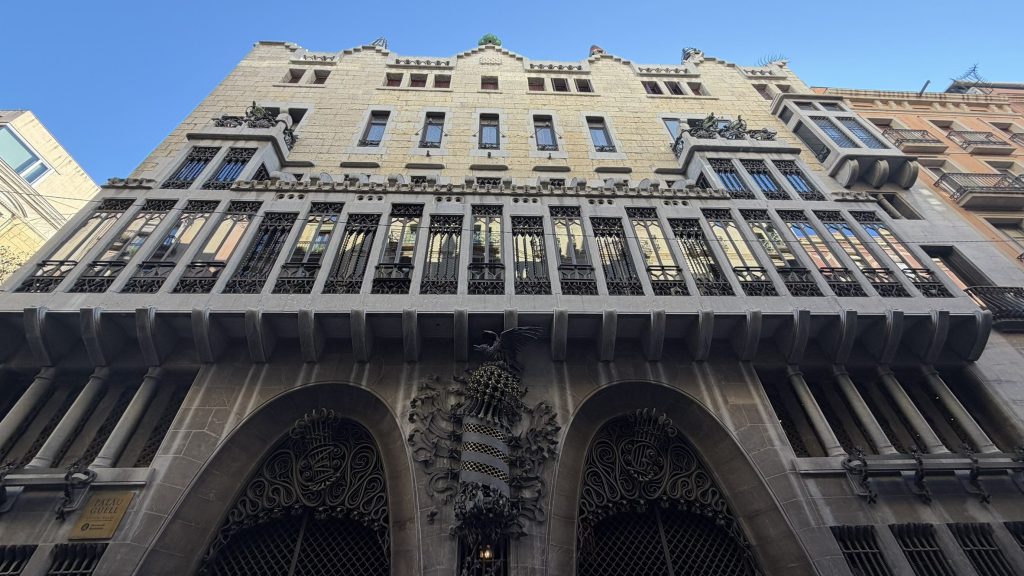
When you cross La Rambla again from the square, you can also see his first architectural work, the Palau Güell, an example of a 19th-century urban palace.
The Spanish Galley
Here the construction finally stopped, and we could walk more freely past the street painters and performers toward the Maritime Museum.
I remembered how, back in school, we were taught about Spain as a great maritime power and how the Spanish galley always came up. I wanted the girls to see one with their own eyes, since all that history still lies ahead of them in the upper grades. And here it was: an almost 60-meter-long replica of the 16th-century royal galley Real.
The museum was almost empty, and we stayed for more than an hour, because it’s not just the galley. There are many other ship replicas, informational films, and interactive displays as well.
The Columbus Monument
You’ve just been admiring an almost 60-meter-long Spanish galley inside the museum, and a moment later you’re outside, looking up at a 60-meter-tall monument to the explorer who discovered America. His connection to Barcelona is that this is where he first stopped to report his discovery to the king and queen. La Rambla ends at the monument, but because it’s aligned with his outstretched right arm, you could say it symbolically continues toward the Mediterranean and, from there, on to the New World.
Port Vell
After a little over a kilometer on La Rambla, which took us a good three hours with all the stops and detours, we took a break for a snack at the harbor. There’s something especially nice about sitting by the sea in winter and enjoying the view. Although calling it “winter” might be a stretch. It was around 15°C.
Crossing the Rambla de Mar, the pedestrian bridge over the harbor, you pass the marina and soon find yourself in front of the Maremagnum shopping center. You can go shopping, or you can watch the cable car cabins slowly rising toward Montjuïc.
We found a taxi and rode to the Ciutat Vella district, where another city landmark was already waiting for us.
Palau de la Música Catalana
In one sentence: a concert hall with a beautiful glass ceiling.
And that was it. We looked around, sat for a while, and left.
If I were planning it again, I wouldn’t pay for this. I’m sure that with a concert the acoustics must be a real treat, but as a tourist visit, especially with kids, it’s just so-so.
Postcards and Stamps
Since we finished so quickly, we went souvenir shopping and picked up the two postcards we always send on our trips, one to my parents and one to a colleague in Denver, Colorado. The stamps are sold separately in tobacco shops.
Barcelona Cathedral
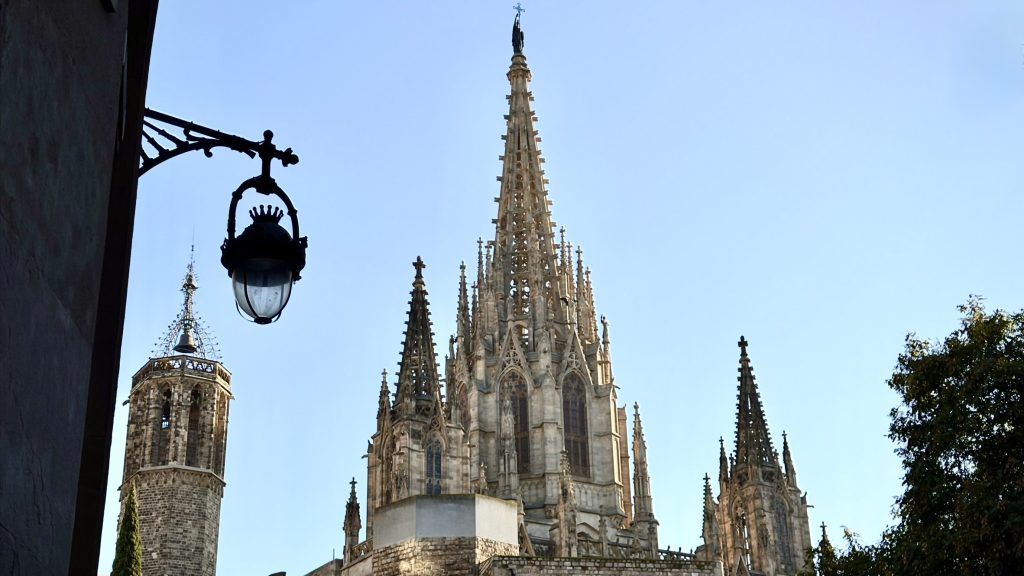
Anja was feeling better, so we decided to walk to the main entrance of Barcelona Cathedral, which had somehow escaped us the last time. This time we found it. When you come in through the narrow Carrer del Dr. Joaquim Pou and the view suddenly opens up…
Compared to this cathedral, with construction that began in the 13th century and a façade that wasn’t completed until the early 20th, the Sagrada Família and its 140 years of building is practically an apprentice. Seen that way, the Sagrada is actually a very well-run project, since it will be finished several centuries earlier.
In front of the cathedral, a street performer was giving a show, a photographer was capturing the moment for a young couple posing in front of it, and we were slowly wandering around the massive façade instead of going inside. Only later, back home, did I read that we could have gone in for free because we happened to be there at exactly the right time. Maybe next time.
Kiss
The plan was to walk back to where our day had begun, to Plaça de Catalunya, so first we passed a contemporary art installation on a wall titled:
The World Begins with Every Kiss.
From a distance it looks like one large kiss, but as you get closer you realize it’s made up of thousands of photographs.
They were sent in by people from all over the world, each one showing what a moment of freedom means to them. It’s also a well-known TikTok spot, so the crowds come with the territory.
Evening in Barcelona
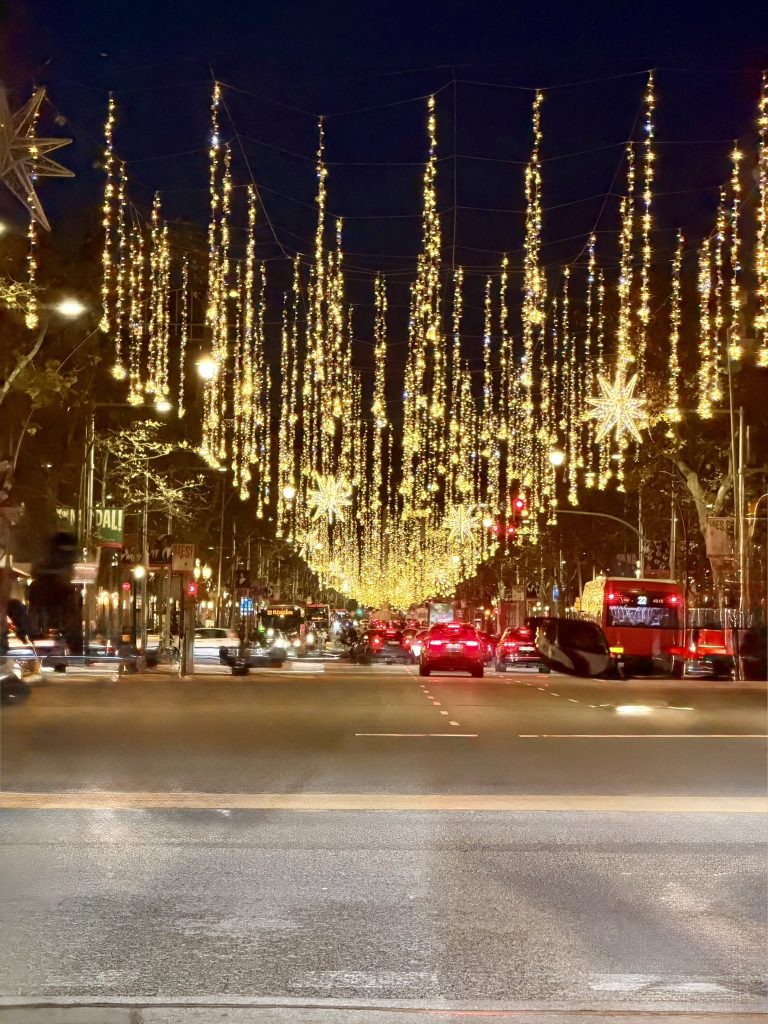
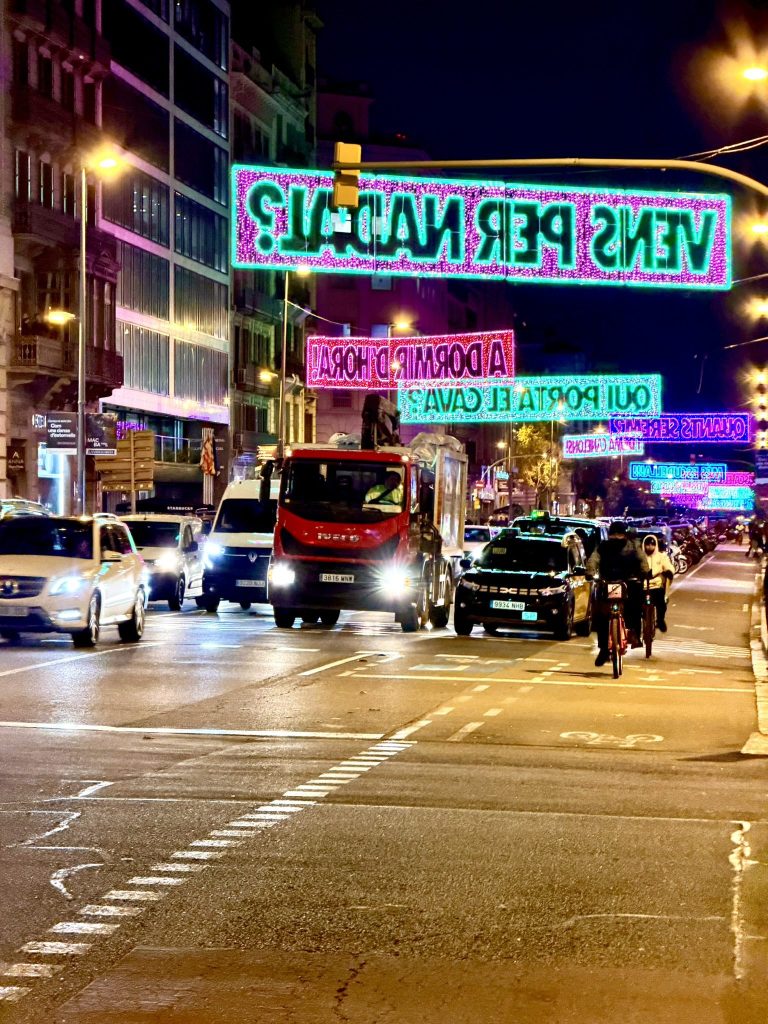
By the time we reached the square, the streetlights were just coming on, along with all the New Year’s decorations.
The next masterpiece was only a short ten-minute walk away, along Passeig de Gràcia. It turned out to be the most beautifully decorated street we saw on the entire trip.
We were making good progress until shop windows started appearing along the sides.
Illogical
Of course they went inside, and with more than a decade of experience as a husband and a father to two girls, I stayed outside.
I watched them move around the store and knew it would take a while. So I used the time to find the best possible spot to photograph the decorated street. That spot, of course, turned out to be in the middle of the road, so I kept walking back and forth across the crosswalk. On what must have been my fifth or sixth crossing, I caught out of the corner of my eye that the girls were now being accompanied by a saleswoman.
A sign that it was time to stop taking photos and head back. The light finally turned green and I crossed the street just as they were stepping out of the store. Empty-handed.
One of those mysteries of the universe I will probably never understand: why go into a store if you’re not going to buy anything?
Casa Batlló
One of Gaudí’s most famous houses, with a wavy façade that looks as if it’s made not of stone but of water, balconies that resemble bones, and, as the final touch, light that changes color every few minutes.
We had started the morning on La Rambla, with the street lamps of a young Gaudí at Plaça Reial and his first architectural masterpiece, the Palau Güell, so it felt only right to end the evening here as well.
Tomorrow is the last day of the year, and his greatest creation is waiting for us: the Sagrada Família.
Rain. That’s how we stepped into the day. Lately, we haven’t had much luck with the weather on our trips, not like before. Even in London we only got properly soaked once. In Portugal, we almost swam through the streets of Lisbon.
Anja says her throat hurts, but that she’ll be fine. Between my sore eye and Nara’s cold, we were starting to feel more suited for bed than for exploring the city. Luckily, we still had our Nia, our eight-year-old swimmer, the only one healthy as a horse.
Montjuïc
The morning was devoted to exploring the Jewish Mountain, which is what Montjuïc means in Catalan, since Jews had their cemetery on its slopes in the Middle Ages.
Geographically, the hill rises almost 200 meters between the sea and the city, and for centuries it has served as an important lookout and defensive point.
The 17th-century fortress on the summit confirms that role, even though its history is also a dark one.
Defensive structures often turn into tools of repression in the hands of authorities hungry for control. During Franco’s dictatorship, it served as a prison, a torture site, and a place of executions. That’s why many Catalans today see this very fortress as a symbol of repression and, at the same time, a symbol of resistance against it.
Palau Nacional
An imposing palace crowns the hill, built for the 1929 World’s Fair, where the world was meant to see technological progress, art, and above all what humans are capable of building.
That very exhibition gave this part of the city its present form.
It’s interesting how, through our travels, we keep noticing the role these fairs, essentially the predecessors of today’s Expos, played in making cities world-famous.
From the Eiffel Tower in Paris, to Plaza de España in Seville, all the way to Lisbon, where the Expo created an entirely new district along the Tagus River.
Inside the palace is the National Museum of Catalan Art (MNAC), which houses one of the richest collections of Romanesque frescoes in the world.
We didn’t plan to go inside, since I doubted it would be especially interesting for the girls. The idea was to go up to the viewing terrace, right to the spot where Anja and I had been 13 years ago.
To wrap up this hill.
It was put back at the center of the world during the 1992 Olympic Games, and today it holds the city’s largest green spaces, botanical gardens, museums, and walking paths. From the other side of the city, from the harbor, you can take a cable car up to the top.
But that’s not for us. Once we’re on the ground, we are very deliberately ground-level tourists, even though we do most of our traveling by plane. Now make sense of that if you can.
Poble Espanyol and the Christmas Streets
We weren’t in a hurry in the morning, since our first entry wasn’t until 10 a.m. Near the hotel, 110 steps were waiting for us, taking us up to the first level of the hill. That’s when we saw it for the first time. The Sagrada Família. All you can really say is wow. A proper reward for all those steps we had just climbed.
Just a short walk away is the entrance to the Spanish Village, Poble Espanyol. It’s another product of the World’s Fair, created to show visitors the typical streets, squares, houses, and architecture of different regions of Spain. During the holiday season, the village transforms into its Natalis version, with decorations everywhere, gifts, lights, music, and creative workshops.
And that was exactly where we were headed. We were among the first inside, so we could wander the streets almost on our own and take them in.
There was something else that really stood out. Around the Christmas tree, which by the way was one of the most beautifully decorated ones we’ve ever seen, there were orange trees everywhere. It looked fantastic. Someone had cleverly tangled little elf legs into them, which only added to the Christmas feel.
We took a million photos because it really was that pretty.
And then, around the corner, there he was. The Grinch. He and Anja hugged like old friends who hadn’t seen each other in years. The Grinch and Home Alone are her favorite Christmas movies. It was perfect.We kept running into fairies and elves all over the village, but the Grinch won by a mile.
By a small church, a beautiful view over Barcelona opened up, and we immediately thought it would be the perfect place to watch the fireworks. Later, one of the little elves told me they were having a private New Year’s party right there, so that idea of ours quietly floated away.
We wandered around the Christmas streets and among the orange trees for quite a while, and in the end stopped for waffles with Nutella and white chocolate. Everything was great. Only snow was missing.
Font Màgica The Magic Fountain and Les Quatre Columnes
So Anja wouldn’t overdo it, we decided to skip the planned viewpoint by the palace and instead started heading down toward the fountain at Plaça d’Espanya, where preparations for New Year’s were already underway.
The fountain was also built for that same World’s Fair.
As we found out later one evening, it puts on an unforgettable show of water, music, and light, and it’s free. It really is magical.
Behind it rise four powerful Ionic columns which, at first glance, well… slightly ruin the view of the palace in the background, but they carry strong symbolic meaning for Catalan identity. They represent the four stripes on the senyera, the Catalan flag.
As you walk away from the Magic Fountain, you can’t help but keep glancing back over your shoulder at Montjuïc. That view is truly spectacular. The only problem is that the best spot is right in the middle of the road. So I waited for the green light and walked back and forth across the crosswalk a few times to catch the shot I wanted.
On your way from the fountain to the metrо station, you can’t avoid passing between two large towers known as the Venetian Towers, meant as the gateway from Plaça d’Espanya toward Montjuïc. They too were built for the World’s Fair and were inspired by none other than the famous one on St. Mark’s Square in Venice.
At the time, Venice was a symbol of European beauty and historic grandeur, so the desire for that kind of inspiration makes perfect sense.
Back to the hotel
And then, on the square, the turn.
Anja says she doesn’t feel well. Just as I was unsuccessfully looking for the metro entrance, she says she feels weak. The decision was instant and unanimous: we’re going back to the hotel.
Where the hell is a taxi when you need one? Nowhere. So we walked.
Later Anja told me she thought we had taken a taxi. The fever was clearly already doing its thing.
When we got back to the room, the rain started pouring down outside. You know how it goes. Everything is good for something, because I doubt we would have gotten much out of the day in that rain anyway.
A few hours in bed might help. Just in case, I checked if there was a hospital nearby.
Reset
This was the first time someone actually got sick on one of our trips. Sure, someone had been a bit under the weather before we left, but I’ve always said it’s better to have a cold in London, Dublin, Helsinki, or Barcelona than to have it at home. Before a trip, that risk is covered by cancellation insurance. If it happens, it happens. Once you’re there, there’s not much you can do except rely on your travel medicine kit and hope for the best.
In my head, I canceled tomorrow’s trip to Tibidabo and let go of the rest of the planning.
Anja fell asleep. At three I checked her temperature, still high. At four, borderline. At six we had tickets for the light show at Santa Maria del Pi. Do we stay in or do we go? Is it even smart? Of course you worry, because you don’t know what’s coming. She said she wanted to go.
Looking back now, that fear of illness while traveling is just as stressful as when you’re at home. You react to the situation, not the location. Maybe that’s the lesson for next time.
Since any real effort was out of the question, I contacted the taxi driver who had picked us up at the airport. He said 30 euros to take us into the center. I knew it was a rip-off, but what could we do.
The ride that changed everything
We slowly got ready and waited for the taxi. The driver was still a man of few words, maybe feeling a bit guilty about the inflated price. Just past La Rambla, he turned off the main road and, over the retractable bollards, drove into Carrer del Pi. All fine, except the street was full of pedestrians.
We moved along at a snail’s pace, people staring at us like we’d fallen from the sky or were slightly out of our minds. I felt awkward, the girls were uncomfortable, and really, we were all a bit in shock.
When we talked about it later, we realized that this crazy ride might have been the very moment when things turned around.
Maybe it was the adrenaline of being in a taxi surrounded by a crowd of pedestrians staring at you in disbelief, maybe it was because we felt uncomfortable and awkward. It had to be something like that, because it woke all of us up and, in a way, filled us with energy. Most of all Anja, which was what mattered most.
Barcelona Cathedral and Plaça de Sant Jaume
Since we still had some time before the show, we decided to visit the cathedral nearby. We made our way through narrow streets that once again felt very Venetian and came out onto an open square. We searched in vain for the cathedral’s famous façade. A few days later we realized we had given up about 20 meters too early.
We followed the crowd and walked under the bridge on Carrer del Bisbe, one of Barcelona’s key photo spots. The bridge again brought to mind the Bridge of Sighs in Venice, as you pass the Doge’s Palace. We’ve never noticed so many similarities between two cities anywhere else. I haven’t found a solid explanation for it, although I doubt the similarities are just coincidence.
The street with the bridge opens out onto Plaça de Sant Jaume, the square of political power, home to City Hall and the seat of the Catalan government.
Then time started pushing us, and we had to head back to the site of the day’s final act.
The laser projection was phenomenal. It looks as if the inside of the church breaks apart, dissolves, disappears. The show lasts a good half hour.
Santa Maria del Pi
Del Pi means “by the pine,” because according to local tradition a mighty pine tree once stood here, in whose crown an image of the Virgin Mary was said to have been found.
It’s one of the city’s oldest churches, striking for its Gothic style and the huge rose window above the entrance. I’ve always found Gothic churches more beautiful than Baroque ones.
The interior is tall and dark, the walls are thick. But we weren’t here for the silence. We came for the light.
Luminiscence is a light show where Gothic architecture meets digital art. I chose the golden ticket because it gives you seats farther back, with a view of the entire nave.
We loved how, over more than half an hour, the church tells its own story. What it has been through, how it bled, how it blossomed, and how it came back to life again. All of this unfolds in a remarkable light show, as the church is built and taken apart before your eyes.
It ends with the “Ode to Joy,” the European anthem from Beethoven’s Ninth Symphony. You feel that you’re part of something bigger.
Discovering these light shows, first in Porto and now here, has been a real revelation. Now I look for them everywhere we go.
What a day it was.
From there, back toward La Rambla. Another taxi. This time 10 euros. Anja was already feeling much better.
When we got back to the room, a strange smell was coming from the bathroom again, this time like someone was baking something. But I simply didn’t have the energy anymore to go down to the front desk.
And that was that day.
It started beautifully, then in the middle of it put the whole trip into question, later pulled us back with a strange ride, and ended with a light show in a 14th-century Gothic church in the middle of Barcelona.
We don’t yet know what tomorrow will bring. We’ll decide in the morning. For now, just sleep.
On October 18, a little over two months before our actual departure, I booked a guided tour of the Sagrada Família for the last day of the year. From past travel experience, it has become clear that major attractions simply need to be booked in advance. Otherwise, you end up standing in front of them, looking at long lines and regretting that you didn’t think to buy tickets earlier.
When we first started organizing our family trips, we always had the same question:
What if we can’t go on the trip because someone gets sick and the tickets go to waste?
We found a solution by insuring our flights, attraction tickets, and public transport passes with Triglav Insurance. This time, the premium was less than 5% of the total ticket value. That way, at least part of the stress goes away.
The main sights are obvious, but for anything beyond that, I visit the library and borrow guidebooks. I usually choose the Eyewitness Travel series, which I like for its clarity and its suggested routes. Especially for us, since we do a lot of walking and truly believe that you see and experience the most when you explore a place on foot.
One small, slightly out-of-place note: apparently Santa Claus also knew where we were going.
Between Google Maps and ChatGPT
Once I’ve written out the places we want to visit from the guidebook, I start putting together a logical day-by-day route so we’re not zigzagging all over the place for no reason.
Over the past few trips, I’ve also started using ChatGPT, mainly because it can give you a rough travel plan in seconds, which you can then comfortably use as a starting point.
When it comes to navigation, opening hours, ticket availability for attractions, and finding kid-friendly restaurants, it’s still a bit lacking, so it’s better to double-check those elsewhere.
But yes, as a baseline, it’s very useful.
The final result is a compact printed booklet with the daily plan, and at the end I always include printouts of all our tickets and reservations. You never know what might happen to your phone.
Once, right in the middle of Estonia’s capital, Tallinn, my phone fell onto the stone pavement in the old town and shattered. That was the end of technology for that trip.
What you can’t really plan for is something like this: a few days before departure, my eye got inflamed and there was nothing else to do but go to the urgent care clinic for antibiotic drops.
Still, it all feels a bit easier when a message like this is waiting for you in your airline’s app.
D-Day
Because our flight was in the afternoon, we had a relaxed morning and finished packing at an easy pace. We left for the airport a bit earlier than usual, since we hadn’t flown with this airline before.
Even though this is our 29th flight together as a family, that same feeling of excitement and anticipation still sweeps over us as if it were the first time.
There’s one question you always end up facing, whether you want to or not, before you check in:
Will they seat us together even if I didn’t reserve and pay for specific seats?
On one of our previous trips with connecting flights, reserving seats for the four of us would have cost almost as much as a round-trip ticket for one person. So I called the airline and said that surely they couldn’t seat a minor separately from a parent. The man on the other end agreed.
Since then, I haven’t paid for seat reservations. Over the next 16 flights, we always ended up sitting together, either three plus one, or two and two in the same row.
It was the same this time, except on the return flight, when Anja and Nara were seated up front and the two of us with Nia were toward the back of the plane. Which really wasn’t the end of the world. and even that only happened because the two seats in the same row were actually broken.
We have a flight to Rome planned in February with Ryanair, and for the May Day holidays to Edinburgh with easyJet. We’ll see how it goes there. In general, with the Star Alliance group (Swiss, Lufthansa, Air Baltic, Edelweiss …) and Vueling, they reliably seat you together.
Vueling
It’s a Spanish low-cost airline that launched a new Brnik–Barcelona route in November 2025. The fares were reasonable, and the departure times were civilized too, 3:35 PM from Ljubljana and 1:10 PM from Barcelona.
The only slightly annoying thing was that check-in through the app wasn’t possible, not even 24 hours in advance. It could only be done at the airport, when dropping off checked baggage. Carry-on luggage is limited to 40 × 30 × 20 cm, but no one really made a fuss if a bag was a centimeter or two over.
The flight takes about two hours, and the most beautiful moment was right at the beginning, when we climbed above the clouds over Brnik and they, lit by the afternoon sun, filled the entire view through the plane window.
There was no turbulence this time, the flight went by in no time, and before we knew it we were already descending toward the Catalan capital, just as the sun was setting.
Landing at El Prat and Barcelona
We landed in 12°C weather, and our Welcome Pickups driver was already on his way. Unlike the driver on our Portugal trip, this one didn’t give us much of an introduction to the city. In fact, he was mostly quiet during the ride and only became more talkative when I mentioned that we might take a taxi again when we leave.
oday, Barcelona is home to around 1.6 million people and serves as the capital of Catalonia, a region shaped by a long tradition of autonomy, its own language (Catalan, not just a dialect of Spanish but a distinct language), and its own flag, the Senyera.
In the Middle Ages, it was the center of the Crown of Aragon and had its own rulers, until political power gradually shifted to Madrid.
It was in Barcelona that Christopher Columbus was received when he returned from his first voyage to the Americas.
The city’s most distinctive mark was left by architect Antoni Gaudí, whose work made Barcelona recognizable around the world. The peak of his life’s work is the Sagrada Família, which is already the tallest church in the world and is expected to be completed in 2033, on the 2,000th anniversary of Jesus’s death.
Apartment below Montjuïc
When we bought our plane tickets, I started looking into where in Barcelona it would make the most sense to celebrate New Year’s Eve. The options were the main promenade La Rambla, the Barceloneta beach, or Plaça Espanya.
La Rambla is crowded pretty much all the time, so that was the first option to go. Especially because we didn’t want to start every day in a river of tourists.
Celebrating on the beach, from what I read, is more relaxed and mostly aimed at younger people. So that was the second option off the list.
That made the decision almost by itself. I booked an aparthotel near Plaça Espanya, below the Montjuïc hill.
The apartment was fine, just the right size, with a small kitchenette and a ground-floor terrace.
Below Montjuïc, next to the famous Magic Fountain, lies Plaça Espanya, and this is where the city’s main New Year’s Eve fireworks take place, drawing more than 100,000 people. The plan was to climb up the hill on December 31 and watch the drone show and fireworks from above, safely away from the crowds down in the square.
It felt sensible, safe, almost ideal for spending the longest night of the year with family in a city like Barcelona.
In the end, that famous climb never happened. We welcomed the new year down on Plaça Espanya, right in the middle of an endless crowd.
First Walk and First Impressions
After unpacking, we went out for a short walk to get a feel for the neighborhood. A grocery store and a bakery were just around the corner, the main road was wide and nicely lit, and it led straight toward Plaça Espanya, less than a kilometer away.
Every now and then, as you walk by, a whiff of weed drifts past your nose, but we’re already used to that from previous trips. There was quite a bit of it in Washington, New York, and Tenerife in particular. We had already explained to the girls what it was about, so it wasn’t an issue.
Otherwise, the area felt safe, and whenever we asked someone something, they tried to help. English was a bit limited at times, but we always managed to understand each other in the end.
The Biggest Stress of Family Travel = Choosing Restaurants
Chicken nuggets, pizza, spaghetti Bolognese, and burgers make up the culinary repertoire of our trips.
After all these journeys, we still haven’t discovered a reliable formula for finding restaurants that offer something a bit more diverse, yet still acceptable to kids.
We’ve tried TripAdvisor, Yelp, and The Fork, Chrome searches, and just about everything else, mostly without much success.
To be fair, every now and then we do manage to find a place that works for everyone, and then… well, then you’re flooded with that feeling of total victory.
But today was not that day. Today, we went for pizza.
A Strange Smell in the Bathroom and Going to the Front Desk in My Pajamas
As we came back to our apartment through the decorated streets and started getting ready for our first night in the Catalan capital, a smell began coming from the bathroom, like something was burning. The smell stayed even when I turned on the ventilation, in fact it got even stronger.
There was nothing else to do but go down to the front desk. I went in my pajamas, because who’s at the front desk at ten in the evening anyway? Of course, that was exactly when it was full of people waiting to check in, and of course I got a few horrified looks.
Which I understand. A guy in pajamas with Christmas reindeer in the middle of the lobby explaining something about a burning smell.
Note to self: next time, put on sweatpants.
In the end, they promised that someone would come and take a look in the morning.
And together with the reindeer, I left the hotel lobby…
What will tomorrow bring?
A long day is waiting for us.
We’ll start by walking up Montjuïc and looking for a place where we’ll welcome the year 2026, then we’ll head back down into the city, hop on the metro to La Rambla, see a full-scale replica of a Spanish galleon, explore the Boqueria market, and end the evening with a light show in a church, similar to the one that impressed us so much in Porto.
December already feels like a busy month all by itself — with school events, after-school activities, and work on top of everything else. I had planned to take three days off before the holidays, while Igor had to keep working anyway.
But of course… why would the plan actually stick and stay simple?
So on Monday I first drove the girls to school, then headed to work myself to take care of a few last-minute things. Instead of being home at the planned noon, I only made it back around 3:30.
That “delay” immediately turned into rushing, because the clock was pushing us to get Nia to swimming practice and Nara to judo. Luckily, the drive to Nara’s training takes almost half an hour each way, so Nara and Igor used that time to go over the material for a test she had the next day.
Somehow, in all that chaos, we managed to get through the day. In the evening, all that was left was wrapping the little gifts for teachers and classmates — and my quiet hope that the next two days would follow the plan in my head at least a little bit.
The Battle Plan Against the Stores (That Didn’t Work)
Even though I had a carefully crafted battle plan to gracefully avoid the stores right before the holidays, it completely fell apart. There’s always something you end up missing.
So there I was on Tuesday morning at 8 a.m., lined up outside the stores, armed with my list and a quiet hope that it wouldn’t be too crowded. Of course, I ran into quite a few familiar faces, which meant that my “quick” one-hour shopping trip ended up taking twice as long.
Tuesday was all about big preparations for Wednesday’s dinner. Since there were more than twenty of us, it was clear the cooking wouldn’t take care of itself, and certainly not if we left it all for the last day.
Christmas Dinner and the People Who Are Family
Christmas dinner is our reserved time for the people we love. So it’s not just our immediate family sitting around the table, but also our friends. There’s a saying for that kind of family: family not by blood, but by heart.
In other words, people who don’t share our last name, but who do have a permanent seat at our table. And in our case, that’s absolutely true.
The day itself passed in a familiar mix of things: a little cooking, a little answering work emails and calls — all at the same time. A perfect pre-holiday kind of chaos, plus the usual drive to get Nia to swimming practice.
December 24th — My Favorite Day
And in the blink of an eye, December 24th arrived, the day that is closest to my heart out of all the days of the year.
The girls were finishing their last day of school for the year, Igor was wrapping up work, and I was putting the final touches on Christmas dinner. Dada set up the firehouse tables. Yes, really. Because of how many people we have, dinner at our place actually happens at two firehouse-style tables in the living room, which we try to dress up as festively as possible.
And finally, 5 p.m. arrived. Guests started showing up — some right on time, some fashionably late, entirely as expected.
For the first time, it all passed without stress or my usual bad mood. Everything felt simple… and a little magical. Maybe because someone very dear to me joined us for the first time with her two children, along with my mom’s friend Jožica. The two of them have been friends since first grade, which by my math makes that about 58 years — a long time and a beautiful friendship.
It was truly wonderful to spend the evening surrounded by people who make you realize you’ve hit the jackpot with your humans. Each of them is special in their own way, and together they create a kind of warmth that makes you feel incredibly lucky.
The kids happily prepared milk and cookies for Santa, who later left gifts for everyone. Slowly, the guests headed home, the house grew quiet, the girls quickly went to bed, and the two of us kept cleaning until about 1 a.m. — tired, but happy.
Holiday Pace, Viruses, and Home Alone
The rest of the holiday days passed in the blink of an eye.
We spent Christmas at home, and I mostly avoided cooking — aside from boiling some potatoes — the rest was leftovers from the day before, which absolutely counts. The day moved slowly, mostly spent on the couch, because Nara woke up with a cold.
I immediately went into full anti-virus mode, hoping it wouldn’t turn into anything worse and that our plans for Barcelona would stay intact.
And in the evening, the classic of all classics: Home Alone, all of us wearing matching pajamas that Santa had brought. If that’s not holiday perfection, I don’t know what is.
Neighbors, Eskimos, and the Garage
Next came our pre–New Year’s gathering with the neighbors in our garage. We’re really lucky — we all get along so well.
A small spread of food, the firehouse tables again, everyone dressed like Eskimos, mulled wine, homemade treats, and American pancakes for the kids. More food and drinks than we could possibly need, since everyone brought something. Maybe we should do it again just to use it all up.
Nara was already feeling much better — just enough for me to breathe a little easier. Of course, Igor ended up with an eye infection. Honestly, it never ends.
The Pharmacy, the Suitcases, and the Holy Trinity
Because I had basically been feeding Nara and Nia vitamins non-stop, our supply ran out quickly. So off to the pharmacy we went — eye drops for Igor, and then even a visit to the urgent care clinic for antibiotic drops.
Luckily, Saturday was a regular working day.
After lunch we started packing and realized it was going surprisingly fast. What took the most time was actually putting together our traveling pharmacy.
✅Cedevita
✅Čokolino
✅Barcaffe
The holy trinity is packed. We can finally close the suitcase with a clear conscience.
On the Starting Line
To top it all off, Home Alone 2, wrapped in blankets and pajamas, and then no more fuss — straight to bed.
Because we’re one of those families who plan vacations early, both for time reasons and for the budget, the idea was born back in late July.
I was sitting on the terrace of our apartment in Tenerife, drinking coffee and scrolling through my phone without any particular goal. Between ads for shoes, I noticed a news item: a direct Ljubljana–Barcelona route was launching in the fall.
The price of the plane tickets? Roughly what you’d spend on a train ride to Maribor and back, with lunch at Maistrov trg in between.
And that’s when the moment of truth arrived.
Before Igor even took his first sip of coffee, I served him my well-known line:
You know what I’ve been thinking…?”
After eleven years of marriage and two children, he knew perfectly well that this didn’t mean a conversation about which shoes I’d been looking at.
No. It meant: a new destination, a new mission, a new place to stay.
To be fair, the ads I see online only ever show shoes and flight connections. Coincidence?
Thirteen Years Ago
We were last in Barcelona thirteen years ago, back then with Igor’s sister Katja and our friend Ciril, who became Igor’s best man two years later.
Thirteen years ago feels, in my mind, almost the same as if we had never been there at all.
If we don’t go celebrate New Year’s as a family now, when will we? Later, when the girls are already grown and roll their eyes at us while walking down La Rambla?
From the first idea to a confirmed destination, it took about half an hour. Just enough time for Igor to check accommodation prices for the Christmas and New Year holidays and realize that, considering the season, they were surprisingly reasonable.
Family Meeting (Still in Pajamas)
About half an hour later, the girls, still half asleep, dragged themselves out onto the terrace of our little “house,” as Nia likes to call it.
With due ceremony and a bit too early for their liking, we revealed the news.
Nara accepted it happily, still half-dreaming. Already used to the fact that we’re always somewhere.
Nia, on the other hand… well. Nia would have preferred Terme Olimia ( a popular thermal spa resort in Slovenia, especially loved by families)
Nia trains swimming and is a child of order, chlorine, pools, and precise training schedules. For months now, patiently, in her opinion far too patiently, she’s been waiting for us to finally give in to a water-based holiday.
Barcelona may not have water slides or pools.
But it does have the sea, tapas, and plenty of new experiences.
So Olimia, for now, remains on her list of unfulfilled wishes. Barcelona, however, is here. Warm, sunny, and ready for us.
How We’ve Celebrated New Year’s So Far
Up until now, we’ve always welcomed the New Year at home.
In the most classic way possible: in pajamas, with a good dinner, a movie or two, and the obligatory countdown on TV.
Last year, we made a small, almost daring break from tradition. We celebrated New Year’s just a few steps away, at our neighbor Tom’s place, who puts up holiday lights every year that could make even Las Vegas feel a little jealous.
December, the Local Way
And so the decision was made: we’ll welcome 2026 in Barcelona. It will be our first New Year’s trip.
But before we pack our bags and raise a toast under the Catalan sky, there’s still our almost traditional pre–New Year’s gathering to look forward to. Every year, we host it right at home, in the most down-to-earth way possible – in our garage.
We get together with the neighbors over snacks, mulled wine, and conversations that tend to last much longer than planned.
This time of year is all about togetherness for us. It probably helps that both Igor and I celebrate our birthdays just four days apart. Laughter, conversations, and that comforting feeling that simply being together is enough.
We usually gather for Halloween as well, out in the garden, surrounded by pumpkins, lanterns, and children’s excitement. This year, because of our trip to Portugal, that tradition had to be skipped.
No harm done. Around here, there’s never a shortage of reasons to get together.
The First Time a Little Farther from Home
This year, all that homely warmth will get a pleasant continuation.
Once Christmas is behind us and the suitcases are finally packed, we’ll be welcoming the New Year a little farther from home for the first time.
In Barcelona, where we hope to be greeted by sunshine, city energy, and a new experience that will reshape how we think about New Year’s celebrations.