Day 1: Journey to Rome

Naslovna slika potovanja v Rim – letalo nad Evropo ob sončnem vzhodu, Italija in napis Rome, Dan 1: pot v Rim, družinski potopis ODPOTUJ
This post is part of the travel series Family Journey to Rome, where the entire journey is told as a story from the first to the last day.
DAY 1 OF 7
Highlights of the Day
Journey to Rome and the First Glimpse of the City
New Home – Monti
The Colosseum in the Evening Light
Quick Jump to the Day’s Logistics

February, Friday the 13th.

The day our journey to the Eternal City begins.

That very evening you find yourself standing in front of the Colosseum, and everything feels strangely familiar, even though the last time you were here was more than ten years ago.

Probably because you have kept meeting it in films, books, and stories along the way. Back then you told yourself: one day I will stand here again.

Now you do.

Kolosej v Rimu ob večerni osvetlitvi, eden najlepših pogledov prvega večera

We arrived at exactly the right moment, just as the evening lights were being switched on. A little tired from the journey from Zagreb, yet still full of anticipation.

If this was only the first encounter, tomorrow we truly begin. But first, let’s go back to the beginning of the story.

I started thinking about organizing Rome in mid-December, two months before departure, when I bought tickets for the Vatican Museums. Even then, some time slots were already sold out. Later, during the trip, out of pure curiosity I checked the availability of morning tickets again and found myself scrolling through the calendar all the way to May.

On the official Colosseum website, it said that ticket sales open only one week in advance. Villa Borghese, one of the more sought-after tickets in Rome, wasn’t even in our plans, so I didn’t check that at all.

Then I put Rome aside for a while.

Writing about Portugal and Barcelona had priority.

The real reminder that it was time to start planning came about three weeks before departure, when I had a red note in my calendar telling me to arrange travel insurance.

That is something I never think twice about. The one time I skipped it, something unexpected happened and our flight tickets were lost because we had to return home early.

Since then, I insure everything: flights, accommodation, tickets. The cost is about five percent of the total value, but those few percent buy peace of mind. And that is worth the most.

Insurance sorted.

The travel plan, however, still didn’t exist.

The closer departure came, the more I reminded myself that I should at least put together a rough outline. Only a week before, when I booked the Colosseum tickets, did I finally sit down seriously. After that, things moved quickly. Apparently, with every new trip we organize, it all becomes a little easier, with less overthinking.

One constant during that last week was Ryanair faithfully inviting me, day after day, to check in early if I reserved and paid for seats. Day after day, I resisted.

That daily pressure inevitably makes you question whether you will end up sitting together, even though I still believe that a minor child cannot, and should not, be seated away from a parent. As far as I could find, certain safety guidelines exist, although there are no clear rules that strictly oblige airlines in this regard.

Anja wrote the introductory post on the Sunday before departure, and by Thursday I was holding a sixteen-page travel booklet in my hands, printed on both sides.

Stran iz vodnika po Rimu z opisom Lateranskega obeliska in fotografijo znamenitosti.
Natisnjen načrt družinskega potovanja v Rim z letalskimi podatki in rezervacijami pred odhodom.
Ilustriran prikaz antičnega Rimskega foruma v vodniku za ogled Rima.

That afternoon before departure always brings a certain nervous energy. Do we have everything sorted before we leave? Have we prepared everything? Are the passports still valid, even though you know they are? Will everything fit into the suitcase? Will it be too heavy? Will everything be fine with the flight?

Questions without real meaning. You know it will all work out. It already has thirty times before. And even when something went wrong, we always managed to solve it.

But the subconscious has its own rhythm.

And then Friday the 13th morning arrives.

Unlike the previous afternoon, there is no nervousness.

Only the anticipation of the first trip of the year.

Check-in Without Paying for Seats

On Thursday, the day before departure, Ryanair sent one final email offering early check-in, of course with the mandatory purchase of seats.

I had read that if you choose not to pay, you can check in 24 hours before the flight. And indeed, at 12:55 the check-in window opened. Even there, it kept trying to sell seats, but I simply wasn’t willing to pay another €40.

Partly out of principle, and partly because I was genuinely curious to see what we would get.

When it gave me one last warning that we might not be seated together…

Click.

You press the random allocation button and suddenly feel like you have done something wrong.

But you haven’t.

The girls were placed at the front of the plane, seats 4A, 4B and 4C, while I ended up near the back in 34C.

Honestly, I expected a middle seat but got an aisle instead. The only downside there is that every time someone walks past, they bump into you a little, because everything on these planes feels tighter than ever. The same arrangement happened again on the return flight.

At least in our case, the myth about low-cost airlines separating children from their parents did not hold up.

The only real change was that you now need their app, since physical boarding passes are no longer accepted. I already had it installed.

Seats assigned, travel plan ready, suitcases packed. Now it was real.

By Train from Slovenia to Zagreb

Our flight was scheduled for early afternoon, so we decided to travel to Zagreb by train. Yes, the journey takes three and a half hours, but it is incomparably more comfortable.

Kovček in nahrbtnik na železniškem peronu pred odhodom na družinsko potovanje v Rim

On the train you can stand up, stretch, go to the restroom, and there is no worry about getting stuck in traffic.

I bought the return tickets a few days earlier. What I didn’t know was that the ticket is valid for an entire month and you can take any train you like.

Morning mist passing by Radovljica.
The construction-covered station in Ljubljana.
The narrow Sava valley near Trbovlje.
The castle above Sevnica.

Past Zaprešić, and soon you arrive at Zagreb’s Main Railway Station.

The day before, I booked a taxi through Welcome Pickups, because Anja had read that taxi drivers sometimes charge unreasonable prices.

If I were travelling alone, I would probably just take one of the taxis waiting outside the station. But with the girls travelling with us, I prefer not to leave things like that, and any potential stress, to chance.

At the Airport

The drive from the railway station to the airport takes just under half an hour. About a kilometre before arrival, the area is filled with fenced parking lots for cars. Clearly, some people quickly recognised a good business opportunity.

Zagreb Airport feels just right. Small enough to navigate easily, yet large enough not to feel crowded.

Letališka tabla odhodov v Zagrebu z označenim letom za Rim Fiumicino pred začetkom družinskega potovanja.

We checked in our suitcase. It was a little over the allowed 23 kilograms, but they did not make an issue of it.

I have never fully understood that concept. If I arrive with my 85 kilograms and a 23 kg suitcase, everything is fine. But if someone who weighs twenty kilos less shows up with a 25 kg suitcase, suddenly there is a problem and an extra fee.

A slightly strange kind of mathematics.

Flight to Rome

Through security, where my backpack was once again pulled aside. This happens to me regularly, probably because my cables are always a tangled mess. I really need to organise that better.

The flight itself was calm and uneventful. Above all, it was quick. We landed in just over an hour.

Rome welcomed us with sunshine.

Letališka ploščad v Rimu po pristanku, začetek našega družinskega potovanja

Train into the City

After collecting our luggage, we headed straight to the train.

I bought the tickets for the Leonardo Express through the Trenitalia app, which we later also used for our return to the airport and for our trip to Tivoli. Otherwise, there were plenty of ticket machines available everywhere.

The ride to Rome takes just under an hour.

You look out of the window, waiting to spot church domes or some ancient ruin, something unmistakably Roman. But the closer you get to the city, the less romantic the view becomes. Wires everywhere, construction sites, worn railway infrastructure, and careless graffiti on neglected walls.

Not exactly a postcard view.

Železniški tiri ob prihodu v Rim, prvi pogled na mesto iz vlaka

But the moment you step off the train, everything changes. The idea of travelling through Rome suddenly becomes real. The dull impression from the approach into the city disappears instantly.

Now we are here. Rome is in front of us, whatever it may turn out to be.

Full of anticipation, we head towards the exit.

First Contact with the City

The station is large enough to serve a city of nearly three million people. Spacious enough for the crowds to spread out, and clear enough that finding the exit is effortless.

You immediately notice the Carabinieri. A few metres away, soldiers as well. For a moment, it feels slightly unusual. Later, our host told us that this is completely normal for Rome.

Gneča na železniški postaji v Rimu ob prihodu, prvi stik z živahnim ritmom mesta

As you walk towards Monti, you start noticing something else. Traffic. Italians drive, well, in an Italian way. Not every pedestrian crossing has traffic lights. Often you are left to the mercy of drivers, who mostly seem to have left that mercy at home. Only when a large enough group of people starts crossing do they finally have no choice but to stop.

And this small daily battle for the right to cross became something we experienced again and again throughout the trip.

Monti and the Basilica di Santa Maria Maggiore

As you walk down from the station, the Basilica di Santa Maria Maggiore opens up in front of you, one of the four papal basilicas. They are, in a way, the VIP churches of the Catholic world.

Bazilika Santa Maria Maggiore v rimski četrti Monti, prvi vtisi Rima po prihodu.

But today the goal was an apartment with a bed and a shower, not a church. So we kept walking.

When I look for the right area to stay, I always try to find something close enough to the main sights, yet far enough that the crowds are not overwhelming. Close to a railway or metro station for easy logistics, and at the same time a solution to our eternal problem: enough restaurants and shops nearby.

That is how I found this apartment in the Monti district.

Our host, Semi, was already waiting for us around the corner. He explained the neighbourhood and showed us the entrance.

The building was under renovation, and the first impression was honestly a bit sceptical. We exchanged a few looks, wondering how this would turn out, because from the outside it looked quite rough. The stairs were covered, unfinished electrical wiring hung from the walls, and some corridor windows were broken or simply missing.

Then he opened the apartment door. A completely different story. Clean, tidy, and at first glance comfortable enough. The only downside was the shower, one of the smallest I have ever seen. But if that is the only issue, the location makes up for it.

Out Again, Because You Can’t Resist

Five minutes. That is how long we lasted.

When the Colosseum is only ten minutes away, it is hard to stay inside the apartment.

We dropped off our things and headed back out.

The street was full of people, restaurants, and bars. Everything within easy reach. The metro station just a few minutes away. Very similar to Santa Catarina in Porto from our trip through Portugal.

First impression completely repaired. For the better.

As long as you were not trying to cross the street.

San Pietro in Vincoli Church

We left the noise of our street behind as we climbed the stairs up to the Esquiline, one of Rome’s seven hills. The steep steps immediately reminded us of those we had walked on Montjuïc in Barcelona. Two flashes of past journeys within just a few metres.

Družinski vzpon po stopnicah v četrti Monti med prvim sprehodom po Rimu

At the top, you are not greeted by a view of the Sagrada Família, but by the church of San Pietro in Vincoli.

From the outside, it does not look particularly impressive. In fact, it hardly feels like a church at all, more like an ancient residence of a Roman nobleman with a preserved façade. But inside, it holds two things of great importance for both faith and art.

The first are the chains of Saint Peter. According to tradition, one set is believed to be the chains used during his imprisonment in Jerusalem, and another from his later imprisonment in Rome. When they were placed together more than 1,500 years ago, they are said to have miraculously fused, and the church received its name from that event.

Next to the relic there was a note written in Italian, accompanied by a drawing of a one-euro coin. Well, what can you do, we dropped in a euro, and at that very moment something sparkled, lights switched on, and the chains slowly disappeared behind a kind of closing panel.

A lady who had been quietly praying nearby suddenly stopped. I thought she was about to scold us for blocking her view of the chains, but instead she simply took out her phone and started enthusiastically taking photos. Later I read that the panel was actually just a decorative cover meant to protect the relic.

Relikvija verig svetega Petra v cerkvi San Pietro in Vincoli v Rimu

The second thing the church is known for is the tomb of one of the popes. To be honest, it is even more famous because it was designed by Michelangelo. The most striking element of this wall tomb is the statue of Moses. He portrayed him at the moment when he returned with the Ten Commandments and saw how his people had fallen into corruption during his absence.

So what you are looking at is an angry Moses.

Michelangelov kip Mojzesa v cerkvi San Pietro in Vincoli v Rimu

Nia didn’t like it. Neither did Nara. I had expected it to be bigger. Anja noticed how incredibly detailed the sculpture was, though she also said that Michelangelo had created even more beautiful works.

And just like that, on a hill somewhere in the middle of Rome, we arrived at the very point of art.

Everyone is free to interpret, understand, and feel in their own way what they are looking at.

Gelato

Back outside again, back on the street, this time heading downhill. On the right, a pastry shop. We stop for the true king of Rome: gelato.

Gelato is an Italian ice cream made with more milk and less fat, which makes it denser and gives it a richer flavor.

We give it a try.

Sladoled gelato v četrti Monti med večernim sprehodom po Rimu

Nia chose chocolate.
Nara went for cookie.
I picked vanilla with caramel.
And Anja chose her favourite flavour, coffee. Without the ice cream, of course.

Everything feels creamier. The flavour is on another level.

And yes, it is excellent.

COLOSSEUM

Security here is taken very seriously. Carabinieri and soldiers are everywhere, and a police helicopter circles overhead almost constantly.

While we were sitting in front of the pastry shop, organised tourist groups kept walking past us, always in the same direction. We knew the Colosseum had to be nearby, but the surrounding buildings still hid it from view. So we simply followed a group of Japanese tourists.

You walk along the street, turn a corner, and suddenly the massive stone masterpiece of the ancient world opens up in front of you.

I didn’t expect it to appear so quickly. I went back around the corner once more. Then I repeated the arrival again.
And I was just as impressed as I had been a minute earlier.

Kolosej v Rimu ob večerni osvetlitvi, prvi večer našega družinskega potovanja

That is the feeling you hope for. The same one you get when standing in front of the Statue of Liberty in New York or the Eiffel Tower in Paris. You have always wanted to be there.

And now you are.
Somewhere in the background of your mind, scenes from Gladiator with Russell Crowe begin to replay.

Nearby, a pedestrian bridge crosses above the road and offers an even more striking perspective. Traffic flowing beneath you, the Colosseum rising in front of you.

Pogled proti Koloseju v Rimu ob večeru med prvim sprehodom po mestu

As you stand on the bridge and look at it, you try to imagine what it must have been like almost two thousand years ago, when crowds rushed here for bread and games. Today, the crowds rush for photographs and for the feeling of standing in front of something truly historic.

Dusk began to fall, and the lights were switched on, highlighting even more clearly the countless arches of the Colosseum.

Kipi v arkadah Koloseja ob večerni osvetlitvi v Rimu

The girls liked it.
Nara says the Eiffel Tower is still more impressive.
For Nia, the Colosseum wins.

We move closer. You take a photo from the left, from the right, then another straight on. You know that most of these pictures will probably never be looked at again.

But just in case, you take one more.

Nočni pogled na Kolosej z ulice Via dei Fori Imperiali med večernim sprehodom po Rimu

End of the First Day

Fatigue finally caught up with us.

In the first trattoria we found, we ordered carbonara, pesto, and bolognese. All homemade, and really good.

Krožnik testenin s pesto omako na večerji v Rimu med družinskim potovanjem.
Krožnik testenin carbonara na večerji v Rimu ob začetku družinskega potovanja.
Krožnik testenin bolognese na večerji v Rimu po prvem dnevu potovanja.

They were preparing tiramisu right in front of us. It would have been a sin not to order it.

And it was amazing.

The journey had started well, even though it was Friday the 13th.

Tomorrow we head into the Colosseum arena early in the morning, followed by the Palatine Hill and the Forum. Rain is in the forecast, so we will see how things unfold.

If today was only a first encounter, tomorrow we truly begin.

Za lažje načrtovanje
Če boš ta dan kdaj načrtoval sam, sem ključne stvari za prvi dan zbral posebej — od poti iz Slovenije do prihoda v center in prvega večera pri Koloseju.
Načrtuj prihod v Rim
Zemljevid poti od Zagreba do Rima z označeno letalsko povezavo med začetkom potovanja in večnim mestom.
DAY ROUTE
🚆 Lesce–Bled train to Zagreb
🚆 Zagreb Main Railway Station taxi to the airport
✈️ Franjo Tuđman Airport (ZAG) flight to Rome
✈️ Fiumicino Airport (FCO) Leonardo Express to the city centre
🚆 Roma Termini walk to the accommodation
🏠 Via Urbana, Monti accommodation
🚶San Pietro in Vincoli → Colosseum → Via dei Fori Imperiali evening walk
🏠Return to accommodation: Via Urbana, Monti
👨‍👩‍👧‍👧 WHO ARE WE?
ODPOTUJ

A family travel blog written day by day, just as we truly experience our journeys.

STARTING POINT
🇬🇧 🇮🇹  All journeys 🇵🇹 🇪🇸

Our current, completed, and upcoming trips, written day by day.

Day 2: Ancient Rome – Colosseum, Palatine Hill and the Roman Forum

Pogled na Kolosej, Rimski forum, Palatin in Avgustov forum z Marsovim templjem v Rimu, glavni antični deli mesta, ki smo jih obiskali drugi dan raziskovanja Rima.
This post is part of the travel series Family Journey to Rome, where the entire journey is told as a story from the first to the last day.
DAY 2 OF 7
Highlights of the Day
Colosseum in the Rain
Arena and the Hypogeum
Palatine Above the Forum
Roman Forum and Julius Caesar
Imperial Forums and Trajan’s Column
Piazza Venezia at Night
Quick Jump to the Day’s Logistics

The Rain We Didn’t Want

The only day we truly hoped would stay dry was today.

But the sky had other plans.

We woke up early because we had tickets for the first possible entry to the Colosseum at 8:30. Along with a few hundred other visitors. A proper queue was already waiting at the entrance, and you can’t help but wonder what it must have looked like back then, when more than 50,000 people were pouring into the arena.

Mokri rimski tlakovci po dežju v četrti Monti v Rimu, pogled nizko ob tleh po ozki ulici med starimi hišami
dve dekleti z dežniki hodita po mokri tlakovani ulici v rimski četrti Monti med dežjem
Vrsta obiskovalcev za vstop v Kolosej v Rimu v deževnem jutru pred odprtjem
Kolosej v Rimu v deževnem vremenu, širok pogled na antični amfiteater z mokro cesto v ospredju

While we waited, the rain came in waves. Anyone watching us from a distance would probably have seen a rather funny scene, as every few minutes we opened and closed our umbrellas again.

When they finally opened the gates, everything moved quickly. First checkpoint. Tickets. ID. Then entry beneath the famous arches.

And right at that moment, the rain started pouring down.

Next came the security check. You watch the rain falling. There is nothing else to do but wait. Which, in the end, was not so bad.

We could take our time and observe everything around us: the arches, the distance to the arena, the steep, worn steps leading to the upper levels that millions had already walked before us. Because of the rain, the stone looked even darker, which made everything feel even more powerful.

At the same time, you notice the unfortunate ones outside, soaked by the heavy rain because they did not have enough patience to wait for a drier view.

We also tried to move higher up, but not everything was under a roof, and at that exact moment the rain was coming down the hardest.
So we turned around, watched a short promotional film about the history of the Colosseum, and started thinking about heading back to the apartment.
Because this was clearly not leading anywhere.

But then the weather decided for us.

Suddenly, the rain stopped.

The Arena – Organized Brutality

Quickly toward the arena. As you walk toward it, scenes from Gladiator start playing in your mind.

vhod v areno Koloseja v Rimu z mokrimi tlemi med dežjem in pogledom proti notranjosti amfiteatra

You step up to the railing and look down into the underground section – the hypogeum. A complex maze of corridors, cages and lifts that could, at any moment, send an animal or a gladiator up into the sand. In your head appears that famous scene from the film, when a tiger suddenly leaps in front of Maximus.

As you look down into that labyrinth of walls, you begin to wonder just how precisely everything must have been organized.

Rome was not chaotic. It was efficient. More than anything, it was clear how well everything was organized. Not only the army. Entertainment as well. And violence.

Every corridor, every lift, every seat had its purpose. Nothing was random. And perhaps that is exactly why the feeling inside the Colosseum is so powerful. You are not just looking at ruins, but at a system that once functioned almost flawlessly.

hipogej Koloseja v Rimu – podzemni hodniki in prostori pod areno, kjer so pripravljali gladiatorje in živali

And that is exactly what strikes you. Not the brutality itself, but the organization of brutality.

This architectural masterpiece, almost 190 meters long and about 50 meters high, was built in less than ten years. Its purpose was to return space to the people that Emperor Nero had previously taken for himself, and at the same time to win the favor of the masses.

Panem et circenses. Bread and games.

In the arena there were gladiatorial fights, hunts for wild animals, and public executions. According to some sources, in the early period the arena was even flooded to stage naval battles, although historians still debate how exactly that worked.

Gladiators were the celebrities of their time. The Ronaldos, Messis and Dončićs of the ancient world.

The idea of the crowd deciding life or death with a thumbs up or down is mostly a cinematic myth. Gladiators were an expensive investment, so they were not killed lightly. It is estimated that only about one in ten fights ended with the death of the defeated fighter.

Many modern researchers believe that the signal for death was actually a raised thumb, symbolizing a sword, rather than a thumb pointing down as often shown in films.

The sand in the arena also had a very practical purpose. It absorbed the blood.

Rain, a Selfie Stick, and a Dash Under the Arches

Just as I set up the stick for a group photo, it started again.

One drop.
Two.
Three.

I quickly adjust the phone. We line up. I press the shutter.

It begins to drizzle.

I press it once more.

And then, as if someone had turned a valve, it pours.

We run under the arches, laughing.

One of the nicest little moments of the trip.

We wait for it to stop again and then climb back up to the first level. This time, successfully.

obiskovalci se po mokrih kamnitih stopnicah vzpenjajo po notranjih hodnikih Koloseja v Rimu

View from Above – A Different Perspective

In the upper section, we take a look at models of the Colosseum and how it was built.
When you step onto the outer ring, you finally realize the true scale of the structure. And that it is still raining.

maketa Koloseja v Rimu, ki prikazuje prvotno podobo amfiteatra in notranjo strukturo tribun
obiskovalci z dežniki opazujejo ruševine Koloseja v Rimu med močnim dežjem

It’s no surprise that it could hold more than 50,000 people.

Each with a precisely assigned seat.
The wealthy down by the arena. The higher you sat, the less important you were.

Thanks to its perfect organization, the Colosseum could fill in a matter of minutes — and empty just as quickly.

When the rain stopped for a moment, Nara and I walked to the edge where the view opens onto the underground labyrinth.

From below, the arena feels almost surreal when you imagine what it must have been like to stand there and wait.

From above, you observe it like a spectator.

pogled z tribun na areno in hipogej Koloseja v Rimu z obiskovalci, ki hodijo po robu amfiteatra

Just a few meters apart. Yet such different fates.

When You Leave It Behind

We waited long enough for the rain to ease a little, so we could start heading back toward Monti and our apartment.

Even though we managed to avoid most of the drops under the arches and corridors, we were still wet in the end. So there was really nothing else to do but return. And honestly, after a visit like the Colosseum, a bit of rest feels almost necessary.

When you leave it and glance back over your shoulder one last time, you know you’re looking at one of the first images that comes to mind whenever someone mentions Rome and its history.
We experienced it in our own way.

Maybe also because we had the first entry of the day

What at first seemed like rain that would ruin the entire morning, we later agreed — while climbing somewhere past the church of San Pietro in Vincoli — had actually been one of the better things that happened to us.

Because of the rain.

Hiding beneath the massive arches and corridors, the failed attempt to reach the upper levels, the dash from the arena just as the downpour began …

Pogled skozi notranje oboke Koloseja v Rimu z obiskovalci, ki se skrivajo pred dežjem

All of it made the visit even more special.

An Ancient Afternoon

Today we planned to climb up to the Palatine Hill, one of the seven hills of Rome. It is considered the most important one, because according to legend this is where the story of Rome began.

This is where the she-wolf is said to have nursed Romulus and Remus, the mythical founders of the city. That is also where the famous image of the she-wolf with the two children comes from, the one you can find in almost every souvenir shop.

kip volkulje z Romulom in Remom simbol nastanka mesta Rim

Romulus is said to have killed Remus after their dispute and founded Rome. The date traditionally given is April 21, 753 BC.

So the Palatine is the hill where Rome began.
The point from which everything slowly spread.

Until, at one moment in history, it controlled most of the known world.

If Rome began here, on the other hand it increasingly seemed to us that today we might begin and end our conquest of Rome right in our apartment in Monti, because outside it was raining cats and dogs.

Our morning ticket for the Colosseum also included entry to the Palatine Hill and the Roman Forum. It was valid until the next day. If it doesn’t work today, then tomorrow, I thought.

Then sometime around two in the afternoon the rain finally stopped.
Perfect timing. Just right for us to go out and grab something to eat.

In one of the nearby restaurants we took our time with a relaxed lunch. When I checked when the last entry to the Forum was, I realized with horror that we had barely half an hour left.

Where is the waiter with the bill when you really need him?

Once the Most Important Piece of Land in the World

At a brisk pace through the streets of Monti. Left onto Via degli Annibaldi, under the bridge where yesterday we admired the Colosseum, which this time we simply hurried past.

peš most čez Via degli Annibaldi s pogledom na Kolosej v Rimu po deževnem dnevu

At the end, a right turn uphill along the Via Sacra, once the most important road of the Roman Empire. You are walking along the road where Rome celebrated its victories and showed its power to the world. And it worked. We were among the last to pass through the security check.

Then it started raining again. And before you even had time to think about what to do next, it stopped as suddenly as it had begun.

Right after entering, the Arch of Titus opens up before you

sprehod po antični cesti Via Sacra proti Slavoloku Tita v Rimskem forumu v Rimu
detajli reliefov in okrasja na Slavoloku Tita v Rimskem forumu v Rimu
relief sedemkrake menore na Slavoloku Tita v Rimskem forumu, ki prikazuje rimske vojake z judovskim templjskim zakladom

It was built by Emperor Titus to commemorate the victory over Jerusalem. It is best known for the relief showing Roman soldiers carrying away the Jewish menorah — the seven-branched candelabrum that today serves as the official symbol of the State of Israel. According to some accounts, this was the last known depiction of it before its trace gradually disappeared from history.

The arch is one of the few structures that still appears relatively complete, which makes it a little easier to imagine how everything once looked.

Beyond it, the view opens onto the entire Forum, and you quickly realize that imagining the past here will require a bit more effort. From where you stand, it doesn’t look particularly monumental, even though this was once the most important piece of land in the world.

Because I had already been here once before, I knew how difficult it is to picture it all. Today, apart from a few columns and ruins, you don’t see much on the Forum. But once you realize that what you are looking at is essentially just the remains, everything becomes far more dependent on the visitor’s imagination.

This time, however, I came prepared.

At home I had searched for all kinds of images of the Roman Forum so I could show the girls what it roughly looked like. Somewhere on a shelf I even found a map of ancient Rome that I had brought back to Slovenia fourteen years ago.

Slavolok Tita na Via Sacra v Rimskem forumu v Rimu z razgledom proti antičnemu Forumu

Since there is so much to see in the Forum, we decide to leave it for the end.
First, we head up to the Palatine Hill.

Palatine Hill – The Hill of Emperors

Moving in the opposite direction from most visitors, we slowly began climbing this famous hill. It lies about 50 meters above sea level. That was interesting to realize as well. Rome is surprisingly low, on average only about 20 meters above sea level, even though it is almost 30 kilometers from the coast.

At the top there were only a few people. The first thing you notice are the tall umbrella pines, giving the space a sense of scale and, at the same time, calm. Up here, the city suddenly steps aside.

Ruševine cesarskih palač na Palatinu v Rimu z značilnimi pinijami nad Rimskim forumom

The Forum lies down there, a good thirty meters lower, where the bustle continues. And you understand why the most desirable residences were located here. This was the Beverly Hills of ancient Rome.

From here you had a view over everything.

On one side, the Colosseum.
On the other, Circus Maximus.

Digitalna rekonstrukcija antičnega Rima z zračnim pogledom na Circus Maximus, Kolosej in Palatin


Below you lies the Roman Forum — the voice of the people. Yet some always stood above it. Quite literally, here on the Palatine Hill.

As you walk among the foundations, you begin to realize just how enormous these buildings once were. You feel it best when you reach the edge and a long rectangular space opens up below you, known as the Stadium of Domitian. Inspired by Greek stadiums, but used not for sport, rather as the emperor’s private garden.

Stadion cesarja Domicijana na Palatinu v Rimu z ruševinami cesarskih palač

If we wanted to see anything more of the Forum, we had to start heading down, because in winter the site closes already at five.

And one more thing.

It was precisely from this hill, the Palatine, that the Latin word palatium came to mean an imperial residence. From it the word palace was born.

So the name for the seat of power was born right here, on the hill where power stood above the city.

Roman Forum

As we were walking down, a parrot flew past us.

We were actually a bit surprised that they even live here. For New Year’s we were in Barcelona, where they have already almost taken over the city. It seems Rome may be heading the same way.

We take our first steps onto the Forum just as a voice over the loudspeaker announces that they will soon begin closing the site. In front of us lie thousands of years of history, while we are chasing minutes.

Once again we are on the Via Sacra, the road where everything important in Rome once walked — or was carried in triumph after victory. Just as I wanted to show the girls what one of the buildings along the way had once been, I stepped a little awkwardly on the uneven stone pavement.

kamnita cesta ob Slavoloku Tita na robu Rimskega foruma v Rimu

In my left ankle something cracked. A wave of weakness rushed over me. For a moment we all stopped.
I put weight on the foot and take a few steps. Okay. Not twisted.

Good thing I was wearing high sneakers. Otherwise the next few days might have been a problem. In Roman times, walking here in nothing but sandals would not have ended well for me.

The road slopes slightly there. The stones are polished smooth by millions of footsteps and slippery from the recent rain. Not even five minutes later someone else almost fell right in front of us. He barely caught himself.

The lesson?

When you walk on a two-thousand-year-old road, it is wise to wear proper shoes.

I even tried to find out if there are any statistics about injuries on the Forum. There are no official numbers, but judging by the warning signs along the path, there are probably quite a few. But who actually reads those signs when the center of the Roman Empire is right in front of you?

My ankle almost gave up in front of the Basilica of Maxentius, the one you recognize by those enormous arches. At first it served as a courthouse and administrative building, and later its architectural form became the model for the first large Christian churches.

Bazilika Maksencija na Rimskem forumu nekoč kot velika rimska bazilika in danes kot ohranjeni oboki ruševine

Inside once stood an approximately 12-meter statue of Emperor Constantine. Today only the head, hands and feet remain. Maybe an ankle as well, who knows. We didn’t go to check in the Capitoline Museums, where the surviving pieces are kept.

The temple area of the Forum

As the ground levels out slightly, you enter the part of the Forum where temples once dominated the landscape.

Primerjava Rimskega foruma nekoč in danes – levo digitalna rekonstrukcija antičnega kompleksa s templji in slavoloki, desno današnje ruševine Foruma z obiskovalci na poti skozi zgodovinsko središče Rima.

The first thing you come across is the Temple of Romulus, which actually has nothing to do with the legendary founder of the city. It stands out mainly because it is round, something quite rare among Roman temples. Even more remarkable are the bronze doors. Original ones. And after almost two thousand years, they are still hanging on their hinges.

Tempelj Romula na Rimskem forumu nekoč in danes – levo rekonstrukcija templja z nišami in kipi, desno današnja ohranjena stavba z bronastimi vrati v Forum Romanum.

A few steps further stand the mighty columns of the Temple of Antoninus and Faustina. Among the best preserved on the entire Forum, which makes it a little easier here to imagine how grand this square must once have been. The emperor built the temple in memory of his late wife Faustina. After her death he declared her divine and dedicated the temple to her. In the Roman world it was quite common for important figures to receive the status of a deity after death — and with it, their own temple.

Across the road lived the Vestal Virgins, priestesses who guarded the sacred fire of Rome. That fire was never allowed to go out, as it was believed it would bring misfortune to the city. They were among the few women in Roman society who had a special status and certain rights. But they also had to live in complete chastity. If one of them broke that vow, she faced one of the harshest punishments imaginable — she was buried alive.

And finally, the Temple of Julius Caesar. The man who crossed the Rubicon — the point of no return — seized power and laid the foundations for a new way of ruling Rome.

It stands on the very spot where his body was cremated after the assassination. The funeral turned into a political spectacle. When Mark Antony read Caesar’s will on the Forum and showed the crowd his blood-stained tunic, the crowd lost control.

And right here, one of the greatest turning points in Roman history unfolded.

The death of one man ended the Republic
and opened the door to the Empire.

Tempelj Divus Julius na Rimskem forumu – primerjava rekonstrukcije templja nekoč in današnjega mesta z grobom Julija Cezarja.

The temple was built by the first Roman emperor, Augustus, who declared Caesar a god. If you look closely, you can still see a slightly raised section that may have served as an altar, where people still spontaneously leave flowers — even two thousand years later.

Republic vs Empire – the history of Rome in one minute

To understand the history of Rome is to understand a constant struggle for power.

On one side, the Republic — the Senate, politics, speeches on the Forum.
On the other, increasingly powerful individuals who want more. Who believe they deserve more.

If we compress the whole story of Rome very quickly:

According to legend, it all begins with a she-wolf, two brothers, and a rather troubled family relationship. Romulus kills Remus and founds Rome.

First come the kings.
Then the Romans overthrow them and establish the Republic.

Centuries follow of senates, alliances, wars, conspiracies and political speeches — while Rome gradually conquers almost the entire known world.

Zemljevid Italije z označeno točko Roma, ki prikazuje začetke vzpona rimskega mesta v antičnem svetu.
Velik zemljevid Rimskega imperija na vrhuncu moči na Via dei Fori Imperiali v Rimu, ki prikazuje obseg rimskih ozemelj okoli Sredozemlja.

Then comes Julius Caesar.
Too successful. Too popular. Too powerful.

And they stab him.

Out of the chaos, the Empire is born.

His adopted son Augustus becomes the first emperor, and Rome enters its golden age. Roads, aqueducts, temples and amphitheatres are built. The state becomes remarkably organized.

Even in organized violence. At the top of that system stood the Colosseum.

The empire keeps growing. And becomes harder and harder to control. Emperors come and go. Some build, others destroy, and some simply lose control.

Eventually it splits into an eastern and a western part.
The western half soon collapses, while the eastern one — Byzantium — continues for almost another thousand years.

Standing here on the Forum, when you look up toward the Palatine, you are looking at the place where it all began — and where, centuries later, it slowly fell apart.

And much of Rome’s history unfolded right here, among the stones we walk on today.

The most interesting part of the Forum was still waiting for us — the place where speeches were given and decisions were made. But just as we were heading there, park staff started appearing from all sides, politely guiding visitors toward the exit. In winter the Forum closes early. To be fair, we already knew. The loudspeakers had been repeating it every few minutes in four different languages.

The Political Heart of the Forum

Primerjava Rimskega foruma nekoč in danes, rekonstrukcija antičnega trga z templji in kipi nad današnjimi ruševinami pri Slavoloku Septimija Severa.

As we walked, I tried to tell the girls about the fairly well-preserved building on the right. The Curia — the seat of the Roman Senate.

This is where Roman senators gathered, the most influential men of the Republic. Formally, the Senate did not pass laws, but it controlled finances, the army and foreign policy, which in practice gave it enormous power.

Kurija (Curia Julia) na Rimskem forumu v Rimu, nekdanja sejna dvorana rimskega senata ob ostankih antičnega tlaka.

Debates could last for hours and hours. If someone wanted to block a vote, he simply had to speak long enough — until night fell, since sessions had to end by sunset.

The Romans called that politics. Today we would probably call it filibustering.

And then there was the Rostra.

This is where the politicians of the Roman Republic gave their speeches.
This is where Caesar addressed the people.
This is where Cicero defended his ideas.

This is where laws, wars and victories were proclaimed.

This part of the square was bordered by the mighty Basilica Julia. Julius Caesar began its construction, and Augustus completed it. It served as a place for court proceedings, administrative matters and business.

Today you mostly see a line of foundations and a few columns, but once it was an enormous building with several floors and long rows of arches.

Here you also find the Temple of Saturn.

It was important because at one point it housed the state treasury of the empire. Gold, silver and important documents were kept here.

Today all that remains are seven tall columns, standing like a symbol of the wealth Rome once represented.

A few steps away stands another ancient “billboard” of Roman victories — the Arch of Septimius Severus.

If anyone has seen Gladiator II – this was the father of those two emperors. Caracalla had his brother Geta killed.

Rekonstrukcija Rimskega foruma iz zraka z baziliko, templji in stebri na osrednjem trgu antičnega Rima.

Park staff were already gently pushing us along. We leave the Forum.

The Imperial Forums

Happy that in the end everything worked out and that we managed to see almost everything in a single day — even though the rain at first suggested otherwise — we decided to take a short walk toward Piazza Venezia. The main road, that wide avenue between the Colosseum and the square, was closed. Not only to traffic, but also to pedestrians. Throughout our visit they had been checking the stability of the large umbrella pines along the road, as several had recently fallen. Nothing stops Rome — except a tree inspection. So there was no other option. We take the long way around.

This area is known as the Imperial Forums. If the old Roman Forum was the political heart of the Republic, the emperors began building their own squares as monumental expansions of the city. In part, it was also a matter of ego — who could build the larger and more magnificent forum. Each emperor wanted to leave his mark.

Right next to the Roman Forum stands the Forum of Julius Caesar, built while he was still dictator of the Republic. Across the street is Augustus’ forum with the Temple of Mars Ultor, followed by the Forum of Peace built by Emperor Vespasian. And finally the largest and most magnificent of them all — Trajan’s Forum. It included libraries, a massive basilica and an entire row of shops, which is why some describe it as something like the first shopping center of ancient Rome.

Rekonstrukcija cesarskih forumov v Rimu – Forum Julija Cezarja, Forum Avgusta, Forum Nerve in Forum miru z osrednjim pogledom iz zraka na kompleks antičnega mesta.

Because the road was closed, we had to approach the forums from the back. In the end, that turned out to be the better option. The sun was slowly setting, and from this side I managed to capture a few beautiful photos.

Stebri templja Marsa Ultorja na Forumu Avgusta v Rimu ob sončnem zahodu, z razgledom proti rimskemu Forumu in spomeniku Vittoriano v ozadju.

From here there was no way forward, so we had to climb uphill again. But almost as if it had been planned — someone had the excellent idea of opening a gelateria right at the top. And of course, there was nothing left to do but reward ourselves with gelato.

Sladoled gelato v kornetu na rimski ulici ob sončnem zahodu, v ozadju pa silhueta stebra na Piazza Venezia v Rimu.
Pogled po ulici Via Magnanapoli proti Trajanovemu stebru v Rimu ob sončnem zahodu, z množico ljudi na stopnicah in starimi rimskimi hišami ob strani.
Detajl spiralnih reliefov na Trajanovem stebru v Rimu, ki prikazujejo prizore rimskih vojn v Daciji.

From the gelateria, stairs lead down toward Trajan’s Column. At that moment the sun was setting behind it, making the scene even more dramatic. The column, almost forty meters high, is wrapped in a spiral relief that tells the story of Trajan’s wars like a stone comic strip. If you were to stretch it out, the story carved in stone would measure almost 200 meters.

Piazza Venezia

When we reached Piazza Venezia, the square was quite chaotic. The central part was fenced off, so all of us — and there were quite a few — were guided into a narrow passage between barriers and the road, moving forward slowly. As you inch along, you have time to notice the balcony on the Palazzo Venezia. Most people don’t even see it. Yet from that very balcony another dictator once addressed the Italian people — Benito Mussolini. If you don’t know the story, you might walk past without giving it a second thought.

What really dominates the square, however, is the enormous white building above it — the Altare della Patria, also known as the Vittoriano. It was built as a monument to the unification of Italy. Because of its size and its bright white color, Romans quickly nicknamed it “the wedding cake.” After a whole day of ancient ruins, this monument almost feels like the complete visual opposite of everything we had been looking at — bright, white and monumental, as if it belonged to a completely different Rome.

Palazzo Venezia na Piazza Venezia v Rimu z znamenitim Mussolinijevim balkonom, od koder je nagovarjal množice.
Pogled s stopnic na Vittoriano oziroma Altare della Patria na Piazza Venezia v Rimu z italijanskimi zastavami in spomenikom Viktorju Emanuelu II.
Pogled po ozki rimski ulici proti Piazza Venezia v Rimu z ljudmi, parkiranimi avtomobili in kupolo cerkve v ozadju.

You can climb to the top via the stairs, from where a beautiful view opens over Rome and the Forum. But we had just been there, and my ankle had already had enough for one day. Back toward Monti — dinner and bed.

It had been a long and full day. Colosseum. Palatine. Forum. Vittoriano.

Rome has this special quality — in a single day you can walk through two thousand years of history.

Tomorrow we will slow the pace. Pantheon in the morning, and then wherever the day takes us — as long as our legs hold up.

Zemljevid poti drugega dne v Rimu od Koloseja preko Palatina in Rimskega foruma do cesarskih forumov in Piazza Venezia.
DAY ROUTE
🏠 Via Urbana, Monti morning walk toward the Colosseum
🏛️Colosseum exploring the arena, hypogeum and stands
🌿Palatine Hill the hill of imperial palaces above the Forum
🏛️ Rimski forum Via Sacra, temples and the political heart of ancient Rome
🏛 Imperial Forums the forums of Caesar, Augustus and Trajan
🍨 Via Magnanapoli gelato stop
🗿 Trajan’s Column spiral relief telling the story of Trajan’s wars
🇮🇹 Piazza Venezia Vittoriano and Palazzo Venezia
🏠 Return to Monti dinner and bed
👨‍👩‍👧‍👧 WHO ARE WE?
ODPOTUJ

A family travel blog written day by day, just as we truly experience our journeys.

STARTING POINT
🇬🇧 🇮🇹  All journeys 🇵🇹 🇪🇸

Our current, completed, and upcoming trips, written day by day.

Day 3: Classical Rome

This post is part of the travel series Family Journey to Rome, where the entire journey is told as a story from the first to the last day.
DAY 3 OF 7
Highlights of the Day
Pantheon and the Oculus
Bernini’s Elephant
Piazza Navona
Sant’Ignazio and the Illusion of the Dome
Hadrian’s Temple
Trevi Fountain
Spanish Steps
Piazza del Popolo
Quick Jump to the Day’s Logistics

Pantheon – the Temple of All Gods

After yesterday’s long and demanding day — walking through the mighty Colosseum, running from the rain, climbing the Palatine Hill, and then descending into the Roman Forum and the Imperial Forums — this morning felt far too early in every possible way.

Still a little sleepy, we somehow managed to get ourselves up, had breakfast, and a moment later were already trying to catch a taxi in Monti. It was too early to start figuring out the buses, and the metro doesn’t even go there.

Ten minutes later we were already standing in a new line.
This time in front of the Pantheon.

It’s best to buy the tickets online so you don’t have to deal with that in the morning — and with yet another queue.
Adults €5, children free.

Just the sight of the massive façade with its enormous Corinthian columns quickly drives away the sleepiness you were still fighting in the taxi only a few minutes earlier.

Panteon v Rimu z mogočnim pročeljem in korintskimi stebri, pred vhodom pa jutranja vrsta obiskovalcev na trgu Piazza della Rotonda.

As you search around the square for the best spot to photograph all those columns, you almost forget about the dome above them.

And yet the dome is actually the very essence of the Pantheon.

It is the largest unreinforced concrete dome in the world.

Which means there is nothing inside it — no mesh, no steel bars.

That is actually quite logical, since it was completed in AD 126. It stands purely because of its brilliant design, thick walls, and materials that become progressively lighter toward the top.

Zadnja stran Panteona v Rimu z masivnim starorimskim zidom in kupolo v ozadju.

How remarkable this achievement was is shown by the fact that Europe forgot this knowledge and rediscovered it only about 1,300 years later in Florence, when the dome of the cathedral Santa Maria del Fiore was built.

And even that one, constructed more than a millennium later, is still smaller than the original here in Rome.

Successors of this dome can be seen in several places we have visited on other journeys — in London, when we watched St Paul’s Cathedral across the Thames; in Washington, when we walked through the rotunda of the United States Capitol; and later right here, when we admired the dome of St Peter’s Basilica in the Vatican.

Kupola katedrale svetega Pavla v Londonu z značilno belo baročno arhitekturo, obdana z gradbenimi žerjavi nad mestnimi stavbami.
Kupola stavbe ameriškega Kongresa v Washingtonu z značilno rotundo in kipom Svobode na vrhu.
Kupola bazilike svetega Petra v Vatikanu, pogled z rimskih ulic proti mogočni renesančni kupoli nad mestom.

Just as we were standing in line waiting to be let inside, the morning sun suddenly rose above the neighboring buildings and almost blinded us. When you stepped into the nearby shade, however, that same sun offered a beautiful view of the building and its columns.

After the doors opened, the Pantheon almost swallowed us whole.

Once inside, of course, the first thing you do is look up, where a huge opening awaits — the oculus. A nine-meter-wide link between earth and sky, between gods and mortals, it is also the only source of light once the doors are closed.

Notranjost Panteona v Rimu z mogočno kasetirano kupolo in odprtino oculus, skozi katero vstopa svetloba nad obiskovalci.

What if it rains? Well, then it rains.

The Romans solved that quite simply. The floor has a slight slope and hidden drainage channels that have been working for almost two thousand years.

When you stand there in the middle, you look around, then up, and then around again. The distances seem almost the same.

And they are. It is as wide as it is high. If you placed a perfect sphere inside, the dome would touch its top and the floor its bottom.

The fact that the space is circular naturally invites you to walk around it.

Glavni oltar v Panteonu v Rimu pod bogato okrašeno zlato kupolo, danes cerkev bazilika svete Marije in mučencev.
Stranski oltar v Panteonu v Rimu z velikim križem in kipom Jezusa na križu v niši starodavne opečnate stene.
Grob renesančnega umetnika Rafaela v Panteonu v Rimu z marmornim kipom Madone z otrokom nad grobnico.

I didn’t know that Raphael, one of the greatest artists of the Renaissance, is buried here — usually mentioned in the same breath as Leonardo da Vinci and Michelangelo. Above his tomb is the inscription:

Here lies Raphael. Nature feared that he would surpass her while he lived, and when he died, she feared that she would die with him.

Now that’s confidence.

Today it is a church — more precisely the Basilica of St Mary and the Martyrs. That is why the earliest possible entry at nine o’clock on Sunday was perfect. An hour later the mass begins, and during that time you cannot buy tickets.

Just over half an hour later we were back outside on the square, which was steadily filling up.

Bernini’s Elephant and Santa Maria sopra Minerva

Not far away, hidden among the streets and houses, lies a small square where an elephant carrying an Egyptian obelisk on its back stands at the center.

The monument was designed by Bernini, the most important artist of the 17th century. What Michelangelo was to the Renaissance, Bernini was to the Baroque. In fact, he shaped a large part of the Rome we see today.

One of those images is this very elephant, which symbolizes wisdom and strength, while the obelisk represents ancient knowledge.

Berninijev slonček z egipčanskim obeliskom na trgu Piazza della Minerva pred cerkvijo Santa Maria sopra Minerva v Rimu.

The idea is simple: wisdom must be strong enough to carry the weight of knowledge.

It feels both charming and a little unusual, and there is another curious story connected to it. Bernini is said to have had a dispute with one of the neighbors on this square, and he supposedly expressed his anger quietly by turning the elephant’s backside directly toward their entrance.

Behind it stands the church Santa Maria sopra Minerva.

It is actually the only major Gothic church in Rome. It is best known for its blue ceiling.

Except it was closed.

Just as we were about to continue wandering through the city, about ten limousines suddenly appeared out of nowhere. I don’t know whether they had come for a wedding, a baptism, or something similar, but clearly something was going on. The square beneath the elephant filled up in an instant.

I noticed that the church doors had meanwhile opened, so I quickly seized the opportunity. I peeked inside just long enough to catch a glimpse of that famous blue ceiling, but soon the limousine visitors chased me back out again.

Notranjost cerkve Santa Maria sopra Minerva v Rimu z gotskimi oboki in značilnim modrim stropom nad ladjo cerkve.

Only later, when I looked at the photo, did I realize how large the church actually is — and that it really does have a blue ceiling. Why it is blue, I don’t know. Probably so that in all that enclosed vastness you still have at least a small feeling of blue sky above you.

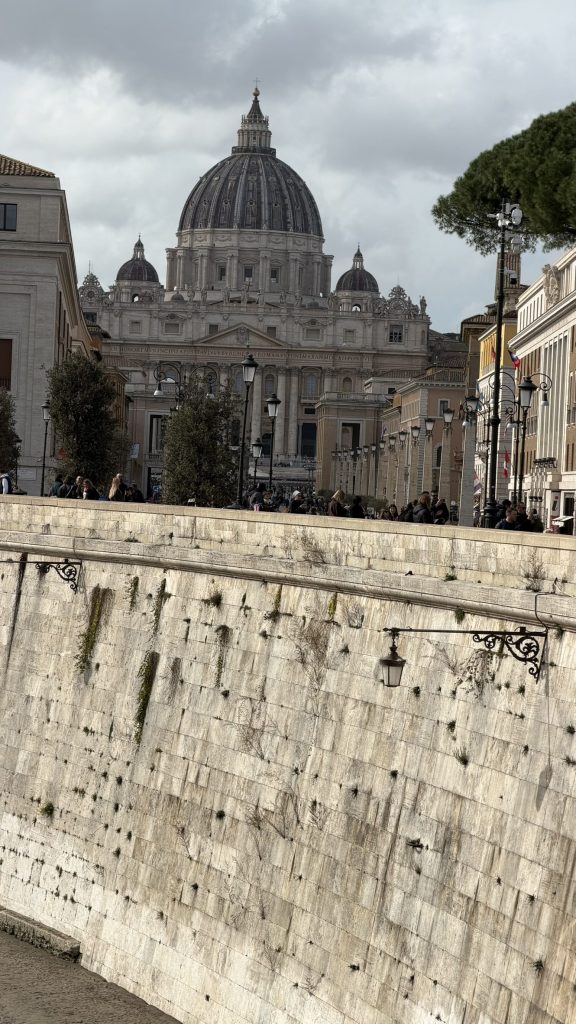
It was time to move on again.

On the way to Piazza Navona, we tried in vain to find the entrance to Palazzo della Sapienza, where a church with an interesting spiral tower is said to stand in the inner courtyard.

After circling the building from three sides, we noticed a few souvenir shops nearby that were convincing enough for us to abandon the search for the entrance.

But this is also one of the curses of Rome for us tourists. Behind almost every street and almost every building there is another square, another ancient ruin, or yet another church. A curse in the sense that there is simply so much — so much that is interesting and beautiful — that there is never enough time to see it all.

Sometimes it is almost better when something is closed. Otherwise you would never get anywhere.

Piazza Navona

You step out of the shop onto the street, take a few steps, and just beyond the corner of the first building, one of the most beautiful squares in Italy opens up on your right in its full length.

Pogled na trg Piazza Navona v Rimu z cerkvijo Sant'Agnese in Agone ter Berninijevo fontano štirih rek.
Fontana del Moro na trgu Piazza Navona v Rimu z obeliskom Fontane dei Quattro Fiumi v ozadju.
Fontana del Nettuno na severnem koncu trga Piazza Navona v Rimu.

In Roman times, this space was a stadium. Many people, myself included, probably assumed that horse races took place here, because the square has that distinctive elongated oval shape.

Although it always seemed a bit strange to me why there would be another racing arena so close to the Circus Maximus.

But that was not the case. No horses at all. This was the Stadium of Emperor Domitian, where sporting competitions were held, mainly running, jumping, and other athletic events. After the fall of the Roman Empire, the stadium slowly fell into ruin. Much of the stone was taken by local residents and reused for new buildings, but the shape of the space remained. Over time, the ancient stadium gradually transformed into a city square.

The square received its final appearance during the Baroque period, when the popes reshaped it with palaces, churches, and fountains. And here, once again, Bernini appears in the story.

In the middle of the square stands his famous fountain, the Fontana dei Quattro Fiumi. It represents four great rivers of the known world at the time: the Danube, the Nile, the Ganges, and the Río de la Plata.

As we were walking toward it, someone was playing Mozart on the cymbals, which added even more to the pleasant atmosphere.

Ulični glasbenik igra na cimbale na trgu Piazza Navona v Rimu.

The fountain is surrounded by four statues of river gods. The girls and I tried to figure out which one represents which river. The easiest to recognize is the Nile, as the river god is covering his face. Why? Because at the time the fountain was built, the source of this longest river in the world was still unknown.

Kip rečnega boga Nila na Berninijevi fontani Fontana dei Quattro Fiumi na trgu Piazza Navona v Rimu.
Berninijeva Fontana dei Quattro Fiumi na trgu Piazza Navona v Rimu z egipčanskim obeliskom.
Kip rečnega boga Río de la Plata na Berninijevi fontani Fontana dei Quattro Fiumi na trgu Piazza Navona v Rimu.

An interesting story is often told about the statue representing the Río de la Plata. Directly opposite the fountain stands the church of Sant’Agnese in Agone, designed by Bernini’s rival, Borromini. The statue, which appears somewhat frightened, raises its hand in front of its face as if afraid that the church might one day collapse on top of it.

In reality, the story has little to do with the facts, since the church was built later and Bernini could not have known what it would look like. Still, it remains a curious coincidence.

While the girls were enjoying the sunshine on the square, I stepped inside to take a quick look at the church.

Bogato poslikana kupola in notranjost cerkve Sant'Agnese in Agone na trgu Piazza Navona v Rimu.

Coffee time.

Not far from Piazza Navona is also Piazza Argentina, the place where Julius Caesar was assassinated. I’m not quite sure why I didn’t include it in our plan. Apparently, coffee felt more important at that moment.

So we headed back toward the Pantheon, where we were greeted by a wall of people. Those two lines in the morning, when we were standing there earlier, seemed almost funny in comparison. Crossing the square felt more like pushing our way through a sea of people.

Church of Sant’Ignazio di Loyola

Along Via del Seminario we walked to our next stop, a church that has become a real hit thanks to TikTok.

Right at the entrance you’re greeted by a long line. Not to get inside, but to take a selfie. We definitely wouldn’t stand in a queue for something like that, and the girls are still too young for the TikTok phase, so we simply walked past the line and went straight into the church.

So what’s the whole point?

The church has a stunning ceiling painting. If you stand in a very specific spot, the ceiling suddenly looks three-dimensional, as if the ceiling is opening up into the sky. At that exact place they’ve set up a large screen that works like a mirror, which is why people sometimes wait for hours just to take that selfie.

Is it worth standing in line for it? I’m not sure. Everyone has their own kind of fun. We just stepped about half a meter away from the screen, tilted our heads back a little, and it looked just as good.

Stropna freska v cerkvi Sant'Ignazio di Loyola v Rimu z znamenito baročno iluzijo odprtega neba.
Narisana kupola v cerkvi Sant'Ignazio di Loyola v Rimu – znamenita baročna optična iluzija na ravnem stropu.

A selfie with a 17th-century fresco was simply not on our list.

But there is another story here, about the dome.

They originally wanted to build one so the church would look even more impressive. But a problem appeared. Such a construction would have blocked the light and the view for the neighboring monastery. Naturally, the monks complained.

And that was the end of the plan. Instead, they came up with a clever solution: they simply painted the dome.

And it works. If you’re not paying close attention, it really looks like a real dome rising above you. In reality, it’s painted on a completely flat surface. A brilliant optical illusion.

When we stepped out of the church, the selfie line had already stretched deep into the street.

Looking at the massive façade of the church, I found myself scanning the square for a statue of an elephant, but there was none.

Baročno pročelje cerkve Sant'Ignazio di Loyola v Rimu na ulici Via del Seminario.

And if there had been one, we all know exactly where its backside would have been pointing.

Hadrian’s Temple

From here it’s just a few steps into the next street, and suddenly you find yourself standing in front of a former temple dedicated not to a god, but to Emperor Hadrian.

Today, mostly the columns remain. But even those are enough to immediately tell a tourist from a Roman.

Pogled ob stebrih Hadrijanovega templja na Piazza di Pietra v Rimu ob ozki mestni ulici.
Stebri Hadrijanovega templja na Piazza di Pietra v Rimu, ostanek antičnega templja cesarja Hadrijana.

The one standing still and looking up is a tourist. The one walking past as if those eleven fifteen-meter columns of Egyptian marble didn’t even exist is a Roman. Makes sense. He’s probably walked past them a million times.

For us amateurs, though, it was a completely different experience.

Trevi Fountain

The closer we got, the more crowded the streets became.

But just one street before you reach it, there’s a sign for Vicus Caprarius – which translates as Goat Street. And why would you turn in here?

Because this is where an archaeological site known as the City of Water is located. Down there, about five meters below the current street level, you can see the remains of Roman buildings, a water channel, and part of the aqueduct that still feeds the famous fountain nearby.

There was no line when we arrived, but the number of visitors is limited, so we had to wait for the next entry slot. Enough time to climb the nearby Quirinal Hill, where the Italian presidential palace stands today.

At the top there’s a large square, and from there we caught our first distant glimpse of the famous dome of St. Peter’s Basilica in the Vatican.

Kvirinalska palača na Piazza del Quirinale v Rimu, uradna rezidenca predsednika Italije na Kvirinalskem griču.
Pogled čez strehe Rima proti kupoli bazilike svetega Petra v Vatikanu, ujete med gradbenim žerjavom nad mestom.

Then back to the City of Water.

The space is small, and the air isn’t particularly good. You see amphorae, a water channel, and a few other archaeological remains. Nothing that caused great excitement, but it does help you imagine a little better how Rome has been built layer upon layer over the centuries.

Podzemni prostori arheološkega najdišča Vicus Caprarius – Mesto vode pri fontani Trevi v Rimu, z osvetljenimi rimskimi zidovi in hodniki.
Ostanki rimskega vodnega sistema in kamnitih stopnic v arheološkem najdišču Vicus Caprarius – Mesto vode pri fontani Trevi v Rimu.
Arheološki predmeti in najdbe iz rimskega obdobja, razstavljeni v podzemnem kompleksu Vicus Caprarius pri fontani Trevi v Rimu.

Let’s go back up to the surface.

We immediately found ourselves in the crowd. The street here is narrow, which only makes the feeling of congestion even stronger.

Slowly we managed to get a bit closer, but when you keep bumping into people and at the same time making sure the girls don’t get lost somewhere in the crowd, the view of the fountain somehow loses much of its charm.

So we turned into a nearby shop instead. Inside there were stairs leading up to what looked like the first floor. I thought maybe there would be a window up there with a better view of the fountain, and above all, a little more peace and quiet. The girls went their way, and I headed upstairs.

Apparently I wasn’t the first to have that idea. Many people had clearly thought of it before me. So many, in fact, that the windows had been half covered with tape.

But I wasn’t giving up.

Somewhere between women’s blouses and rows of jeans, I pushed my way through the clothing racks to the window, stood on my toes… and pressed my face against the glass.

Pogled iz trgovine na množico turistov pred fontano Trevi v Rimu, fontana se vidi skozi izložbeno okno med napisi na steklu.

We knew we were supposed to toss a coin as well, but with a crowd like that it simply wasn’t possible.

Maybe next time. And with that thought, we left the fountain behind.

Towards the Spanish Steps

The day was beautiful, so there was no need to rush anywhere. We decided to walk to Piazza di Spagna and lose ourselves a little in the streets along the way.

As you walk through Rome, you often notice manhole covers in the pavement marked with the letters S.P.Q.R.

Pokrov kanalizacije z napisom SPQR na ulici v Rimu, simbol Senatus Populusque Romanus na mestni infrastrukturi.

Wait a minute. I had seen this somewhere before. Weren’t these the letters carried by Roman soldiers?

So I did a bit of digging. The abbreviation stands for Senatus Populusque Romanus – The Senate and the People of Rome – the official symbol of ancient Rome. It once appeared on the standards of the Roman legions and on public buildings across the empire.

Today, the city of Rome still uses it as its emblem, which is why you’ll spot it all over the place: on city crests, manhole covers, fountains, street lamps, and other public fixtures around town.

Every now and then the view opened up toward a beautiful fountain somewhere along the way. At one point we took a wrong turn and briefly climbed uphill, but eventually we found the right street, where an obelisk at the end leads you straight to the top of the Spanish Steps.

Fontana del Tritone na trgu Piazza Barberini v Rimu, kip Tritona fotografiran skozi rožnate cvetove v ospredju.
Prometna rimska ulica Via Sistina z majhnimi avtomobili in starimi stavbami v smeri Španskih stopnic.
Pogled po ulici Via dei Condotti v Rimu proti obelisku na vrhu Španskih stopnic pri cerkvi Trinità dei Monti.

Spanish Steps

The obelisk was made in Rome, so in a way it’s a kind of Temu version of an Egyptian original. No, no, it’s actually quite beautiful. To the right of it stands the church that is, in fact, the reason the famous steps exist below.

In short: at the top of the hill stands the French church Trinità dei Monti, while at the bottom lies Piazza di Spagna, named after the Spanish embassy. The Spanish Steps between them were built in the 18th century. The project was led by Rome, the money came from a French diplomat, and the name remained Spanish. Rome is simply a city where different nations meet on the same staircase without much trouble.

One of the most famous scenes from the film Roman Holiday takes place right here on the Spanish Steps. Princess Ann, played by Audrey Hepburn, escapes royal protocol for a day, sits on the steps, and eats gelato. A journalist, played by Gregory Peck, notices her there. The year was 1953.

Today, sitting on the steps is no longer allowed. It was quite amusing to watch the tireless guards blowing their whistles and chasing away tourists who wanted, for a brief moment, to become Audrey Hepburn and sit down on those famous steps.

And if they catch you with a gelato, it’s even worse.

The fine: €250.

Piazza del Popolo

If you want to get from here to Piazza del Popolo, it’s easy. Just follow the next obelisk at the end of the street. This one, unlike the previous one, is the real thing. In fact, it’s one of the oldest objects in the city.

Around 3,500 years ago, it stood in a temple of the sun god in the Egyptian city of Heliopolis. During the reign of Emperor Augustus, it was brought to Rome and placed in the center of the Circus Maximus. After the fall of the Roman Empire, it was forgotten for a long time, until it was eventually restored and erected here on Piazza del Popolo, where it now serves as an impressive gateway for anyone entering Rome from the north.

Egipčanski obelisk na trgu Piazza del Popolo v Rimu, viden na koncu ravne ulice Via del Corso med rimskimi stavbami in prometom.
Fontana Dea di Roma na trgu Piazza del Popolo v Rimu z monumentalno kiparsko skupino in razgledno teraso Pincio v ozadju.
Vrata Porta del Popolo na trgu Piazza del Popolo v Rimu, zgodovinski vhod v mesto, skozi katerega so v Rim prihajali popotniki po Via Flaminia.

When you turn back toward the Spanish Steps, three perfectly straight streets lead from here toward the city center. At the entrance of two of them stand twin churches. At first glance they look almost identical, and together they create a sense of perfect symmetry on the square.

After a full day of walking, we had had enough of Rome for today.
Luckily, there was a metro station nearby, so we were soon back in our apartment in Monti.

Tomorrow we’re heading to Ostia Antica, once the main port of ancient Rome.
When we return to the city later, we’re also thinking about visiting the Baths of Caracalla.

Zemljevid poti tretjega dne v Rimu od Montija preko Panteona, Navone in Fontane Trevi do Španskih stopnic in Piazza del Popolo
DAY ROUTE
🏠 Via Urbana, Monti morning walk from the apartment toward the Pantheon
🏛️ Pantheon the great dome with the oculus and Raphael’s tomb
🐘 Piazza della Minerva Bernini’s elephant and the church of Santa Maria sopra Minerva
⛲ Piazza Navona the Fountain of the Four Rivers and the church of Sant’Agnese in Agone
🎨 Sant’Ignazio di Loyola the famous optical illusion ceiling
🏛️ Hadrijanov tempelj ancient columns at Piazza di Pietra
⛲ Trevi Fountain the most famous fountain in Rome
🏛️ Piazza Barberini Bernini’s Triton Fountain
🪜 Spanish Steps Trinità dei Monti above Piazza di Spagna
🏛 Piazza del Popolo Egyptian obelisk and the twin churches
👨‍👩‍👧‍👧 WHO ARE WE?
ODPOTUJ

A family travel blog written day by day, just as we truly experience our journeys.

STARTING POINT
🇬🇧 🇮🇹  All journeys 🇵🇹 🇪🇸

Our current, completed, and upcoming trips, written day by day.

Day 4: Rome Beyond the Postcards

Pogled z Aventinskega griča na kupolo svetega Petra in rimski akvadukti v Parco degli Acquedotti ob večerni svetlobi, zaključek dneva izven klasičnega Rima
This post is part of the travel series Family Journey to Rome, where the entire journey is told as a story from the first to the last day.
DAY 4 OF 7
Highlights of the Day
Trevi Fountain without the crowds
Ostia Antica
Basilica of St Paul Outside the Walls
Aventine Hill and views toward the Vatican
Circus Maximus and the aqueducts
Quick Jump to the Day’s Logistics

Trevi Fountain

I woke up very early today. The girls were still asleep, so I got ready and quietly slipped out of the apartment. The streets were empty as I passed the large exhibition hall on Via Nazionale and turned toward the tunnel beneath the Quirinal Hill.

Razsvetljena Palazzo delle Esposizioni na Via Nazionale v Rimu zgodaj zjutraj na poti proti Fontani di Trevi

After just under 20 minutes, I arrived at the same place where only yesterday we could barely move through the overwhelming crowd.

This time, there were maybe fifty of us. Access to the fountain was free in the early morning; they only start charging later in the day.

Dawn was slowly breaking. The sky was still dark, which made the white façade in front of me feel even more dramatic.

Fontana di Trevi v Rimu zgodaj zjutraj z dramatičnim modrim nebom in osvetljenim belim pročeljem

It depicts the arrival of water into Rome. At the center stands Neptune as the master, surrounded by horses and Tritons representing the unpredictable nature of water. This is also where the ancient Roman aqueduct Aqua Virgo ends — and through this very system, water still flows into the city two thousand years later.

In the morning, it felt completely different. Without the crowds, you experience it in another way. You can walk around it, take it in from every angle, and really see it in peace.

Detajl Fontane di Trevi v Rimu z vodo, skalami in osvetljenimi stebri ob modrem jutranjem nebu
Detajl kipa Neptuna v Fontani di Trevi v Rimu z vodnimi kipi in stebri v ozadju
Stranski pogled na Fontano di Trevi v Rimu z turkizno vodo in modrim jutranjim nebom brez gneče

Until the moment two Americans showed up with a hired photographer and took over the entire place — suddenly they were everywhere.

What stuck with me the most was the moment they were trying to pose for a shot and the guy just couldn’t quite get it right. And then, across the whole fountain, a voice rang out:

“Come on, we practiced this yesterday.”

That was too much for me. It completely took the magic out of the moment. So I left…

… and made my way back through the slowly waking streets of Rome to the girls.

Pogled po ulici v rimskem Montiju proti baziliki Santa Maria Maggiore z veliko kupolo v ozadju

Ostia Antica – a day trip from Rome

Today we were heading out to Ostia Antica, the main port of ancient Rome. This is where ships arrived with grain from Egypt, olive oil from Hispania, and wine from across the Mediterranean. Everything Rome needed to function — from basic food to everyday luxury — first passed through here.

And this is where a day begins that is no longer Rome from postcards.

It almost ended here, too.

But let’s start at the beginning.

A morning that starts with the essentials: coffee and breakfast. The girls had their chocolate cereal, we stuck to our usual, and then headed straight to the metro toward Roma Termini. It was only one stop away, but we had a feeling there would be a lot of walking ahead of us, so we took the easy option and saved a bit of energy for later.

As for the trip itself, one of its biggest advantages is how simple the logistics are. You just buy a metro ticket, and it takes you all the way to the archaeological site. The ride takes about half an hour. The landscape is flat, with some low shrubs, and every now and then you spot a tall umbrella pine in the distance. Other than that, there’s nothing particularly striking along the way.

The train was almost empty. When we got off, it was just us and a few locals. As we walked toward the old harbor, we hardly saw anyone at all. We even commented on what a contrast it was compared to the constant crowds in Rome, and how lucky we were to have the whole site almost to ourselves.

Metro na postaji Termini v Rimu tik pred odhodom proti Ostii Antici, mirno jutro brez gneče
Drevored pinij pri vhodu v Ostio Antico, miren dostop do arheološkega parka brez gneče

We turned left into a pleasant avenue lined with towering umbrella pines, and soon the entrance appeared ahead of us. Silence. No crowds, no lines. It all felt almost too good to be true.

I walked up to the ticket counter to buy the tickets, and the man simply said, “Closed.” Monday. Just like many archaeological sites across Italy.

Apparently common knowledge. First time hearing it myself.

In a matter of seconds, I went through all five stages of grief. First denial — this can’t be happening. Then anger — what do they mean it’s closed? Bargaining — what if I just ask nicely, maybe he’ll make an exception. And then resignation — nothing’s going to change, this just sucks.

Then I looked over at the girls. They burst out laughing. Apparently, they had just watched all those stages play out live on my face.

So I wrapped up the whole grieving process with acceptance — taking the situation for what it was, with a sense of relief.

Monday = closed

The fact that many museums and archaeological sites in Italy are closed on Mondays isn’t a coincidence. It’s actually a very practical decision.

Most of these places are at their busiest over the weekend. Saturday and Sunday are peak tourist days, so Monday has become a day to reset — for staff, maintenance, and cleaning.

Of course, this doesn’t apply to the major landmarks. Those can’t really afford to close, so they stay open almost every day. That’s why most tourists don’t even notice this pattern until they step a little off the usual path.

And that’s exactly where Monday catches you. Just like it caught us.

So in the end, all we could see from behind the fence was a single Roman road and a few building foundations. But the place clearly held much more than what that first glance revealed. Inside, there’s also a remarkably well-preserved theatre, similar to the one we saw in Tarragona while wandering through Catalonia.

Stara rimska kamnita cesta v Ostii Antici, obdana z drevesi in ostanki antičnega mesta
Ostanki rimskih stavb v Ostii Antici med zelenjem in drevesi, miren pogled na arheološko najdišče
Zemljevid arheološkega najdišča Ostia Antica z označenimi glavnimi potmi in objekti ob vhodu

Once we had fully come to terms with the fact that it was closed, two more visitors arrived from the station. You could see the excitement on their faces as they realized how quiet it was, almost no one around, no lines. As they walked past, I almost said something, but I didn’t want to be the one to ruin the moment.

Then the familiar story played out. Entrance. Tickets. Closed. Disappointment. Frustration.

found out they were Americans, and that this was their last day here. And just like that, in front of the closed gates of one of the best-preserved archaeological sites, there we stood — four Slovenians and two Americans — all disappointed, all for the same simple reason: it was Monday.

Medieval Castle in Ostia (Castello di Giulio II)

From the entrance, you walk along a tree-lined path for a few hundred meters — and almost a thousand years forward in time — until you reach a castle built in the Middle Ages.

Castello di Giulio II pri Ostii Antici, mogočna srednjeveška utrdba ob vhodu v arheološko najdišče

If Ostia was once a port at the height of Roman power, built for expansion, prosperity and conquest, this castle belongs to a very different time. A time of defense. A time when Rome was no longer conquering, but protecting itself.

As for us, we weren’t interested in any of that. Not conquest, not defense. We just wanted to catch the next train.

Basilica of St Paul Outside the Walls (San Paolo fuori le Mura)

Since it was right on the way, we got off and went to see it. This was already the second of the four “VIP” churches of the Catholic world. We had passed Santa Maria Maggiore, the first of them, on our very first day, while wandering through Monti with our suitcases, looking for our accommodation.

If the first is dedicated to Mary, the second is dedicated to Paul. The same Paul, the Apostle to the Gentiles, who first reported Christians to the authorities, then experienced a conversion, and ultimately became one of the key figures in spreading Christianity across the Roman Empire.

Because of his prominence and influence, Paul became an ideal scapegoat in the time of Nero. When Rome burned and someone had to be blamed quickly, the responsibility was shifted onto the Christians, who were already unwelcome. Today, it is generally believed that Nero himself most likely did not start the fire, and the exact cause remains unclear. Despite its monumental buildings, much of Rome was still largely built of wood, which only helped the flames spread faster.

Because Paul was a Roman citizen, he was not crucified but beheaded. He was buried on the spot where this church stands today. As the name suggests, the burial took place outside the city walls, which was completely typical for that time. His tomb is precisely the reason why this place has been an important pilgrimage site for centuries.

We began our own little pilgrimage by walking around the building instead of heading straight to the entrance. I’m not sure how we managed to miss it. Maybe because it’s so massive. You really feel that scale when you walk around three sides of it.

But once you finally find the entrance, it becomes clear why you came. One column after another, very few people, and a calm atmosphere all around.

Dvorišče bazilike San Paolo fuori le Mura z dolgimi vrstami stebrov in pogledom proti vhodu v cerkev

You step inside and immediately find yourself among the columns. They stretch out in front of you and to both sides, wherever you look. Then you move toward the center, where your view opens up to two palm trees, and between them stands Paul, holding a sword.

Above it all rises a colorful façade that immediately draws your eye. Beautiful. So much so that you simply have to sit down for a few minutes and just look.

Dolga vrsta marmornatih stebrov v hodniku bazilike San Paolo fuori le Mura, pogled proti vhodu v notranjost
Fasada bazilike San Paolo fuori le Mura z mozaikom in kipom svetega Pavla na dvorišču pred cerkvijo

And then we left the courtyard and headed back to the station.

Only now, as I’m writing this, have I asked myself for the first time why we didn’t go inside the church as well, even though we were just a few meters away. Apparently, it’s even more impressive inside.

And to this day, I still don’t know why we didn’t.

That courtyard must have captured us so completely that none of us even thought it might be worth stepping inside. Strange. At the time, we didn’t feel like we were missing anything.

Don’t be like us. If you’re there, go inside as well.

Anyway, we were already on the train toward the Pyramid of Cestius.

A Pyramid in the Middle of Rome

If you’re heading to the Aventine Hill, you get off at the Piramide station. Why that name? Because Egypt was something of a trend at the beginning of our era, and one Roman official decided to build himself a pyramid as his final resting place. And it’s really there. Just a few steps after you come out of the metro, it suddenly appears in front of you. It fits here about as well as a saddle on a cow. Another curious example of human vanity.

A different story are the city walls standing right next to it. Like every empire in history, Rome eventually reached a point when it was no longer only expanding, but also thinking about defense. That’s how the Aurelian Walls were built — nearly 20 kilometers long and more than 10 meters high. The pyramid was given a new role. Since it was already there, they simply incorporated it into the fortifications. If you already have something, why not use it.

Cestijeva piramida in Aurelijanovo obzidje v Rimu pod dramatičnim nebom, pogled čez široko mestno cesto

Even walls that powerful couldn’t stop what was coming. The Visigoths didn’t break into the city by force. They surrounded it, starved it out, and in the end the gates were opened from within. And just like that, Rome fell for the first time in centuries.

The Keyhole of Three Lands – and a line we didn’t join

The rain was getting closer. No point overthinking it, we took a taxi up the hill. Good decision, because it turned out not to be that close at all.

I asked the driver to drop us somewhere with a nice view over the city. Instead, he dropped us in front of a line about a hundred meters long.

Dolga vrsta ljudi pred ključavnico na Aventinskem griču v Rimu, kjer obiskovalci čakajo na pogled proti kupoli svetega Petra

It was immediately clear we had arrived at the next TikTok sensation. This time not a mirror, but a keyhole.

The idea is simple. You stand with your feet in Italy, look through the keyhole on the gate of the Knights of Malta, across their garden, and your view ends on the dome of St Peter’s in the Vatican. The Knights of Malta are an old religious order that has its own territory here.

With a single glance, you connect three different worlds. Interesting…

But not interesting enough to wait.

So we headed into the park next door instead, where a wide, open view awaits you… of the dome of St Peter’s.

Drevored pinij v parku na Aventinskem griču z razgledom proti kupoli svetega Petra v daljavi
Kupola bazilike svetega Petra nad rimskimi strehami, pogled z Aventinskega griča
Kamnita pot z Aventinskega griča proti Bocca della Verità, pogled nizko ob tleh med starimi zidovi in zelenjem

You walk down from the hill along a wide road lined with ivy-covered walls. As you return to the city, you run into yet another line.

The Mouth of Truth that bites

It’s an old stone disc with a face, most likely an ancient cover for a drain or a well. Like the Spanish Steps, it became famous thanks to the film Roman HolidayLegend says it will bite off your hand if you’re not telling the truth. In reality, it doesn’t bite anything, except maybe an hour of your life while standing in line.

Apparently, the story still works, because the line was long. Too long. We took a look from a distance and moved on. Up on the hill, we saw another one. The complete opposite of the one below.

Usta resnice (Bocca della Verità) v Rimu – kamnit obraz, v katerega naj bi po legendi segel z roko le tisti, ki govori resnico
Kamniti obraz vodnjaka na Aventinskem griču v Rimu, iz katerega teče voda po obrabljenem kamnu

Across the street stands something far more interesting.

On Piazza della Bocca della Verità there is a round temple that reminds you of the one on the Roman Forum. But this isn’t the Temple of the Vestal Virgins. It’s the Temple of Hercules, one of the best-preserved ancient temples in the city. Hercules was the protector of merchants and travelers, which is why it stands right here, where an old port once operated along the Tiber.

There was no line. It stands there almost unnoticed, among the umbrella pines.

And that’s probably one of the things you quickly notice in Rome. The biggest crowds gather where something has become a “must see,” while just a few steps away you can find places you can enjoy almost on your own.

Herkulov tempelj pri Circus Maximusu v Rimu, okrogla antična zgradba ob parku z borovci in sprehajalci

It had been a full day, with its ups and downs, and somehow we forgot to eat. As we were looking for a place to grab something, we realized on the map that we were just a few steps away from the largest entertainment venue of ancient Rome.

Circus Maximus – where Rome raced its chariots

Between the Aventine and Palatine Hills stretches a space that today feels like an ordinary park.

It was more than half a kilometer long and could hold over 150,000 people. The main attraction was chariot racing. The fastest and most dangerous “sport” of its time.

It’s hard to imagine the atmosphere today. The noise, the dust, the roar of the crowd, the rivalry between teams… This is where the Romans lived their own version of Champions League matches.

Po sredini stadiona je potekala dolga pregrada, imenovana spinaDown the middle of the stadium ran a long divider called the spina. It was lined with statues, fountains, and even an Egyptian obelisk. The same one we had seen just the day before at Piazza del Popolo.

And we were standing right in the middle of it.

Pogled iz sredine Circus Maximusa v Rimu danes, kjer je nekoč potekala spina z obeliskom in dirkami z vozovi

After lunch, we walked across it. To your left, the Palatine opens up, where imperial palaces once stood, offering the best views of the races below.

Today it’s a vast open space where people walk their dogs, go for a run, or simply stroll, just like we did. The atmosphere is calm. The only disturbance came from construction machines repairing a section of the road. It’s hard to imagine compared to the chaos that once ruled this track thousands of years ago.

Apparently the food gave us the energy we needed. The sky looked like it might hold, so we weren’t ready to call it a day just yet.

We went to see something I had always wanted to see, but never had the chance.

An aqueduct in all its grandeur.

Parco degli Acquedotti

It’s a bit outside the city, so we had nearly an hour on the metro ahead of us. And even when you finally arrive, there’s still quite a bit of walking to do. At one point, it felt like we’d never actually make it to the park. Our legs were already heavy.

And then, suddenly, the park opens up in front of you.

And there they are. The aqueducts.

Rimski akvadukt v Parco degli Acquedotti v Rimu, kamniti loki nad zelenim travnikom pod oblačnim nebom

Not just one. Several of them. Long stone lines stretching across the fields. Rome needed more and more of them as the city grew, bringing water from distant springs in the hills.

The whole system was based on a simple principle: gravity. Water flowed gently downhill toward the city, without any pumps. Where the terrain dropped, they built high stone arches, the ones you can see in the park today.

At first they’re lower, we even climbed onto one. You walk among low trees and bushes, so you can’t really see far ahead.

Then you hear sheep.

And as you turn the corner, one of the most beautiful views of the day opens up. Maybe even of the whole trip. You’re standing among umbrella pines, in front of you a wide meadow, shepherds moving a large flock across it, and behind them a backdrop that feels almost unreal. A real, monumental aqueduct.

Rimski akvadukt v Parco degli Acquedotti v Rimu, pod katerim se pase čreda ovac na zelenem travniku

If it hadn’t been for the walk back to the station, which somehow felt even longer now, it would have been almost perfect. But we managed that too.

And so the day slowly came to an end. In the morning I had stood where the water’s journey ends, at the Trevi Fountain. Now, in the late afternoon, we were standing where it all begins, flowing down from the hills.

Tomorrow brings a new trip. This time to Tivoli, a town of villas, gardens, and powerful cascades of water.

Zemljevid poti četrtega dne v Rimu, ki prikazuje pot od centra mesta do Ostie Antice, nato skozi Aventinski grič, Circus Maximus in do akvaduktov v Parco degli Acquedotti.
DAY ROUTE
🏠 Via Urbana, Monti early morning walk toward the Trevi Fountain
⛲ Trevi Fountain this time without the crowds
🚇 Ostia Antica a trip to the ancient Roman port
⛪ Basilica of St Paul Outside the Walls a peaceful courtyard, columns and a colorful façade
🔺 Pyramid of Cestius a pyramid in the middle of Rome, built into the Aurelian Walls
🔑 Aventine Hill the Knights of Malta keyhole and a view toward St Peter’s dome
👄 Bocca della Verità a long line for the Mouth of Truth and the nearby Temple of Hercules
🏟️ Circus Maximus a walk across the former chariot racing arena
🌿 Parco degli Acquedotti monumental aqueducts and a calm end to the day, far from the crowds
👨‍👩‍👧‍👧 WHO ARE WE?
ODPOTUJ

A family travel blog written day by day, just as we truly experience our journeys.

STARTING POINT
🇬🇧 🇮🇹  All journeys 🇵🇹 🇪🇸

Our current, completed, and upcoming trips, written day by day.

Day 5: Tivoli and Trastevere

Neptunova fontana v Villi d’Este, aleja stotih fontan, Trastevere in Marcellovo gledališče ob Tibri v Rimu
This post is part of the travel series Family Journey to Rome, where the entire journey is told as a story from the first to the last day.
DAY 5 OF 7
Highlights of the Day
Missed train in Rome
Villa d’Este without water
Neptune Fountain
Walk through Trastevere
Across the Tiber
Quick Jump to the Day’s Logistics

Where to today?

Today was once again about exploring beyond Rome. We even considered going as far as Pompeii or Florence, but quickly realized we’d spend half the day just getting there. On top of that, tickets bought this late would have been painfully expensive.

Tivoli turned out to be the most sensible choice.
Both in terms of time and cost.

Yesterday, we were left standing at the gates of Ostia Antica because I hadn’t checked the opening hours. On the way back to Rome, I decided to take matters into my own hands, looked a bit more closely into Tivoli, and sorted everything out right away. I bought the tickets and train fares so nothing would be left to chance.

Even so, something came up that made the morning…
well, let’s just say exciting.

Rome’s trains and metro

Rome’s metro is actually quite simple. In practice, you mostly rely on just two lines, which take you to most of the main sights.

Line A runs towards the Vatican and stops at Spagna, right by the Spanish Steps. Line B takes you to the Colosseum and further south across the city. The two lines intersect at Roma Termini, the main transport hub.

Children under the age of 10 travel for free.

With Line B, you can use the same ticket to reach Piramide station, where you transfer to the Lido train. It takes you towards the sea, stopping first at Ostia Antica. If you’re lucky and it’s not Monday, you’ll find the gates open to one of the best-preserved ancient sites near Rome.

The other type of trains in Rome are those operated by Italy’s national railway, Trenitalia. These take you out of the city, either towards Fiumicino Airport, like the Leonardo Express, or into the surrounding areas, for example towards Tivoli.

These are no longer city trains, but regular regional or high-speed services, which require a separate railway ticket. Children no longer travel for free here. Tickets can easily be purchased through their app, and conductors checked them regularly.

If instead of heading towards the sea you go inland, towards the hills, the most practical departure point for Tivoli is Roma Tiburtina station.

Trije različni vlaki v Rimu: regionalni vlak Trenitalia na peronu, metro na postaji in Leonardo Express za letališče

And this is where things got complicated.

How you can easily miss a train in Rome

After using the metro systems in London, Paris, Washington, and New York, it’s easy to underestimate Rome’s metro with just two lines.

But Line B splits towards the end. If you’re not paying attention, it’s very easy to get on the wrong train.
And that’s exactly what we did.

Zemljevid rimskega metroja z linijama A in B ter prestopno postajo Termini

At the station, we tried to find a taxi. No luck. As if by design, there wasn’t a single one in sight.

Since we had left the metro, we couldn’t re-enter with the same ticket. So we bought new ones.
One stop back, then one forward to the right line.

When we got off, we had five minutes left before our train.
But which platform?

Platform 28.
Of course, on the complete opposite side of the station.

And just like that, we missed our train.

Tivoli

While we were waiting for the next train, I gave the girls a quick explanation of where we were actually heading.

Tivoli is a small town about 30 kilometers from Rome. Even in Roman times, it was known as a place to escape to, mainly because of the views and the abundance of water, which has always played an important role here. As you approach it, a beautiful view opens up over the town and the valley of the Aniene River.

Razgled na Tivoli z znamenitim templjem Veste na robu pečine nad dolino Aniene, obdanim z zelenjem in starim mestnim jedrom

Among the most famous sights in Tivoli is Villa Adriana, the former residence of Emperor Hadrian. In reality, it’s not just a single villa, but a vast complex of buildings, pools, colonnades, and open spaces spread across a large area. It was developed over several years and is considered one of the most important archaeological sites from the time of the Roman Empire.

Another highlight is Parco Villa Gregoriana, a park more focused on nature. Well-maintained paths lead you into a gorge filled with waterfalls, rock formations, and dense greenery.

When planning today’s trip, both of these options felt a bit too much, so I chose a third one instead.

Villa d’Este

Gravity is the basic force that drives the entire system of fountains at Villa d’Este.
No pumps, no modern technology.

The water flows naturally from one terrace to another, which is why the entire complex had to be built high above the town. And, above all, with remarkable precision.

It is one of the most famous Renaissance villas in Italy, now also listed as a UNESCO World Heritage Site, known especially for its gardens and extraordinary design. Behind it all stood a cardinal who, in the mid-16th century, envisioned something quite ambitious.

Not just a villa, but a garden that would demonstrate power, knowledge, and influence.

The construction and landscaping took decades, and the system of fountains was, for its time, almost unbelievable.

It is precisely this simple principle, water flowing downward, that elevates everything to another level.

When you step off the train, you find yourself at the bottom. To truly understand how the system works, you first have to make your way up.

Železniška postaja Tivoli z peroni, tiri in pogledom na mesto v ozadju
Ozka ulica v Tivoliju med vzponom proti Villi d’Este z zgodovinskimi hišami ob poti
Vhod v Villo d’Este v Tivoliju s keramično tablo z napisom Villa d’Este

You’re looking at about a half-hour walk. And honestly, it’s nothing too demanding.

As you start the climb, you move through narrow streets, under passageways, over worn cobblestones. There are hardly any people around. From the station, we were pretty much on our own.

At the top, you’re greeted by shops, restaurants, and cafés.
A clear sign you’ve arrived in a tourist town.

I had bought the tickets the day before, right on the train as we were heading back to Rome. In the end, it turned out to be completely unnecessary. And, if I’m honest, a bit silly. There was no line. No one made an issue, even though we were running over an hour late.

And then came the irony of the day.

The place best known for its fountains, where water driven by gravity creates the very scenes people come here to see… had no water today. That’s what it said at the ticket office. They were offering a €5 discount on the spot, of course not for those of us who had bought tickets in advance. You couldn’t make it up. All that effort just to get here, and then… no water. Well, at least let’s go and see the gardens.

Fountains without water

You first step into a charming courtyard, where a fountain stands with a statue of a sleeping Venus, the goddess of love.

Then, through long corridors and a series of rooms with remarkably beautiful ceilings, you slowly make your way towards the exit.

Fontana s kipom speče Venere na dvorišču Ville d’Este v Tivoliju
Dolgi hodnik z loki in visečimi svetilkami v notranjosti Ville d’Este v Tivoliju
Bogato poslikan renesančni strop v notranjosti Ville d’Este v Tivoliju

That’s where the gardens reveal themselves for the first time. They cascade down in terraces far below you, almost a hundred meters by feel, connected by stairways, pathways, and long axes lined with fountains.

Zunanjost Ville d’Este v Tivoliju z renesančno arhitekturo, stopniščem in vhodom v vrtove
Pogled z terase Ville d’Este na zelene vrtove spodaj v Tivoliju

Oval Fountain

The first one we stopped at was the Oval Fountain. You reach it through an open passage.

In front of you, a wide semicircular space unfolds, surrounded by greenery and rock.

The whole area feels like a kind of water stage. Above the fountain rises an artificial mountain, from which water is meant to flow.

Polkrožna panorama vrta Ville d’Este v Tivoliju z ovalnim bazenom, zelenjem in zgodovinsko arhitekturo

You can walk all the way around it and even pass through a tunnel behind the fountain. It must be quite an experience when the water is flowing, with torrents cascading in front of you while everything around you echoes, sprays, and foams.

With no water, of course, you miss all of that. Still, we liked this place. Enclosed by rock and greenery, with an unusual tree standing to the side, it carries a strong sense of nature, clearly something they were trying to create here.

Fountain of the Dragons

As you descend one level further, you come across the Fountain of the Dragons. Four dragons stand in a circle, each facing a different direction, like guardians. They symbolize power and influence.

Terasasti vrtovi in fontana zmajev v Villi d’Este v Tivoliju, dva usklajena pogleda z enako svetlobo in slogom

Above them, terraces rise in perfect symmetry, along with the staircase from which we first caught sight of the gardens.

The Hundred Fountains

Somewhere, at least according to the signs, there should have been the Hundred Fountains, a long walkway lined with small water outlets creating an almost continuous sound of flowing water.

Despite the effort, Nara and I couldn’t find them, even though there are supposed to be a hundred. With no water, they’re just openings hidden among the greenery, easy to overlook.

Neptune Fountain

At the very end, there’s one more fountain. Large, imposing, set at the far edge of the lower gardens. This is meant to be the grand finale of water.

But instead, you’re left looking at a few statues gazing out over the gardens towards Rome, as if they too are wondering where all the water has gone.

I later found a photo online of how it’s supposed to look. The difference is obvious.

Fontana Neptuna v Villi d’Este v Tivoliju prikazana v primerjavi brez vode in z vodnimi kaskadami in pogledom na terasaste vrtove

The exit is where you started, so all those steps we had already walked were waiting for us again. At the top, a wide view opens over the plain below, and you begin to understand why they chose to build their villas here.

Trastevere

By one o’clock, we were already on the train back to Rome. After a few changes between metro lines and buses, we found ourselves in Trastevere. The name means “across the Tiber,” and this part of the city is often described as more lively and relaxed compared to the other side of the river. To us, it felt quite similar to elsewhere.

One of the oldest churches in Rome stands here, the Basilica di Santa Maria in Trastevere, known for its golden mosaics. We spent some time lingering in the square in front of it, then made our way through the narrow streets back towards the Tiber.

Bazilika Santa Maria in Trastevere v Rimu s pogledom na odprt trg in zvonik v topli popoldanski svetlobi
Živahna tlakovana ulica v rimskem Trastevereju z ljudmi, toplimi barvami fasad in večernim vzdušjem italijanskega mestnega življenja

You cross it via a small island that has been associated with healing since ancient times. A tiny island, home to a hospital that still carries on that tradition today.

It is connected to the other side of the river by the oldest bridge in Rome, more than 2,000 years old.

If we still had plenty of energy in Tivoli, Trastevere clearly drained what was left of it, and even that “healing” island didn’t help much.

We passed by the ancient Theatre of Marcellus and headed towards the steps of the Capitoline Museums, but by then we had no energy left to climb them.

We took a taxi back to Monti, and later in the evening treated ourselves to gelato, something you simply can’t get enough of here.

We really needed the rest, though, because tomorrow is a big day. We’re visiting the smallest country in the world, the Vatican.

Zemljevid poti iz Rima do Tivolija z označeno traso do Ville d’Este in glavnimi točkami na poti
DAY ROUTE
🚇 Roma Termini → Roma Tiburtina morning metro ride towards the train station for Tivoli
🚆 Tivoli train from Rome and a walk uphill towards Villa d’Este
🌿 Villa d’Este Renaissance gardens, terraces, fountains… and a day without water
🚶Tivoli Railway Station walk back down through the town and return towards Rome
🚆 Roma Termini rain back to the city and transfer to the metro
🚇 Circus Maximus metro exit and continuation by bus
🚌 Trastevere a walk through narrow streets to the Basilica of Santa Maria in Trastevere
⛪ Bazilika Santa Maria in Trastevere time spent in the square in front of one of the oldest churches in Rome
🏝️ Tiber Island crossing the island, linked to healing since ancient times
🌉 Ponte Fabricio crossing the oldest preserved bridge in Rome
🏛️ Theatre of Marcellus walk past the ancient Roman theatre towards Capitoline Hill
🪜 Capitoline Museums Steps we made it this far, but had no energy left to climb them
🚕 Monti end of the day with a taxi ride back to Via Urbana
👨‍👩‍👧‍👧 WHO ARE WE?
ODPOTUJ

A family travel blog written day by day, just as we truly experience our journeys.

STARTING POINT
🇬🇧 🇮🇹  All journeys 🇵🇹 🇪🇸

Our current, completed, and upcoming trips, written day by day.

Day 6: Vatican – St. Peter’s Basilica and the Sistine Chapel

Pogled na Castel Sant’Angelo, most z angeli in kupolo bazilike svetega Petra ob reki Tiberi v topli večerni svetlobi Rima

This post is part of the travel series Family Journey to Rome, where the entire journey is told as a story from the first to the last day.
DAY 6 OF 7

Highlights of the Day
Vatican Museums
Egypt and mummies
Pinecone Courtyard and the Sphere
Sistine Chapel
Spiral staircase
St. Peter’s Square
Castel Sant’Angelo
Walk along the Tiber

Quick Jump to the Day’s Logistics
 

A Country Within Half a Square Kilometer

Our journey is slowly drawing to a close. We began with ancient Rome, continued through its classical layers, and even ventured a little beyond the city. But there’s still one place left that simply cannot be missed.

And that, of course, is the Vatican. The smallest country in the world, the seat of the Christian world, shaping the fate of millions for centuries. A place filled with faith and extraordinary architecture, yet also layered with mystery and controversy.

Within less than half a square kilometer lies a state you can walk across in minutes, yet explore for days. It has its own army, its own post office, its own coins, and even its own railway station. In reality, it feels less like a country and more like a city within a city, with an influence that stretches far beyond its walls.

At every step, you come across something that would stand on its own as a major attraction anywhere else. Here, it’s simply part of everyday life.

If you want to actually see all of this, you first have to get out of bed. And we did, early enough not to miss our entry to the Vatican Museums.

Vatican Museums

The Vatican Museums are not just a single attraction, but almost a city of art in their own right. Corridors, halls, galleries… one after another, statue after statue, masterpiece after masterpiece.

They house one of the largest art collections in the world, from ancient sculptures to Renaissance masterpieces that most people know only from books. And of course, you’re not alone there. More than six million people visit each year.

Vhod v Vatikanske muzeje v Rimu z napisom MVSEI VATICANI nad kamnitim portalom, pred katerim stojijo varnostniki in obiskovalci.

That’s why a visit takes a bit more planning.

The first thing is tickets, which need to be booked well in advance. We got ours back in December, about two months ahead, as the early morning slots sell out quickly.

The second important factor is where you stay. If you’re close to a metro station, you can be on your way in minutes, without unnecessary stress or rushing. It makes a big difference before you even step inside the museums, especially since it’s going to be a long day.

And then there’s the third thing: morning time slots. Wherever we’ve been, whether at Versailles in France, the Alcázar in Seville, the Sagrada Família in Barcelona, or here at the Colosseum, it always proves the same. The earliest entries are the best choice.

Not just because there are fewer people, but because mornings carry a certain atmosphere. The city is only just waking up, and you’re already standing in front of something grand, historic, almost monumental.

Punctuality matters to me, so I always push us to get going on time. It can be a bit annoying, especially early in the morning, but without it, the whole day can start falling apart before it even begins.

You also quickly realize that the entrance to the museums is not on St. Peter’s Square, but a bit further away. If you’re coming from the city center, the most practical option is to get off at Ottaviano station and walk from there.

The Japanese, the queue, and one pigeon to say good morning

From the metro station, you don’t really need navigation anymore. You simply follow the crowd, in our case a group of Japanese tourists, and soon you find yourself standing in front of the massive walls that surround the entire state. Rising about ten meters high, they are impressive in their own right.

Sprehod ob visokem vatikanskem obzidju v Rimu v topli večerni svetlobi, kjer mimo hodijo pešci in vozijo avtomobili ob dolgi kamniti steni.

The path doesn’t lead you straight in. The wall gently guides you, first to the right, then to the left, and before you know it, you’re already in a queue.

You stand there. You watch. You wander around a bit. And then you realize this isn’t even your line. This one is for those who don’t have tickets yet.

In the new line, we were among the first. But since our tickets were for 08:30 and it was only 08:00, the guard wouldn’t let us through. With a smile, he suggested we go grab a cappuccino in the meantime.

One of those moments when you’re too well organized and still too early. It never quite works out perfectly, does it?

We skipped the coffee and returned to the line. But in the time we weren’t allowed in, it had stretched to about a hundred meters. Organized groups started arriving as well, calmly moving past us without much hesitation.

Dolga vrsta obiskovalcev ob vatikanskem obzidju v Rimu pred vstopom v Vatikanske muzeje.

So we slowly inched along the wall, when suddenly something flew out of a small opening right next to us. Nothing dramatic, just a pigeon.

If anyone standing nearby hadn’t fully woken up by then, they definitely did in that moment.

Egypt, the Pinecone, and a Sphere within a Sphere

First the tickets, then the security check where plastic water bottles are not allowed, followed by passports and the tickets once again. And just like that, you’re inside.

Soon after, you’re outside again, standing on a terrace that opens up to a perfectly symmetrical garden with a fountain at its center. Behind the trees, the dome of St. Peter’s rises into view, while in front of you stand reproductions of the Sistine Chapel.

Kupola bazilike svetega Petra v Vatikanu, ki se dviga nad zelenimi drevesi pod modrim nebom
Plakat Sikstinske kapele z upodobitvami fresk in prizorov iz svetopisemskih zgodb, poravnan in zajet čez celoten kader.

Maybe because restoration work has been going on for some time, and you don’t get to see it in its entirety. A kind of compensation, perhaps. Or you can take it as an introduction to the greatest thing here.

Just as all roads lead to Rome, in the Vatican Museums all paths lead to the Sistine Chapel.

The museums are vast. Truly. Visitors had already spread out, perhaps most of them heading straight for Michelangelo’s masterpiece. We, on the other hand, had no strict plan, so we simply wandered.

We first found ourselves in the Egyptian section of the museums. Statues of pharaohs, sarcophagi, hieroglyphs, mummies… Those mummies in open sarcophagi are just a little unsettling.

Starodavna egipčanska kamnita stela z vklesanimi hieroglifi in reliefnimi figurami, razstavljena v muzeju na temnem ozadju
Egipčanska mumija v odprtem sarkofagu z bogato poslikanim pokrovom, razstavljena v muzeju z drugimi starodavnimi artefakti v ozadju

We continue down the corridor, and as I glance out the window, I spot a giant pinecone. Wait… a pinecone? What is that doing here?

Of course, I had to Google it immediately.

It turns out to be a nearly four-meter-tall bronze pinecone from ancient Rome, over 1,800 years old. It symbolizes life, renewal, and something that remains even after everything else fades. It once stood near the Pantheon, and like so many things here, eventually found its way into these museums.

On either side stand two peacocks. They symbolize eternity and immortality which, considering how long this pinecone has been standing there, seems quite fitting.

Velika bronasta skulptura pinije v dvorišču Vatikanskih muzejev, obdana z marmornimi elementi in kipi pavov pod jasnim nebom.
Velika bronasta sfera v dvorišču Vatikanskih muzejev z odsevom okolice, pred klasično stavbo s stebri in urejenim vrtom.

But there’s something else here as well. Something we had already seen at Trinity College in Dublin, in front of the United Nations in New York, and now again here, in the Pinecone Courtyard in the heart of the Vatican.

It’s one of the cracked bronze spheres by the Italian artist, scattered across different parts of the world. Each one is slightly different, unique, yet the message remains the same. From the outside, the sphere represents perfection, while the cracks reveal its interior. Complex, chaotic, and fragile. Much like the world itself.

So much symbolism in one place, the only thing missing was a coffee machine to sit down and take it all in.

Violent Statues, Marble Animals, and a Bathtub in the Middle of the Room

Then come the statues. Perseus holding Medusa’s severed head, a man struggling with snakes, sarcophagi filled with scenes of battle… You start to get the feeling that everyone here is in some kind of conflict with everyone else.

And then, when you pass a statue that’s simply standing there, not being attacked, not about to be bitten or devoured, it almost catches you off guard.

Dolga galerija v Vatikanskih muzejih, obdana s klasičnimi kipi ob straneh in svetlobo, ki se odseva na sijočih tleh.
Klasična marmorna skulptura Perzeja z mečem in Meduzino glavo, postavljena v niši z marmornim ozadjem.
Marmornat rimski kip moškega v togo, postavljen med stebri v dvorišču Vatikanskih muzejev.

When you get tired of people, you step into the next room, which belongs to animals. Dogs, deer, snakes, and bulls. Someone even thought it was a good idea to carve a lion attacking a horse in marble.

Dramatična marmorna skulptura leva, ki napada konja, razstavljena v notranjosti Vatikanskih muzejev.

After unsuccessfully searching for at least one marble cat, we had already wandered into the next room. It’s modeled after the Pantheon, and at its center stands a massive stone basin, carved from a single block.

Around it, in the niches, are statues and heads of Roman emperors, gods, and heroes, all brought together by a masterfully crafted mosaic floor.

This was the first room I truly liked.

Gallery of Tapestries, Gallery of Maps, and the Raphael Rooms

Then you enter a long corridor, with tapestries stretching along both sides. At first, I thought they were paintings, but once you step closer, you quickly realize you were mistaken.

But why were they even made? I read that some took months to create, others even years.

First of all, they helped keep the rooms warm, which was quite practical. At the same time, they told stories and made it very clear to any visitor who had the money, since they were incredibly expensive.

So, in a way, a combination of a radiator, a painting, and a status symbol.

Tapiserija z motivom večerje v Emavsu, kjer Jezus sedi za mizo z dvema učencema, z bogatimi detajli in toplimi barvami v notranjosti Vatikanskih muzejev.
Dolga zlato okrašena galerija zemljevidov v Vatikanskih muzejih, z bogato poslikanim stropom in obiskovalci, ki hodijo po svetlečih marmornatih tleh.
Bogato okrašen strop Vatikanskih muzejev z renesančnimi freskami, zlatimi ornamenti in svetopisemskimi prizori.

The corridor just keeps going. Then a passage. As you step through, your eyes are immediately drawn upward. The ceiling, covered in gold. Wait… is all of that really gold?

Paintings, frescoes, everything intertwined with gilded details.

The space is called the Gallery of Maps and yes, maps of Italy line both sides. But it’s the ceiling that truly reigns over this corridor. Although the maps themselves hold quite a story too.

Stenski zemljevid Italije v Galeriji zemljevidov v Vatikanskih muzejih, bogato okrašen z zlatimi okvirji in detajli.

Before they were drawn, this land was actually walked and surveyed. No satellites, no technology. Just terrain, time, and a few blisters along the way.

When the galleries come to an end, you step into the rooms created by Raphael, the same artist whose tomb we saw in the Pantheon on our third day. There are four rooms. In each one, painting after painting, fresco after fresco.

Each telling its own story.

Freske Rafaela v Rafaelovih sobah v Vatikanu z zgodovinskimi in verskimi prizori v razkošno okrašenih dvoranah.

The first celebrates thinkers and philosophers, the second miracles, the third the popes, and the fourth the triumph of Christianity.

Beautiful. But the true highlight is still to come.

Sistine Chapel

Suddenly, a crowd gathers at the entrance to the next room. And just like that, everything around you falls quiet.

Of course. You’re stepping into the Sistine Chapel.

Everyone in front of you is looking up.

This is the place where the pope is chosen, the most important figure in the Christian world. The decision made here determines whether the smoke will be white or black.

The ceiling. Michelangelo. It took him four years. And no, he wasn’t lying on his back. He stood on scaffolding, painting above his head for hours, days, months. The colors were applied onto fresh plaster, which meant there was no room for mistakes.

A masterpiece where you can read the Bible from beginning to end. From Creation to the Last Judgment.

It is high, though, that ceiling. You see it, but the details can easily slip away if you’re not paying attention. I even had to search a bit to find that famous scene where the fingers of God and man almost touch.

In a room filled with paintings, photography is not allowed. If someone happened to take a photo, which of course I didn’t… but if a phone shutter just accidentally clicked, it might look something like this.

Pogled na strop Sikstinske kapele od spodaj z Michelangelovimi freskami, z izboljšano jasnostjo spodnjega dela in vidnim oltarnim prizorom.
Strop Sikstinske kapele v Vatikanu z znamenitimi freskami Michelangela, vključno s prizori iz Geneze

Vatican Post and the Double Spiral Staircase

Postcards aren’t really sent much anymore. We still send them regularly to just two people, my parents and a friend in Denver, Colorado, with whom I traveled across most of Argentina almost twenty years ago.

I returned to Slovenia afterward, while he kept going… and in the end, traveled the world.

You’re not in the smallest country in the world every day, so this time we sent them from here.

The post office window is right before the exit of the museums, just before you descend down that famous spiral staircase.

Roka oddaja razglednico Vatikana v rumen poštni nabiralnik Poste Vaticane pred Vatikanskimi muzeji.

Why is it so famous? Because of how it’s designed. The idea dates back more than 500 years. It’s built as a double spiral, one wrapped around the other. One for going up, the other for going down, so that people never cross paths.

Spiralne stopnice v Vatikanskih muzejih, pogled od zgoraj z izrazitim vzorcem kroženja in detajli kovinske ograje.
Pogled navzgor skozi spiralne stopnice Vatikanskih muzejev proti steklenemu kupolastemu stropu z geometrijskim vzorcem.

St. Peter’s Square

A natural continuation after the museums is, of course, the square. And even more logical than that, a coffee stop.

We hardly came across any Slovenians on this trip. In fact, I don’t remember hearing a single sentence in Slovene anywhere. Well, while we were enjoying a well-deserved coffee in the sun, I suddenly heard familiar words.

I looked over… and there was Boštjan Gorenc – Pižama, passionately explaining something to the group following him. They were heading toward the museums, clearly running a bit late.

How fitting that the first Slovene words you hear come from someone who brings Slovenian literature into a kind of modern 2.0 version, presenting it to today’s younger generation in his own unique way.

It was Wednesday, the day of the Pope’s audience, so the square was closed in the morning. Entry was only possible with tickets, which need to be reserved in advance.

As we approached the square, the crowd was already massive. We joined it, but more and more people kept arriving from behind, so we stepped aside. Within minutes, we would have been completely stuck, with nowhere to move.

Množica ljudi na ulici proti Vatikanu v Rimu, v ospredju poročni par med sprehodom skozi mesto

Just as we stepped a few meters away, the square suddenly opened. Quickly. Let’s go.

Most people joined the new line for St. Peter’s Basilica, so for a moment, we had almost the entire square to ourselves.

The square is shaped like an ellipse, with a more than 2,000-year-old obelisk standing at its center, brought here from Egypt.

Obelisk na Trgu sv. Petra v Vatikanu, pogled od spodaj proti nebu z dramatičnimi oblaki

On each side, it is embraced by a colonnade of columns arranged in four rows, 284 in total. They surround the square like two great arms. Above them stand 140 statues of saints.

Another masterpiece by Bernini.

With the girls, we searched the ground for that exact spot where, if you stand on it, all four rows of columns align into a single line. Of course, we found it soon enough. And yes, everything lines up. Incredible.

Točka na Trgu svetega Petra, kjer se stebri Berninijeve kolonnade vizualno poravnajo v eno linijo ob pogledu na vodnjak in množico ljudi

I had forgotten just how vast this space is. Towering above the square is the dome of St. Peter’s Basilica.

This was already the third of the four papal basilicas, the “VIP churches” of the Catholic world, that we had seen in recent days, after the Basilica of Santa Maria Maggiore and the Basilica of St. Paul Outside the Walls.

Bazilika svetega Petra v Vatikanu od spredaj z mogočno fasado, stebri in kupolo pod delno oblačnim nebom

That meant only the Lateran Basilica was still missing.

From the Vatican Museums, it’s even possible to make your way up into the dome of this famous church.

Anja remembered that the passage, when we were here years ago, was narrow and quite claustrophobic, so we didn’t even consider it. Especially after our last experience in the tower of the Sagrada Família in Barcelona.

From the square, you can also spot something familiar from television, the balcony from which the Pope addresses the world. Just today, he delivered the Urbi et Orbiblessing from there, the Easter blessing to the city and the world.

Detajl fasade Bazilike svetega Petra z visokimi stebri in oknom, v ospredju letita dva galeba.

The line to enter the basilica was already wrapping around the entire square, so that was no longer an option for us. Fatigue was slowly catching up with us as well, the morning had been full, in every sense.

We decided to walk to the nearest metro station. To avoid taking the same route as in the morning, we turned toward the Tiber.

Castel Sant’Angelo and the Tiber

As you walk away from the square, the outline of a building slowly takes shape in the distance, a structure that has been many things throughout history. A mausoleum. A fortress. A prison. A papal refuge.

You’re standing just in front of Castel Sant’Angelo.

Somewhere beneath your feet runs a secret passage that once connected St. Peter’s Basilica with this castle. When things went wrong, the popes would simply disappear from the Vatican and retreat along this route to the safety of the fortress.

At the top today stands the statue of the Archangel Michael, after whom the castle is named. Legend has it that he appeared there and sheathed his sword as a sign that the plague had come to an end.

Castel Sant’Angelo z angelom na vrhu, pogled od spodaj skozi veje nad Rimom

It is connected to the other side of the Tiber by a bridge adorned with statues of angels. Beautiful. Bernini again.

From the bridge, we continued along the Tiber toward Piazza del Popolo, where the metro station is.

As the river gently begins to curve, we took one last look back at that iconic dome.

Bazilika svetega Petra v Vatikanu z mostom čez reko Tibero v ospredju

We last stood here looking at this view fourteen years ago.

And now, here we are again.

Will we ever see it again?

zemljevid Rima z potjo dneva 6  od Montija do Vatikana ter peš ob Tiberi

DAY ROUTE
🚇 Roma Termini → Ottaviano morning metro ride toward the Vatican and the start of the day at the museum entrance
🏛 Vatican Museums entry into one of the largest museum complexes in the world
🎨 Sistine Chapel the highlight of the visit with Michelangelo’s frescoes on the ceiling and altar wall
⛪ St. Peter’s Square exit from the museums toward the basilica and Bernini’s colonnade
🏰 Castel Sant’Angelo walk along the Vatican walls to the fortress by the Tiber
🌉 Ponte Sant’Angelo crossing the bridge with angels and one of the most beautiful views toward the Vatican
🚶 Piazza del Popolo a longer walk through the city to the large square on the northern edge of the center
🏡 Via Urbana 18 return to Monti and the end of the day in the apartment

👨‍👩‍👧‍👧 WHO ARE WE?
ODPOTUJ

A family travel blog written day by day, just as we truly experience our journeys.

STARTING POINT
🇬🇧 🇮🇹   Vsa potovanja   🇵🇹 🇪🇸

Our current, completed, and upcoming trips, written day by day.

Day 7: Rome in the Rain

Razgled na Piazza del Popolo v dežju z obeliskom in pogledom proti kupoli svetega Petra, zadnji dan v Rimu

This post is part of the travel series Family Journey to Rome, where the entire journey is told as a story from the first to the last day.
DAY 7 OF 7
Highlights of the Day
A slow final morning, without a plan
Spanish Steps, finally without the crowds
A quiet view over Piazza del Popolo
A visit to the Leonardo da Vinci Museum
A coin tossed into the Trevi Fountain

Quick Jump to the Day’s Logistics

Last Morning in Rome

And just like that, we reached our final full day in Rome.

Tomorrow morning, it’s just a trip to the airport and then back home.

On our very first morning, less than a week ago, we barely escaped the rain, hiding from it under the arches of the Colosseum. This last morning didn’t look much different.

Back then, I wrote that the rain was exactly what made that moment one of the most memorable of the entire trip. Maybe today has a surprise waiting for us too.

We had already passed 100,000 steps. Our legs were starting to feel it, though to be honest, Anja and I were struggling more than the girls.

Today, we had no real plan. We usually leave the last day open.

It’s a day for slowing down. For coffee breaks, a bit of souvenir shopping, and for returning to places that caught our attention along the way, the kind you quietly promise yourself you’ll come back to.

A day that belongs only to us. No time slots, no rushing across the city, no complicated logistics.

The view through the window promised rain. The forecast said it would rain. The Windy app insisted it was already raining.

But it wasn’t.

Let’s go.

A few minutes later, we were already sitting on the metro, heading towards the Spanish Steps.

Views Over Rome

After walking the Colosseum arena, almost twisting our ankles on the Roman Forum, taking in the city from the Palatine Hill, wandering through the Pateon and Piazza Navona, pushing through the crowds at the Trevi Fountain, escaping Rome to Ostia Antica and Tivoli, and getting lost in the Vatican, there was only one part of the city left for us – Villa Borghese.

As soon as we stepped out of the metro, we found ourselves at the Spanish Steps. There were far fewer people than that afternoon when we arrived from above. At one moment, we even had the steps completely to ourselves.

Mama in hčerka hodita po Španskih stopnicah proti cerkvi Trinità dei Monti v Rimu

We slowly made our way up to the top. From there, you turn left and continue along the road, where every now and then some genius decides it’s a good idea to drive down the steps… and, of course, gets stuck.

As you walk, the city begins to open up between the trees. Your eyes keep drifting back to the dome of St. Peter’s, rising above the rooftops.

Razgled na Rim skozi drevesa z vidno kupolo bazilike svetega Petra in mestnimi strehami v ozadju
Pogled na Piazza del Popolo z egipčanskim obeliskom in mestno ulico v Rimu

Then you stop at the terrace overlooking Piazza del Popolo. Below, you spot one of the oldest things in the city – an Egyptian obelisk, more than 3,000 years old. Powerful, monumental, and almost untouched by time.

Then you turn the other way, towards the park, and see something completely different. A giant metal ring, shaped like a diamond. Visually flat, a bit kitsch, and… well, something else entirely.

Velika skulptura diamantnega prstana v parku Villa Borghese v Rimu, ujeta pod oblačnim nebom

On one side, millennia that have endured. On the other, a moment trying to stand out, soon to be forgotten.

Any resemblance to the modern world is purely coincidental.

Park Vila Borghese

Just as Hyde Park is to London or Central Park to New York, Villa Borghese is to Rome. A place to step into green space, away from the noise of the city.

It began as the private estate of the Borghese family, with a villa at its heart, its own lake, and a gallery that today houses works by Caravaggio and Bernini.

All around are carefully designed gardens, museums, and even a zoo at the far end.

And from all that art and beauty, we saw… well, almost nothing. One statue, to be exact. Just as we stepped into the park, the rain started.

Kip ženske skrit med rastlinjem v parku Villa Borghese v Rimu ob robu majhnega vodnega bazena

What now?

A few days earlier, while searching for the metro entrance at Piazza del Popolo, we noticed the Leonardo da Vinci Museum and said to ourselves: if we ever need to escape the rain, this might be a good option.

And so we found ourselves rushing down all those steps to the square, stepping into the world of one of Italy’s greatest Renaissance minds.

A visit to the Leonardo da Vinci Museum

I expected another tourist trap with steep prices. And, to be fair, I wasn’t completely wrong, the ticket wasn’t exactly cheap. But when it comes to the experience itself, I was.

The museum is hidden underground, beneath the Church of Santa Maria del Popolo. Which turns out to be the perfect shelter from the rain. Instead of a traditional museum, you step into a journey through his ideas, where sketches come to life as wooden models. For the first time, I saw a model of his tank and flying machines in real life, the kind you usually only know from books.

Otrok opazuje model leteče naprave Leonarda da Vincija v muzeju v Rimu
Zgodnja potapljaška oprema po načrtih Leonarda da Vincija, razstavljena v muzeju v Rimu
Model tanka Leonarda da Vincija z vidnim notranjim mehanizmom v muzeju v Rimu

What makes it especially interesting is that many of the exhibits are hands-on. You can turn the mechanisms, move the parts, and slowly begin to understand how a mind worked that was centuries ahead of its time.

Alongside that, there are replicas of his most famous works, from The Last Supper to the Mona Lisa. The walls are filled with his detailed anatomical sketches, and for the kids, there’s even a creative corner where they can follow on-screen instructions and draw their own masterpieces.

Mona Lisa Leonarda da Vincija kot ena najbolj znanih renesančnih slik na svetu
Avtoportret Leonarda da Vincija kot renesančna risba v lesenem okvirju, razstavljena v muzeju v Rimu
Vitruvijski človek Leonarda da Vincija kot renesančna študija človeških proporcev

And to finish, something a bit special, a 3D experience of flying over Florence in one of Da Vinci’s flying machines. The bravest of us was Nia, who for a few minutes actually “flew” above the city.

Otrok preizkuša VR simulacijo letenja nad Firencami v muzeju Leonarda da Vincija.

It turned out to be well worth it. And the best part, when we stepped back outside, the sun had returned.

We’ll be back one day

From the square, three main streets branch out: Via di Ripetta, leading towards the Pateon; Via del Corso, taking you to Piazza Venezia and the Altare della Patria; and Via dei Babuino, heading towards the Spanish Steps.

Between the twin churches of Santa Maria dei Miracoli and Santa Maria in Montesanto, we first stepped onto Via del Corso. Along the way, we took care of a few last purchases, as it’s one of the main shopping streets in Rome.

Now that the sun was out again, the street quickly began to fill up.

Piazza del Popolo v Rimu z egipčanskim obeliskom in cerkvama Santa Maria dei Miracoli in Santa Maria in Montesanto
Notranjost galerije z bogato arhitekturo in steklenim stropom, kjer se ljudje sprehajajo po elegantnem prehodu
Umetniška instalacija z ogledali v obliki maske v bližini Španskih stopnic v Rimu

So we turned into the side streets and made our way back towards the Spanish Steps, where we had actually started the day.

As we were thinking about how to spend the rest of the afternoon, we found ourselves right near the steps again. That’s when Nia said we still hadn’t thrown a coin into the Trevi Fountain.

A perfect way to end the trip. Through narrow passages and past a few modern art installations, we made our way to the fountain.

And about ten minutes later, we were standing right by the water, each of us tossing a coin in, with the quiet hope that we’ll return one day.

Fontana di Trevi v Rimu z mogočno baročno arhitekturo in slapovi vode, simboličen zaključek družinskega potovanja po Italiji

Maybe even together…

And just like that, our journey through Rome slowly comes to an end.

Tomorrow, there’s only the flight home.

And at the end of April, a new adventure is already waiting. Scotland.

Zemljevid poti po Rimu od postaje Termini do Španskih stopnic, Pincio razgleda in Fontane di Trevi, z označenimi glavnimi točkami dneva.

DAY ROUTE
🚇 Roma Termini → Spagna morning metro ride towards the Spanish Steps and a calm start to the final day
🏛️ Spanish Steps a walk up the iconic steps, this time with far fewer people
🌇 View over Piazza del Popolo a view of the obelisk, domes, and Rome stretching out below from one of the day’s most beautiful viewpoints
🌳 Villa Borghese a short walk along the edge of the park, cut short by the rain
☔ Leonardo da Vinci Museum an unexpected escape from the rain into a world of inventions, models, and Renaissance ideas
🚶 Via del Corso a walk along one of Rome’s main streets, with a few last stops and the feeling of the journey coming to an end
🏛️ Spanish Steps returning to where the day had actually begun
💧 Fontana di Trevi a final symbolic stop, where we tossed coins with the hope of returning one day

👨‍👩‍👧‍👧 WHO ARE WE?
ODPOTUJ

A family travel blog written day by day, just as we truly experience our journeys.

STARTING POINT
🇬🇧 🇮🇹  All journeys 🇵🇹 🇪🇸

Our current, completed, and upcoming trips, written day by day.

Alea iacta est: We’re going to Rome

✍️ Written by Anja

Restless after returning

Just a few days after we came back from Portugal, I started to feel uneasy because I knew we did not yet have a destination for the winter holidays.

Sometimes I feel our trips are what keep us upright. In between, we somehow manage the rhythm of school, homework, afternoon drives to training sessions, and of course work.

When we talk about where to go next and we have no idea, Igor often says Istanbul.

This time, I suggested Rome, the Eternal City, which Igor, our friend Ciril, and I visited once before, about fourteen years ago, back in May.

And so it came down to Rome and Istanbul.

Flight prices were comparable. Departures to Istanbul would be from Ljubljana, to Rome from Zagreb. On the list of pros and cons, the weather tipped the scale toward Rome.

We were honestly surprised to learn that Rome tends to have fewer rainy days than Istanbul at that time of year.

Alea iacta est. The die was cast. The decision was made.

How to travel when it is not entirely during school holidays

Apparently Rome is not a particularly busy destination in winter, so flights from Zagreb operate only once a week, on Fridays. That means the girls will miss one day of school.

Whenever possible, we try to plan our trips fully within the holidays so they miss as little school as possible. But sometimes it simply cannot be done.

So far, we have never had any problems at school. I think the teachers already understand our travel itch.

What we will do and what we will not

Planning this trip to Rome might be a bit easier, since, as mentioned, it is a destination Igor and I have already visited. We know what we want to see and what we prefer to skip.

On the “no” list is also the dome of St Peter’s Basilica.

We ticked that box years ago, and this time we are leaving the heights alone.

After the epic adventure inside the Sagrada Família, where the passages were narrow, dark, and far from ideal for calm breathing, we learned something important: if someone starts hyperventilating and their legs turn to jelly, we no longer put ourselves in situations that are terrifying for the girls.

Lesson learned.

Rome and me, history and a little fear

Rome is a city that is simply overwhelming in terms of history. Wherever you look, you step straight into the past, and in a way that is anything but boring.

That is exactly why we want to experience it with the girls. Rome is special, it offers stories at every corner, and it pulls you in even if you are not exactly a history enthusiast.

I am not one either. And yet Roman history still feels the closest to me, probably because so many things in today’s world originate from that period.

Even the famous line by Gaius Julius Caesar, Alea iacta est, comes from Roman times.

And this is more or less where my general knowledge of history runs out. Igor could write much more about it, but I will draw the line here, before I ruin my reputation as someone who knows what she is talking about.

From crime novels to Cicero

While preparing for Rome, I swapped my evening crime novels for a reread of a book from our home library, Imperium, which I once received as a birthday gift from our friend Ciril. It follows the rise of Cicero, the greatest Roman orator and statesman.

Knjiga Imperij Roberta Harrisa o vzponu Cicerona pred potovanjem v Rim

Reading pulled me so deeply into the world of the ancient Romans that I am even thinking about finally picking up Roman Law again.

That was a first year university subject. Pure fear.

Now I could read it without pressure, with curiosity and with an understanding of how important the Roman period really is.

Whenever I think about Rome, my mind drifts back to my student days. Stress. Shaky knees. An exam that felt like the horror of all horrors.

Back then, I read with eyes focused on how to pass, not with the desire to understand.

Now, without a grade book in my hand, everything feels different.

We gave the book to Igor for his 40th birthday. Whether he ever opened it remains a mystery.

Maybe it was waiting for me all along. Ready to be read without fear or stress, with the awareness that knowledge changes over time. From terror to pleasure.

Knjiga Rimsko pravo kot priprava na družinsko raziskovanje Rima

A bit of planning, a bit of freedom

Let us put exams and Romans aside for a moment.

This time, Igor prepared the travel plan in a more relaxed spirit. After Barcelona, we realized that we enjoy it most when not every minute of every day is scheduled.

What stayed with us the most was our trip to Tarragona, which was completely spontaneous and unforgettable.

Of course, we do have a few fixed visits, mainly because of time slots that help us avoid the crowds. Park Güell already taught us how quickly everything can sell out.

We are planning to visit Ostia, maybe Tivoli.

Just yesterday at dinner, our friend Lara, who visited Rome last autumn, suggested a trip to Pompeii. Apparently, it is quite close.

Who knows. Maybe the suggestion will come true.

The last days before departure

As we are entering the final week before we leave, we used the weekend for the last check.

Our travel pharmacy has been restocked with the things we had run out of, and we checked the expiration dates of the medicines.

Cedevita and Čokolino are safely bought. Coffee was not on the list this time.

Santa was very generous, and I still have around fifteen kilos at home, in packages ranging from one hundred grams to one kilo.

Zaloga Barcaffe kave za družinsko potovanje v Rim

Yes, it is true.

And no, we are not giving it away.

One pack is coming with me, because without coffee it simply does not work.

The clothes were washed over the weekend and are already migrating from the closet to the packing pile.

Let’s go

And so another new adventure awaits us. Rome.

Relaxed, curious, with open eyes, ready for the city to surprise us where we least expect it.

And maybe even convince me that an espresso can be better than my Barcaffè from a thermos.

👨‍👩‍👧‍👧 WHO ARE WE?
ODPOTUJ

A family travel blog written day by day, just as we truly experience our journeys.

STARTING POINT
🇬🇧 🇮🇹  All journeys 🇵🇹 🇪🇸

Our current, completed, and upcoming trips, written day by day.