
Pantheon – the Temple of All Gods
After yesterday’s long and demanding day — walking through the mighty Colosseum, running from the rain, climbing the Palatine Hill, and then descending into the Roman Forum and the Imperial Forums — this morning felt far too early in every possible way.
Still a little sleepy, we somehow managed to get ourselves up, had breakfast, and a moment later were already trying to catch a taxi in Monti. It was too early to start figuring out the buses, and the metro doesn’t even go there.
Ten minutes later we were already standing in a new line.
This time in front of the Pantheon.
It’s best to buy the tickets online so you don’t have to deal with that in the morning — and with yet another queue.
Adults €5, children free.
Just the sight of the massive façade with its enormous Corinthian columns quickly drives away the sleepiness you were still fighting in the taxi only a few minutes earlier.

As you search around the square for the best spot to photograph all those columns, you almost forget about the dome above them.
And yet the dome is actually the very essence of the Pantheon.
It is the largest unreinforced concrete dome in the world.
Which means there is nothing inside it — no mesh, no steel bars.
That is actually quite logical, since it was completed in AD 126. It stands purely because of its brilliant design, thick walls, and materials that become progressively lighter toward the top.

How remarkable this achievement was is shown by the fact that Europe forgot this knowledge and rediscovered it only about 1,300 years later in Florence, when the dome of the cathedral Santa Maria del Fiore was built.
And even that one, constructed more than a millennium later, is still smaller than the original here in Rome.
Successors of this dome can be seen in several places we have visited on other journeys — in London, when we watched St Paul’s Cathedral across the Thames; in Washington, when we walked through the rotunda of the United States Capitol; and later right here, when we admired the dome of St Peter’s Basilica in the Vatican.


Just as we were standing in line waiting to be let inside, the morning sun suddenly rose above the neighboring buildings and almost blinded us. When you stepped into the nearby shade, however, that same sun offered a beautiful view of the building and its columns.
After the doors opened, the Pantheon almost swallowed us whole.
Once inside, of course, the first thing you do is look up, where a huge opening awaits — the oculus. A nine-meter-wide link between earth and sky, between gods and mortals, it is also the only source of light once the doors are closed.

What if it rains? Well, then it rains.
The Romans solved that quite simply. The floor has a slight slope and hidden drainage channels that have been working for almost two thousand years.
When you stand there in the middle, you look around, then up, and then around again. The distances seem almost the same.
And they are. It is as wide as it is high. If you placed a perfect sphere inside, the dome would touch its top and the floor its bottom.
The fact that the space is circular naturally invites you to walk around it.


I didn’t know that Raphael, one of the greatest artists of the Renaissance, is buried here — usually mentioned in the same breath as Leonardo da Vinci and Michelangelo. Above his tomb is the inscription:
Here lies Raphael. Nature feared that he would surpass her while he lived, and when he died, she feared that she would die with him.
Now that’s confidence.
Today it is a church — more precisely the Basilica of St Mary and the Martyrs. That is why the earliest possible entry at nine o’clock on Sunday was perfect. An hour later the mass begins, and during that time you cannot buy tickets.
Just over half an hour later we were back outside on the square, which was steadily filling up.
Bernini’s Elephant and Santa Maria sopra Minerva
Not far away, hidden among the streets and houses, lies a small square where an elephant carrying an Egyptian obelisk on its back stands at the center.
The monument was designed by Bernini, the most important artist of the 17th century. What Michelangelo was to the Renaissance, Bernini was to the Baroque. In fact, he shaped a large part of the Rome we see today.
One of those images is this very elephant, which symbolizes wisdom and strength, while the obelisk represents ancient knowledge.

The idea is simple: wisdom must be strong enough to carry the weight of knowledge.
It feels both charming and a little unusual, and there is another curious story connected to it. Bernini is said to have had a dispute with one of the neighbors on this square, and he supposedly expressed his anger quietly by turning the elephant’s backside directly toward their entrance.
Behind it stands the church Santa Maria sopra Minerva.
It is actually the only major Gothic church in Rome. It is best known for its blue ceiling.
Except it was closed.
Just as we were about to continue wandering through the city, about ten limousines suddenly appeared out of nowhere. I don’t know whether they had come for a wedding, a baptism, or something similar, but clearly something was going on. The square beneath the elephant filled up in an instant.
I noticed that the church doors had meanwhile opened, so I quickly seized the opportunity. I peeked inside just long enough to catch a glimpse of that famous blue ceiling, but soon the limousine visitors chased me back out again.

Only later, when I looked at the photo, did I realize how large the church actually is — and that it really does have a blue ceiling. Why it is blue, I don’t know. Probably so that in all that enclosed vastness you still have at least a small feeling of blue sky above you.
It was time to move on again.
On the way to Piazza Navona, we tried in vain to find the entrance to Palazzo della Sapienza, where a church with an interesting spiral tower is said to stand in the inner courtyard.
After circling the building from three sides, we noticed a few souvenir shops nearby that were convincing enough for us to abandon the search for the entrance.
But this is also one of the curses of Rome for us tourists. Behind almost every street and almost every building there is another square, another ancient ruin, or yet another church. A curse in the sense that there is simply so much — so much that is interesting and beautiful — that there is never enough time to see it all.
Sometimes it is almost better when something is closed. Otherwise you would never get anywhere.
Piazza Navona
You step out of the shop onto the street, take a few steps, and just beyond the corner of the first building, one of the most beautiful squares in Italy opens up on your right in its full length.


In Roman times, this space was a stadium. Many people, myself included, probably assumed that horse races took place here, because the square has that distinctive elongated oval shape.
Although it always seemed a bit strange to me why there would be another racing arena so close to the Circus Maximus.
But that was not the case. No horses at all. This was the Stadium of Emperor Domitian, where sporting competitions were held, mainly running, jumping, and other athletic events. After the fall of the Roman Empire, the stadium slowly fell into ruin. Much of the stone was taken by local residents and reused for new buildings, but the shape of the space remained. Over time, the ancient stadium gradually transformed into a city square.
The square received its final appearance during the Baroque period, when the popes reshaped it with palaces, churches, and fountains. And here, once again, Bernini appears in the story.
In the middle of the square stands his famous fountain, the Fontana dei Quattro Fiumi. It represents four great rivers of the known world at the time: the Danube, the Nile, the Ganges, and the Río de la Plata.
As we were walking toward it, someone was playing Mozart on the cymbals, which added even more to the pleasant atmosphere.

The fountain is surrounded by four statues of river gods. The girls and I tried to figure out which one represents which river. The easiest to recognize is the Nile, as the river god is covering his face. Why? Because at the time the fountain was built, the source of this longest river in the world was still unknown.


An interesting story is often told about the statue representing the Río de la Plata. Directly opposite the fountain stands the church of Sant’Agnese in Agone, designed by Bernini’s rival, Borromini. The statue, which appears somewhat frightened, raises its hand in front of its face as if afraid that the church might one day collapse on top of it.
In reality, the story has little to do with the facts, since the church was built later and Bernini could not have known what it would look like. Still, it remains a curious coincidence.
While the girls were enjoying the sunshine on the square, I stepped inside to take a quick look at the church.

Coffee time.
Not far from Piazza Navona is also Piazza Argentina, the place where Julius Caesar was assassinated. I’m not quite sure why I didn’t include it in our plan. Apparently, coffee felt more important at that moment.
So we headed back toward the Pantheon, where we were greeted by a wall of people. Those two lines in the morning, when we were standing there earlier, seemed almost funny in comparison. Crossing the square felt more like pushing our way through a sea of people.
Church of Sant’Ignazio di Loyola
Along Via del Seminario we walked to our next stop, a church that has become a real hit thanks to TikTok.
Right at the entrance you’re greeted by a long line. Not to get inside, but to take a selfie. We definitely wouldn’t stand in a queue for something like that, and the girls are still too young for the TikTok phase, so we simply walked past the line and went straight into the church.
So what’s the whole point?
The church has a stunning ceiling painting. If you stand in a very specific spot, the ceiling suddenly looks three-dimensional, as if the ceiling is opening up into the sky. At that exact place they’ve set up a large screen that works like a mirror, which is why people sometimes wait for hours just to take that selfie.
Is it worth standing in line for it? I’m not sure. Everyone has their own kind of fun. We just stepped about half a meter away from the screen, tilted our heads back a little, and it looked just as good.


A selfie with a 17th-century fresco was simply not on our list.
But there is another story here, about the dome.
They originally wanted to build one so the church would look even more impressive. But a problem appeared. Such a construction would have blocked the light and the view for the neighboring monastery. Naturally, the monks complained.
And that was the end of the plan. Instead, they came up with a clever solution: they simply painted the dome.
And it works. If you’re not paying close attention, it really looks like a real dome rising above you. In reality, it’s painted on a completely flat surface. A brilliant optical illusion.
When we stepped out of the church, the selfie line had already stretched deep into the street.
Looking at the massive façade of the church, I found myself scanning the square for a statue of an elephant, but there was none.

And if there had been one, we all know exactly where its backside would have been pointing.
Hadrian’s Temple
From here it’s just a few steps into the next street, and suddenly you find yourself standing in front of a former temple dedicated not to a god, but to Emperor Hadrian.
Today, mostly the columns remain. But even those are enough to immediately tell a tourist from a Roman.


The one standing still and looking up is a tourist. The one walking past as if those eleven fifteen-meter columns of Egyptian marble didn’t even exist is a Roman. Makes sense. He’s probably walked past them a million times.
For us amateurs, though, it was a completely different experience.
Trevi Fountain
The closer we got, the more crowded the streets became.
But just one street before you reach it, there’s a sign for Vicus Caprarius – which translates as Goat Street. And why would you turn in here?
Because this is where an archaeological site known as the City of Water is located. Down there, about five meters below the current street level, you can see the remains of Roman buildings, a water channel, and part of the aqueduct that still feeds the famous fountain nearby.
There was no line when we arrived, but the number of visitors is limited, so we had to wait for the next entry slot. Enough time to climb the nearby Quirinal Hill, where the Italian presidential palace stands today.
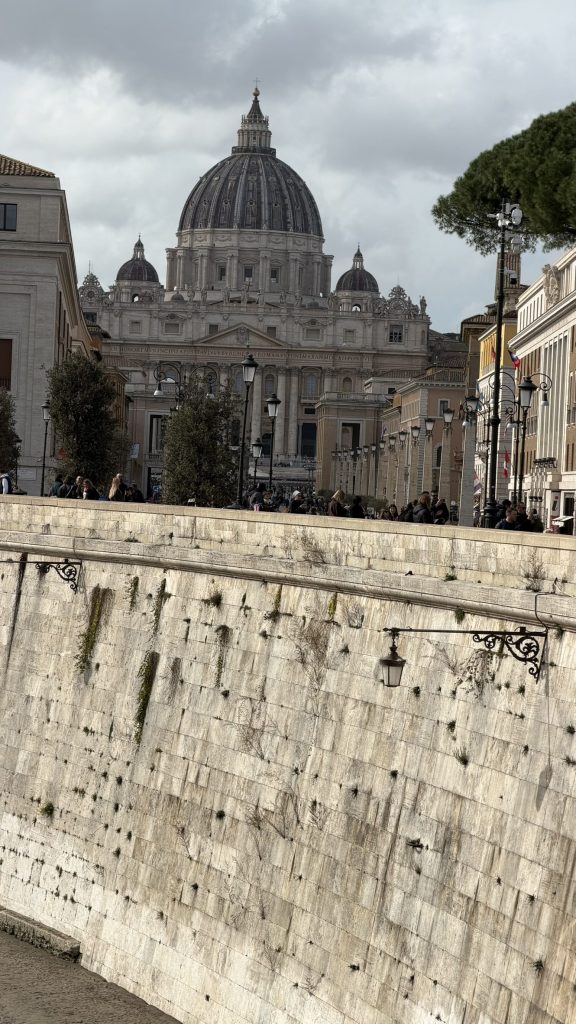
At the top there’s a large square, and from there we caught our first distant glimpse of the famous dome of St. Peter’s Basilica in the Vatican.


Then back to the City of Water.
The space is small, and the air isn’t particularly good. You see amphorae, a water channel, and a few other archaeological remains. Nothing that caused great excitement, but it does help you imagine a little better how Rome has been built layer upon layer over the centuries.


Let’s go back up to the surface.
We immediately found ourselves in the crowd. The street here is narrow, which only makes the feeling of congestion even stronger.
Slowly we managed to get a bit closer, but when you keep bumping into people and at the same time making sure the girls don’t get lost somewhere in the crowd, the view of the fountain somehow loses much of its charm.
So we turned into a nearby shop instead. Inside there were stairs leading up to what looked like the first floor. I thought maybe there would be a window up there with a better view of the fountain, and above all, a little more peace and quiet. The girls went their way, and I headed upstairs.
Apparently I wasn’t the first to have that idea. Many people had clearly thought of it before me. So many, in fact, that the windows had been half covered with tape.
But I wasn’t giving up.
Somewhere between women’s blouses and rows of jeans, I pushed my way through the clothing racks to the window, stood on my toes… and pressed my face against the glass.


We knew we were supposed to toss a coin as well, but with a crowd like that it simply wasn’t possible.
Maybe next time. And with that thought, we left the fountain behind.
Towards the Spanish Steps
The day was beautiful, so there was no need to rush anywhere. We decided to walk to Piazza di Spagna and lose ourselves a little in the streets along the way.
As you walk through Rome, you often notice manhole covers in the pavement marked with the letters S.P.Q.R.

Wait a minute. I had seen this somewhere before. Weren’t these the letters carried by Roman soldiers?
So I did a bit of digging. The abbreviation stands for Senatus Populusque Romanus – The Senate and the People of Rome – the official symbol of ancient Rome. It once appeared on the standards of the Roman legions and on public buildings across the empire.
Today, the city of Rome still uses it as its emblem, which is why you’ll spot it all over the place: on city crests, manhole covers, fountains, street lamps, and other public fixtures around town.
Every now and then the view opened up toward a beautiful fountain somewhere along the way. At one point we took a wrong turn and briefly climbed uphill, but eventually we found the right street, where an obelisk at the end leads you straight to the top of the Spanish Steps.


Spanish Steps
The obelisk was made in Rome, so in a way it’s a kind of Temu version of an Egyptian original. No, no, it’s actually quite beautiful. To the right of it stands the church that is, in fact, the reason the famous steps exist below.
In short: at the top of the hill stands the French church Trinità dei Monti, while at the bottom lies Piazza di Spagna, named after the Spanish embassy. The Spanish Steps between them were built in the 18th century. The project was led by Rome, the money came from a French diplomat, and the name remained Spanish. Rome is simply a city where different nations meet on the same staircase without much trouble.
One of the most famous scenes from the film Roman Holiday takes place right here on the Spanish Steps. Princess Ann, played by Audrey Hepburn, escapes royal protocol for a day, sits on the steps, and eats gelato. A journalist, played by Gregory Peck, notices her there. The year was 1953.
Today, sitting on the steps is no longer allowed. It was quite amusing to watch the tireless guards blowing their whistles and chasing away tourists who wanted, for a brief moment, to become Audrey Hepburn and sit down on those famous steps.

And if they catch you with a gelato, it’s even worse.
The fine: €250.
Piazza del Popolo
If you want to get from here to Piazza del Popolo, it’s easy. Just follow the next obelisk at the end of the street. This one, unlike the previous one, is the real thing. In fact, it’s one of the oldest objects in the city.
Around 3,500 years ago, it stood in a temple of the sun god in the Egyptian city of Heliopolis. During the reign of Emperor Augustus, it was brought to Rome and placed in the center of the Circus Maximus. After the fall of the Roman Empire, it was forgotten for a long time, until it was eventually restored and erected here on Piazza del Popolo, where it now serves as an impressive gateway for anyone entering Rome from the north.


When you turn back toward the Spanish Steps, three perfectly straight streets lead from here toward the city center. At the entrance of two of them stand twin churches. At first glance they look almost identical, and together they create a sense of perfect symmetry on the square.

After a full day of walking, we had had enough of Rome for today.
Luckily, there was a metro station nearby, so we were soon back in our apartment in Monti.
Tomorrow we’re heading to Ostia Antica, once the main port of ancient Rome.
When we return to the city later, we’re also thinking about visiting the Baths of Caracalla.

Useful Links
- 🏛️ Pantheon visitor information and tickets
- ⛲ Piazza Navona Bernini’s Fountain of the Four Rivers
- 🎨 Church of Sant’Ignazio di Loyola the famous optical illusion dome
- 💧 Vicus Caprarius The City of Water
- ⛲ Trevi Fountain one of the most famous fountains in the world
A family travel blog written day by day, just as we truly experience our journeys.
Our current, completed, and upcoming trips, written day by day.


