
This post is part of the travel series
Barcelona Family Trip – A Day-by-Day Travel Diary,where the entire journey is told as a story from the first to the last day.
Like Seeing a Ghost
Anja checked her temperature in the morning. It was right on the edge again, but she said she felt fine. We decided to stick with the original plan for the day and head toward La Rambla. If anything felt off, we would turn back.
I went down to the front desk a bit earlier to order a taxi, but before I even said a word, I was met by the receptionist’s completely pale face. Clearly shaken, she asked me twice in a row if I was coming from room B17. Twice I told her no, that I was from the neighboring B16.
She looked so confused that I started to doubt myself about which room I was actually staying in.
When her supervisor came over, the three of us slowly managed to piece it together and confirm that I was indeed from B16.
What all that early-morning drama was about, I’ll probably never know.
But somehow, from that day on, the strange burnt smell in our bathroom was gone.
The Metro
We always get around the city by metro. It’s a simple system. You follow the colors and watch the direction of the final station. The only place where I’ve ever fully surrendered was New York, where even after a week I still couldn’t make sense of the famous mix of numbers, letters, and multi-level stations.
I still remember how we all waited, slightly tense, to see which station would appear next. Would it be a moment of triumph, or would we hear:
“I guess Dad got it wrong again.”

Compared to that, Barcelona’s metro is simple. You follow the colors, one direction on one platform, the other on the opposite side. There are plenty of escalators, the stations are spacious enough, but empty, without any artistic or iconic features. They are just ordinary places where you wait for a train. As if they’re quietly telling you:
Hey, Barcelona is up there, not down here.!
As everywhere, there are several types of tickets you can buy at the station here as well.
For us, the most practical option was the T-familiar, which gives you eight rides for just over €12. The advantage is that you only need one card for the whole family. In our case, we simply validated it four times each time we entered.

Honestly, we only used the metro on the last day, so I can’t say that much about it. But when we did, it worked perfectly well. The trains ran frequently, they were busy but manageable, and in every car there was a display showing which station you were at, plus announcements telling you what was coming next. It was hard to miss anything.
Taxi
Anja still wasn’t fully back to herself, so we adjusted and used taxis instead. They’re easy to spot in their black-and-yellow colors, even from a distance. Apart from the first day, when we really needed one, I don’t remember ever waiting more than a minute. Rides cost around €10 and you can pay by card, so roughly twice as expensive as the metro.
La Rambla

The taxi dropped us off at a traffic light, and suddenly we were standing at the beginning of the city’s main promenade, almost a kilometer long. It’s bordered by Plaça de Catalunya to the north and ends at the Columbus Monument and the harbor to the south. It was once a dry riverbed that, during heavy rains, served as the old city’s sewer. Today it separates the Barri Gòtic, the oldest part of the city, from El Raval, a former working-class neighborhood below Montjuïc.
Wikipedia adds that it’s a wide pedestrian promenade shaded by plane trees. Well… here we go again.
What on earth is a plane tree?
It’s a hardy, fast-growing tree that handles urban heat, pollution, and compacted soil extremely well. That’s why, when European boulevards and promenades were being laid out in the 19th century, it became the tree of choice.

So basically, the king of street trees in Paris, Madrid, Vienna, and Barcelona and we were hearing about it for the first time.
La Boqueria: Dancing Shrimp and Octopus on a Stick
As we walked down La Rambla, even the plane trees couldn’t improve the view of the promenade, because it was completely torn up. Fences and construction equipment were everywhere, squeezing the already large crowds into even narrower streams.

Most people soon turned right, where the steel-and-glass entrance to La Boqueria suddenly opens in front of you.
One of Spain’s most famous markets greets you with chocolate in countless forms the moment you step inside. And just in case that isn’t enough, ten meters later they add strawberries to the mix.

The explosion of colors and flavors continues with spices, then shifts into the seafood section, where the girls were horrified to discover that the shrimp were still moving, while at the opposite stall you could buy octopus on a stick. At that point, you can honestly say you’ve seen it all and head for the exit.

Plaça Reial and a Young Gaudí
You follow the river of people toward the harbor. That’s where most of them are going, but we soon turn left instead. We arrive at the charming Plaça Reial, full of palm trees and almost free of tourists. Gaudí doesn’t begin with the Sagrada Família, but right here, where a young Antoni Gaudí designed the street lamps as one of his first public works for the city.

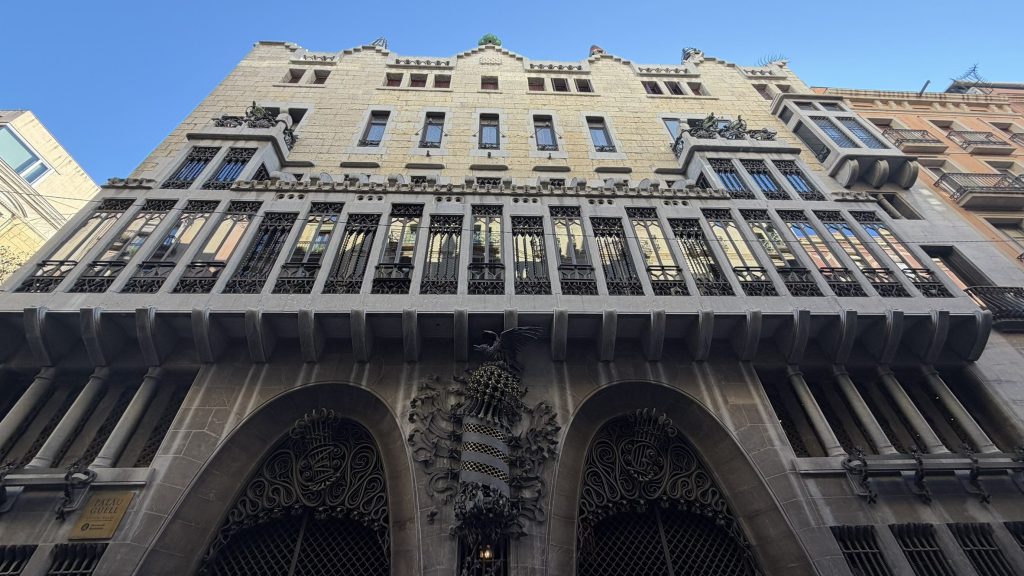
When you cross La Rambla again from the square, you can also see his first architectural work, the Palau Güell, an example of a 19th-century urban palace.
The Spanish Galley
Here the construction finally stopped, and we could walk more freely past the street painters and performers toward the Maritime Museum.


I remembered how, back in school, we were taught about Spain as a great maritime power and how the Spanish galley always came up. I wanted the girls to see one with their own eyes, since all that history still lies ahead of them in the upper grades. And here it was: an almost 60-meter-long replica of the 16th-century royal galley Real.


The museum was almost empty, and we stayed for more than an hour, because it’s not just the galley. There are many other ship replicas, informational films, and interactive displays as well.
The Columbus Monument
You’ve just been admiring an almost 60-meter-long Spanish galley inside the museum, and a moment later you’re outside, looking up at a 60-meter-tall monument to the explorer who discovered America. His connection to Barcelona is that this is where he first stopped to report his discovery to the king and queen. La Rambla ends at the monument, but because it’s aligned with his outstretched right arm, you could say it symbolically continues toward the Mediterranean and, from there, on to the New World.

Port Vell
After a little over a kilometer on La Rambla, which took us a good three hours with all the stops and detours, we took a break for a snack at the harbor. There’s something especially nice about sitting by the sea in winter and enjoying the view. Although calling it “winter” might be a stretch. It was around 15°C.
Crossing the Rambla de Mar, the pedestrian bridge over the harbor, you pass the marina and soon find yourself in front of the Maremagnum shopping center. You can go shopping, or you can watch the cable car cabins slowly rising toward Montjuïc.

We found a taxi and rode to the Ciutat Vella district, where another city landmark was already waiting for us.
Palau de la Música Catalana
In one sentence: a concert hall with a beautiful glass ceiling.

And that was it. We looked around, sat for a while, and left.
If I were planning it again, I wouldn’t pay for this. I’m sure that with a concert the acoustics must be a real treat, but as a tourist visit, especially with kids, it’s just so-so.
Postcards and Stamps
Since we finished so quickly, we went souvenir shopping and picked up the two postcards we always send on our trips, one to my parents and one to a colleague in Denver, Colorado. The stamps are sold separately in tobacco shops.
Barcelona Cathedral
Anja was feeling better, so we decided to walk to the main entrance of Barcelona Cathedral, which had somehow escaped us the last time. This time we found it. When you come in through the narrow Carrer del Dr. Joaquim Pou and the view suddenly opens up…
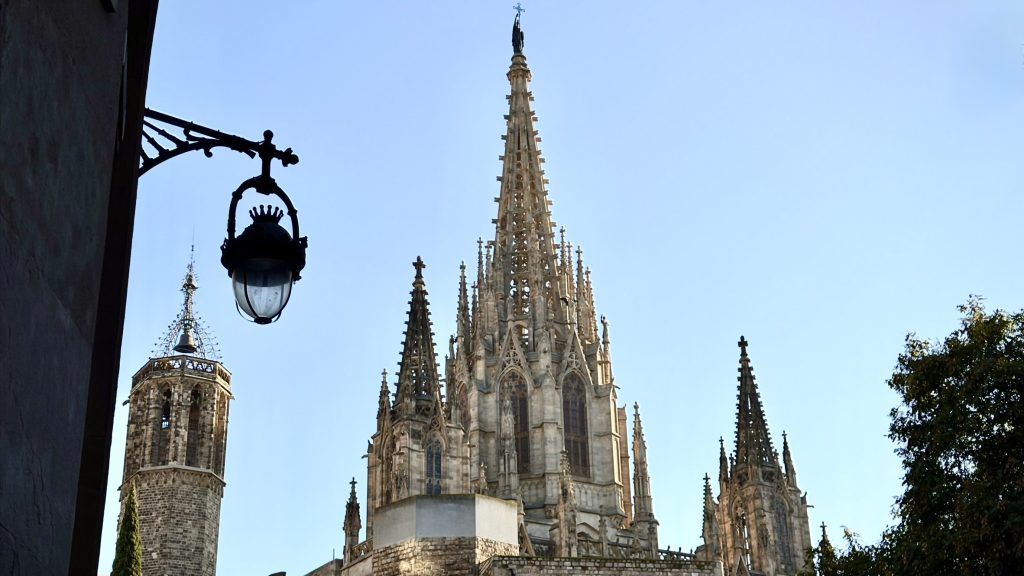
Compared to this cathedral, with construction that began in the 13th century and a façade that wasn’t completed until the early 20th, the Sagrada Família and its 140 years of building is practically an apprentice. Seen that way, the Sagrada is actually a very well-run project, since it will be finished several centuries earlier.
In front of the cathedral, a street performer was giving a show, a photographer was capturing the moment for a young couple posing in front of it, and we were slowly wandering around the massive façade instead of going inside. Only later, back home, did I read that we could have gone in for free because we happened to be there at exactly the right time. Maybe next time.

Kiss
The plan was to walk back to where our day had begun, to Plaça de Catalunya, so first we passed a contemporary art installation on a wall titled:
The World Begins with Every Kiss.
From a distance it looks like one large kiss, but as you get closer you realize it’s made up of thousands of photographs.

They were sent in by people from all over the world, each one showing what a moment of freedom means to them. It’s also a well-known TikTok spot, so the crowds come with the territory.
Evening in Barcelona
By the time we reached the square, the streetlights were just coming on, along with all the New Year’s decorations.
The next masterpiece was only a short ten-minute walk away, along Passeig de Gràcia. It turned out to be the most beautifully decorated street we saw on the entire trip.

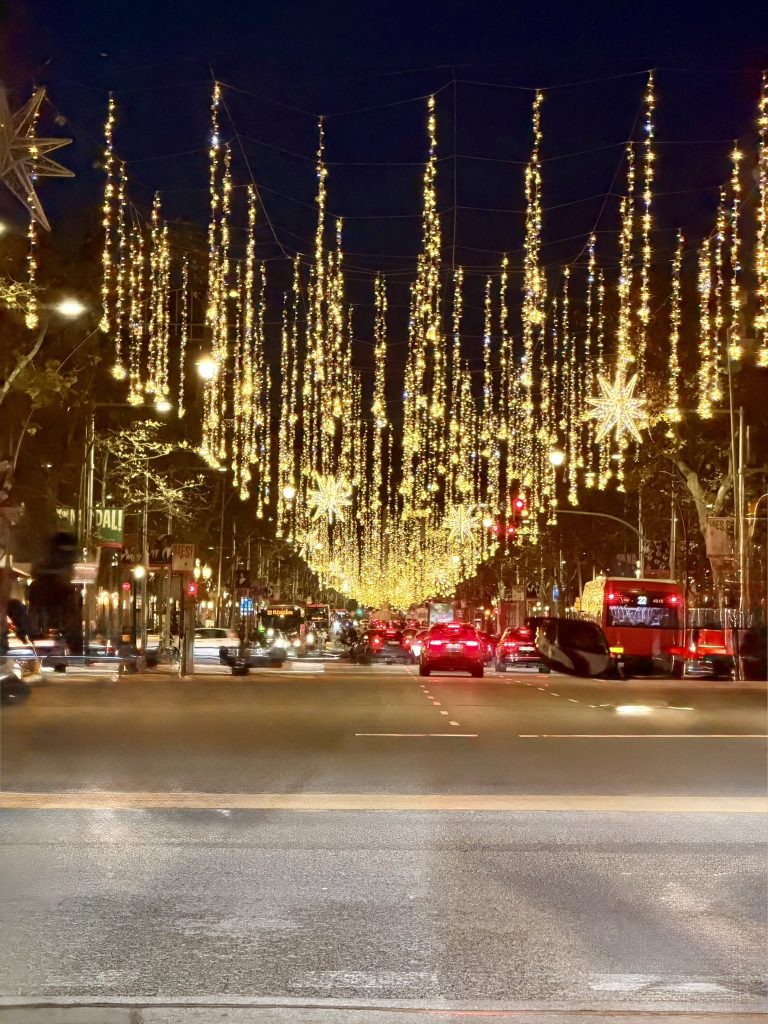
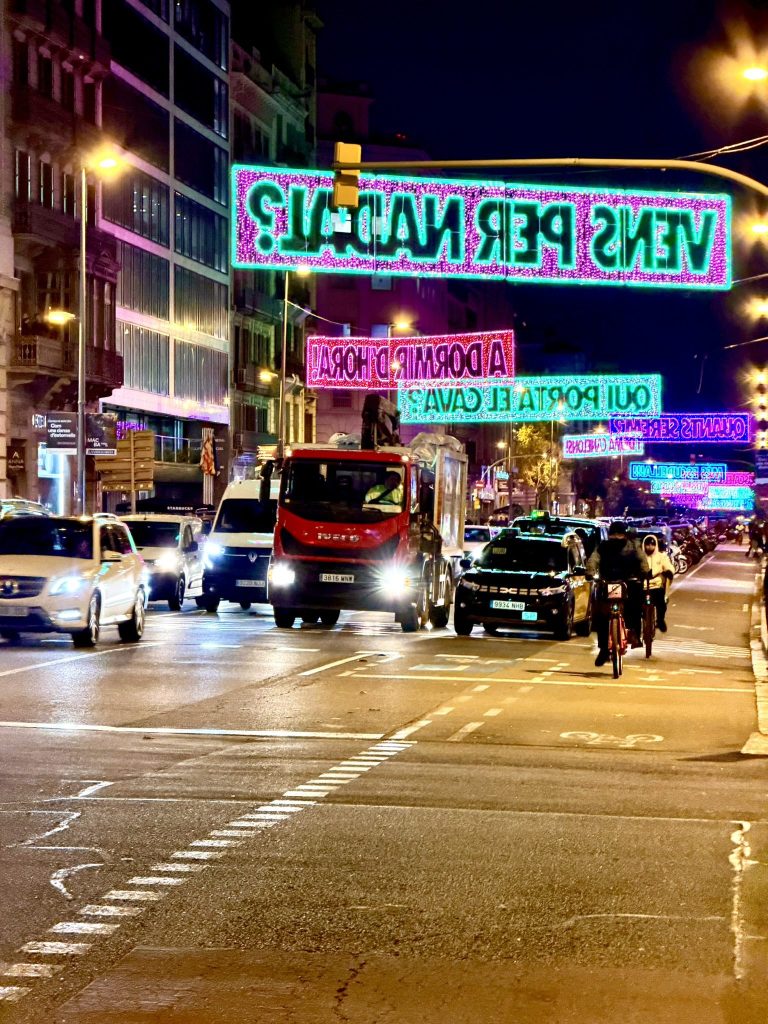
We were making good progress until shop windows started appearing along the sides.
Illogical
Of course they went inside, and with more than a decade of experience as a husband and a father to two girls, I stayed outside.
I watched them move around the store and knew it would take a while. So I used the time to find the best possible spot to photograph the decorated street. That spot, of course, turned out to be in the middle of the road, so I kept walking back and forth across the crosswalk. On what must have been my fifth or sixth crossing, I caught out of the corner of my eye that the girls were now being accompanied by a saleswoman.

A sign that it was time to stop taking photos and head back. The light finally turned green and I crossed the street just as they were stepping out of the store. Empty-handed.
One of those mysteries of the universe I will probably never understand: why go into a store if you’re not going to buy anything?
Casa Batlló
One of Gaudí’s most famous houses, with a wavy façade that looks as if it’s made not of stone but of water, balconies that resemble bones, and, as the final touch, light that changes color every few minutes.


We had started the morning on La Rambla, with the street lamps of a young Gaudí at Plaça Reial and his first architectural masterpiece, the Palau Güell, so it felt only right to end the evening here as well.
Tomorrow is the last day of the year, and his greatest creation is waiting for us: the Sagrada Família.

🧭 Useful Links
- 🚇 Public Transport Public Transport Barcelona – metro and tickets
- 🍓 La Boqueria Mercat de la Boqueria – official market website
- 🌴 La Rambla La Rambla – Barcelona’s main promenade
- ⚓ Maritime Museum Maritime Museum of Barcelona
- 🎶 Palau de la Música Palau de la Música Catalana
- ⛪ Cathedral Barcelona Cathedral – information and visiting
- 🏛️ Casa Batlló Casa Batlló – Gaudí’s masterpiece
A family travel blog written day by day, just as we truly experience our journeys.
Our current, completed, and upcoming trips, written day by day.