Day 3: Classical Rome

This post is part of the travel series Family Journey to Rome, where the entire journey is told as a story from the first to the last day.
DAY 3 OF 7
Highlights of the Day
Pantheon and the Oculus
Bernini’s Elephant
Piazza Navona
Sant’Ignazio and the Illusion of the Dome
Hadrian’s Temple
Trevi Fountain
Spanish Steps
Piazza del Popolo
Quick Jump to the Day’s Logistics

Pantheon – the Temple of All Gods

After yesterday’s long and demanding day — walking through the mighty Colosseum, running from the rain, climbing the Palatine Hill, and then descending into the Roman Forum and the Imperial Forums — this morning felt far too early in every possible way.

Still a little sleepy, we somehow managed to get ourselves up, had breakfast, and a moment later were already trying to catch a taxi in Monti. It was too early to start figuring out the buses, and the metro doesn’t even go there.

Ten minutes later we were already standing in a new line.
This time in front of the Pantheon.

It’s best to buy the tickets online so you don’t have to deal with that in the morning — and with yet another queue.
Adults €5, children free.

Just the sight of the massive façade with its enormous Corinthian columns quickly drives away the sleepiness you were still fighting in the taxi only a few minutes earlier.

Panteon v Rimu z mogočnim pročeljem in korintskimi stebri, pred vhodom pa jutranja vrsta obiskovalcev na trgu Piazza della Rotonda.

As you search around the square for the best spot to photograph all those columns, you almost forget about the dome above them.

And yet the dome is actually the very essence of the Pantheon.

It is the largest unreinforced concrete dome in the world.

Which means there is nothing inside it — no mesh, no steel bars.

That is actually quite logical, since it was completed in AD 126. It stands purely because of its brilliant design, thick walls, and materials that become progressively lighter toward the top.

Zadnja stran Panteona v Rimu z masivnim starorimskim zidom in kupolo v ozadju.

How remarkable this achievement was is shown by the fact that Europe forgot this knowledge and rediscovered it only about 1,300 years later in Florence, when the dome of the cathedral Santa Maria del Fiore was built.

And even that one, constructed more than a millennium later, is still smaller than the original here in Rome.

Successors of this dome can be seen in several places we have visited on other journeys — in London, when we watched St Paul’s Cathedral across the Thames; in Washington, when we walked through the rotunda of the United States Capitol; and later right here, when we admired the dome of St Peter’s Basilica in the Vatican.

Kupola katedrale svetega Pavla v Londonu z značilno belo baročno arhitekturo, obdana z gradbenimi žerjavi nad mestnimi stavbami.
Kupola stavbe ameriškega Kongresa v Washingtonu z značilno rotundo in kipom Svobode na vrhu.
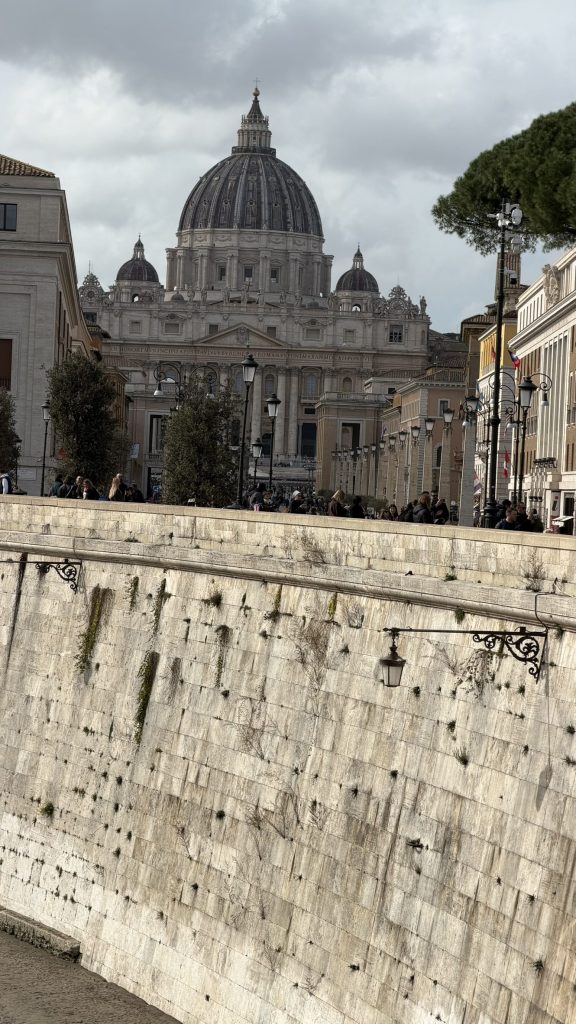
Kupola bazilike svetega Petra v Vatikanu, pogled z rimskih ulic proti mogočni renesančni kupoli nad mestom.

Just as we were standing in line waiting to be let inside, the morning sun suddenly rose above the neighboring buildings and almost blinded us. When you stepped into the nearby shade, however, that same sun offered a beautiful view of the building and its columns.

After the doors opened, the Pantheon almost swallowed us whole.

Once inside, of course, the first thing you do is look up, where a huge opening awaits — the oculus. A nine-meter-wide link between earth and sky, between gods and mortals, it is also the only source of light once the doors are closed.

Notranjost Panteona v Rimu z mogočno kasetirano kupolo in odprtino oculus, skozi katero vstopa svetloba nad obiskovalci.

What if it rains? Well, then it rains.

The Romans solved that quite simply. The floor has a slight slope and hidden drainage channels that have been working for almost two thousand years.

When you stand there in the middle, you look around, then up, and then around again. The distances seem almost the same.

And they are. It is as wide as it is high. If you placed a perfect sphere inside, the dome would touch its top and the floor its bottom.

The fact that the space is circular naturally invites you to walk around it.

Glavni oltar v Panteonu v Rimu pod bogato okrašeno zlato kupolo, danes cerkev bazilika svete Marije in mučencev.
Stranski oltar v Panteonu v Rimu z velikim križem in kipom Jezusa na križu v niši starodavne opečnate stene.
Grob renesančnega umetnika Rafaela v Panteonu v Rimu z marmornim kipom Madone z otrokom nad grobnico.

I didn’t know that Raphael, one of the greatest artists of the Renaissance, is buried here — usually mentioned in the same breath as Leonardo da Vinci and Michelangelo. Above his tomb is the inscription:

Here lies Raphael. Nature feared that he would surpass her while he lived, and when he died, she feared that she would die with him.

Now that’s confidence.

Today it is a church — more precisely the Basilica of St Mary and the Martyrs. That is why the earliest possible entry at nine o’clock on Sunday was perfect. An hour later the mass begins, and during that time you cannot buy tickets.

Just over half an hour later we were back outside on the square, which was steadily filling up.

Bernini’s Elephant and Santa Maria sopra Minerva

Not far away, hidden among the streets and houses, lies a small square where an elephant carrying an Egyptian obelisk on its back stands at the center.

The monument was designed by Bernini, the most important artist of the 17th century. What Michelangelo was to the Renaissance, Bernini was to the Baroque. In fact, he shaped a large part of the Rome we see today.

One of those images is this very elephant, which symbolizes wisdom and strength, while the obelisk represents ancient knowledge.

Berninijev slonček z egipčanskim obeliskom na trgu Piazza della Minerva pred cerkvijo Santa Maria sopra Minerva v Rimu.

The idea is simple: wisdom must be strong enough to carry the weight of knowledge.

It feels both charming and a little unusual, and there is another curious story connected to it. Bernini is said to have had a dispute with one of the neighbors on this square, and he supposedly expressed his anger quietly by turning the elephant’s backside directly toward their entrance.

Behind it stands the church Santa Maria sopra Minerva.

It is actually the only major Gothic church in Rome. It is best known for its blue ceiling.

Except it was closed.

Just as we were about to continue wandering through the city, about ten limousines suddenly appeared out of nowhere. I don’t know whether they had come for a wedding, a baptism, or something similar, but clearly something was going on. The square beneath the elephant filled up in an instant.

I noticed that the church doors had meanwhile opened, so I quickly seized the opportunity. I peeked inside just long enough to catch a glimpse of that famous blue ceiling, but soon the limousine visitors chased me back out again.

Notranjost cerkve Santa Maria sopra Minerva v Rimu z gotskimi oboki in značilnim modrim stropom nad ladjo cerkve.

Only later, when I looked at the photo, did I realize how large the church actually is — and that it really does have a blue ceiling. Why it is blue, I don’t know. Probably so that in all that enclosed vastness you still have at least a small feeling of blue sky above you.

It was time to move on again.

On the way to Piazza Navona, we tried in vain to find the entrance to Palazzo della Sapienza, where a church with an interesting spiral tower is said to stand in the inner courtyard.

After circling the building from three sides, we noticed a few souvenir shops nearby that were convincing enough for us to abandon the search for the entrance.

But this is also one of the curses of Rome for us tourists. Behind almost every street and almost every building there is another square, another ancient ruin, or yet another church. A curse in the sense that there is simply so much — so much that is interesting and beautiful — that there is never enough time to see it all.

Sometimes it is almost better when something is closed. Otherwise you would never get anywhere.

Piazza Navona

You step out of the shop onto the street, take a few steps, and just beyond the corner of the first building, one of the most beautiful squares in Italy opens up on your right in its full length.

Pogled na trg Piazza Navona v Rimu z cerkvijo Sant'Agnese in Agone ter Berninijevo fontano štirih rek.
Fontana del Moro na trgu Piazza Navona v Rimu z obeliskom Fontane dei Quattro Fiumi v ozadju.
Fontana del Nettuno na severnem koncu trga Piazza Navona v Rimu.

In Roman times, this space was a stadium. Many people, myself included, probably assumed that horse races took place here, because the square has that distinctive elongated oval shape.

Although it always seemed a bit strange to me why there would be another racing arena so close to the Circus Maximus.

But that was not the case. No horses at all. This was the Stadium of Emperor Domitian, where sporting competitions were held, mainly running, jumping, and other athletic events. After the fall of the Roman Empire, the stadium slowly fell into ruin. Much of the stone was taken by local residents and reused for new buildings, but the shape of the space remained. Over time, the ancient stadium gradually transformed into a city square.

The square received its final appearance during the Baroque period, when the popes reshaped it with palaces, churches, and fountains. And here, once again, Bernini appears in the story.

In the middle of the square stands his famous fountain, the Fontana dei Quattro Fiumi. It represents four great rivers of the known world at the time: the Danube, the Nile, the Ganges, and the Río de la Plata.

As we were walking toward it, someone was playing Mozart on the cymbals, which added even more to the pleasant atmosphere.

Ulični glasbenik igra na cimbale na trgu Piazza Navona v Rimu.

The fountain is surrounded by four statues of river gods. The girls and I tried to figure out which one represents which river. The easiest to recognize is the Nile, as the river god is covering his face. Why? Because at the time the fountain was built, the source of this longest river in the world was still unknown.

Kip rečnega boga Nila na Berninijevi fontani Fontana dei Quattro Fiumi na trgu Piazza Navona v Rimu.
Berninijeva Fontana dei Quattro Fiumi na trgu Piazza Navona v Rimu z egipčanskim obeliskom.
Kip rečnega boga Río de la Plata na Berninijevi fontani Fontana dei Quattro Fiumi na trgu Piazza Navona v Rimu.

An interesting story is often told about the statue representing the Río de la Plata. Directly opposite the fountain stands the church of Sant’Agnese in Agone, designed by Bernini’s rival, Borromini. The statue, which appears somewhat frightened, raises its hand in front of its face as if afraid that the church might one day collapse on top of it.

In reality, the story has little to do with the facts, since the church was built later and Bernini could not have known what it would look like. Still, it remains a curious coincidence.

While the girls were enjoying the sunshine on the square, I stepped inside to take a quick look at the church.

Bogato poslikana kupola in notranjost cerkve Sant'Agnese in Agone na trgu Piazza Navona v Rimu.

Coffee time.

Not far from Piazza Navona is also Piazza Argentina, the place where Julius Caesar was assassinated. I’m not quite sure why I didn’t include it in our plan. Apparently, coffee felt more important at that moment.

So we headed back toward the Pantheon, where we were greeted by a wall of people. Those two lines in the morning, when we were standing there earlier, seemed almost funny in comparison. Crossing the square felt more like pushing our way through a sea of people.

Church of Sant’Ignazio di Loyola

Along Via del Seminario we walked to our next stop, a church that has become a real hit thanks to TikTok.

Right at the entrance you’re greeted by a long line. Not to get inside, but to take a selfie. We definitely wouldn’t stand in a queue for something like that, and the girls are still too young for the TikTok phase, so we simply walked past the line and went straight into the church.

So what’s the whole point?

The church has a stunning ceiling painting. If you stand in a very specific spot, the ceiling suddenly looks three-dimensional, as if the ceiling is opening up into the sky. At that exact place they’ve set up a large screen that works like a mirror, which is why people sometimes wait for hours just to take that selfie.

Is it worth standing in line for it? I’m not sure. Everyone has their own kind of fun. We just stepped about half a meter away from the screen, tilted our heads back a little, and it looked just as good.

Stropna freska v cerkvi Sant'Ignazio di Loyola v Rimu z znamenito baročno iluzijo odprtega neba.
Narisana kupola v cerkvi Sant'Ignazio di Loyola v Rimu – znamenita baročna optična iluzija na ravnem stropu.

A selfie with a 17th-century fresco was simply not on our list.

But there is another story here, about the dome.

They originally wanted to build one so the church would look even more impressive. But a problem appeared. Such a construction would have blocked the light and the view for the neighboring monastery. Naturally, the monks complained.

And that was the end of the plan. Instead, they came up with a clever solution: they simply painted the dome.

And it works. If you’re not paying close attention, it really looks like a real dome rising above you. In reality, it’s painted on a completely flat surface. A brilliant optical illusion.

When we stepped out of the church, the selfie line had already stretched deep into the street.

Looking at the massive façade of the church, I found myself scanning the square for a statue of an elephant, but there was none.

Baročno pročelje cerkve Sant'Ignazio di Loyola v Rimu na ulici Via del Seminario.

And if there had been one, we all know exactly where its backside would have been pointing.

Hadrian’s Temple

From here it’s just a few steps into the next street, and suddenly you find yourself standing in front of a former temple dedicated not to a god, but to Emperor Hadrian.

Today, mostly the columns remain. But even those are enough to immediately tell a tourist from a Roman.

Pogled ob stebrih Hadrijanovega templja na Piazza di Pietra v Rimu ob ozki mestni ulici.
Stebri Hadrijanovega templja na Piazza di Pietra v Rimu, ostanek antičnega templja cesarja Hadrijana.

The one standing still and looking up is a tourist. The one walking past as if those eleven fifteen-meter columns of Egyptian marble didn’t even exist is a Roman. Makes sense. He’s probably walked past them a million times.

For us amateurs, though, it was a completely different experience.

Trevi Fountain

The closer we got, the more crowded the streets became.

But just one street before you reach it, there’s a sign for Vicus Caprarius – which translates as Goat Street. And why would you turn in here?

Because this is where an archaeological site known as the City of Water is located. Down there, about five meters below the current street level, you can see the remains of Roman buildings, a water channel, and part of the aqueduct that still feeds the famous fountain nearby.

There was no line when we arrived, but the number of visitors is limited, so we had to wait for the next entry slot. Enough time to climb the nearby Quirinal Hill, where the Italian presidential palace stands today.

At the top there’s a large square, and from there we caught our first distant glimpse of the famous dome of St. Peter’s Basilica in the Vatican.

Kvirinalska palača na Piazza del Quirinale v Rimu, uradna rezidenca predsednika Italije na Kvirinalskem griču.
Pogled čez strehe Rima proti kupoli bazilike svetega Petra v Vatikanu, ujete med gradbenim žerjavom nad mestom.

Then back to the City of Water.

The space is small, and the air isn’t particularly good. You see amphorae, a water channel, and a few other archaeological remains. Nothing that caused great excitement, but it does help you imagine a little better how Rome has been built layer upon layer over the centuries.

Podzemni prostori arheološkega najdišča Vicus Caprarius – Mesto vode pri fontani Trevi v Rimu, z osvetljenimi rimskimi zidovi in hodniki.
Ostanki rimskega vodnega sistema in kamnitih stopnic v arheološkem najdišču Vicus Caprarius – Mesto vode pri fontani Trevi v Rimu.
Arheološki predmeti in najdbe iz rimskega obdobja, razstavljeni v podzemnem kompleksu Vicus Caprarius pri fontani Trevi v Rimu.

Let’s go back up to the surface.

We immediately found ourselves in the crowd. The street here is narrow, which only makes the feeling of congestion even stronger.

Slowly we managed to get a bit closer, but when you keep bumping into people and at the same time making sure the girls don’t get lost somewhere in the crowd, the view of the fountain somehow loses much of its charm.

So we turned into a nearby shop instead. Inside there were stairs leading up to what looked like the first floor. I thought maybe there would be a window up there with a better view of the fountain, and above all, a little more peace and quiet. The girls went their way, and I headed upstairs.

Apparently I wasn’t the first to have that idea. Many people had clearly thought of it before me. So many, in fact, that the windows had been half covered with tape.

But I wasn’t giving up.

Somewhere between women’s blouses and rows of jeans, I pushed my way through the clothing racks to the window, stood on my toes… and pressed my face against the glass.

Pogled iz trgovine na množico turistov pred fontano Trevi v Rimu, fontana se vidi skozi izložbeno okno med napisi na steklu.

We knew we were supposed to toss a coin as well, but with a crowd like that it simply wasn’t possible.

Maybe next time. And with that thought, we left the fountain behind.

Towards the Spanish Steps

The day was beautiful, so there was no need to rush anywhere. We decided to walk to Piazza di Spagna and lose ourselves a little in the streets along the way.

As you walk through Rome, you often notice manhole covers in the pavement marked with the letters S.P.Q.R.

Pokrov kanalizacije z napisom SPQR na ulici v Rimu, simbol Senatus Populusque Romanus na mestni infrastrukturi.

Wait a minute. I had seen this somewhere before. Weren’t these the letters carried by Roman soldiers?

So I did a bit of digging. The abbreviation stands for Senatus Populusque Romanus – The Senate and the People of Rome – the official symbol of ancient Rome. It once appeared on the standards of the Roman legions and on public buildings across the empire.

Today, the city of Rome still uses it as its emblem, which is why you’ll spot it all over the place: on city crests, manhole covers, fountains, street lamps, and other public fixtures around town.

Every now and then the view opened up toward a beautiful fountain somewhere along the way. At one point we took a wrong turn and briefly climbed uphill, but eventually we found the right street, where an obelisk at the end leads you straight to the top of the Spanish Steps.

Fontana del Tritone na trgu Piazza Barberini v Rimu, kip Tritona fotografiran skozi rožnate cvetove v ospredju.
Prometna rimska ulica Via Sistina z majhnimi avtomobili in starimi stavbami v smeri Španskih stopnic.
Pogled po ulici Via dei Condotti v Rimu proti obelisku na vrhu Španskih stopnic pri cerkvi Trinità dei Monti.

Spanish Steps

The obelisk was made in Rome, so in a way it’s a kind of Temu version of an Egyptian original. No, no, it’s actually quite beautiful. To the right of it stands the church that is, in fact, the reason the famous steps exist below.

In short: at the top of the hill stands the French church Trinità dei Monti, while at the bottom lies Piazza di Spagna, named after the Spanish embassy. The Spanish Steps between them were built in the 18th century. The project was led by Rome, the money came from a French diplomat, and the name remained Spanish. Rome is simply a city where different nations meet on the same staircase without much trouble.

One of the most famous scenes from the film Roman Holiday takes place right here on the Spanish Steps. Princess Ann, played by Audrey Hepburn, escapes royal protocol for a day, sits on the steps, and eats gelato. A journalist, played by Gregory Peck, notices her there. The year was 1953.

Today, sitting on the steps is no longer allowed. It was quite amusing to watch the tireless guards blowing their whistles and chasing away tourists who wanted, for a brief moment, to become Audrey Hepburn and sit down on those famous steps.

And if they catch you with a gelato, it’s even worse.

The fine: €250.

Piazza del Popolo

If you want to get from here to Piazza del Popolo, it’s easy. Just follow the next obelisk at the end of the street. This one, unlike the previous one, is the real thing. In fact, it’s one of the oldest objects in the city.

Around 3,500 years ago, it stood in a temple of the sun god in the Egyptian city of Heliopolis. During the reign of Emperor Augustus, it was brought to Rome and placed in the center of the Circus Maximus. After the fall of the Roman Empire, it was forgotten for a long time, until it was eventually restored and erected here on Piazza del Popolo, where it now serves as an impressive gateway for anyone entering Rome from the north.

Egipčanski obelisk na trgu Piazza del Popolo v Rimu, viden na koncu ravne ulice Via del Corso med rimskimi stavbami in prometom.
Fontana Dea di Roma na trgu Piazza del Popolo v Rimu z monumentalno kiparsko skupino in razgledno teraso Pincio v ozadju.
Vrata Porta del Popolo na trgu Piazza del Popolo v Rimu, zgodovinski vhod v mesto, skozi katerega so v Rim prihajali popotniki po Via Flaminia.

When you turn back toward the Spanish Steps, three perfectly straight streets lead from here toward the city center. At the entrance of two of them stand twin churches. At first glance they look almost identical, and together they create a sense of perfect symmetry on the square.

After a full day of walking, we had had enough of Rome for today.
Luckily, there was a metro station nearby, so we were soon back in our apartment in Monti.

Tomorrow we’re heading to Ostia Antica, once the main port of ancient Rome.
When we return to the city later, we’re also thinking about visiting the Baths of Caracalla.

Zemljevid poti tretjega dne v Rimu od Montija preko Panteona, Navone in Fontane Trevi do Španskih stopnic in Piazza del Popolo
DAY ROUTE
🏠 Via Urbana, Monti morning walk from the apartment toward the Pantheon
🏛️ Pantheon the great dome with the oculus and Raphael’s tomb
🐘 Piazza della Minerva Bernini’s elephant and the church of Santa Maria sopra Minerva
⛲ Piazza Navona the Fountain of the Four Rivers and the church of Sant’Agnese in Agone
🎨 Sant’Ignazio di Loyola the famous optical illusion ceiling
🏛️ Hadrijanov tempelj ancient columns at Piazza di Pietra
⛲ Trevi Fountain the most famous fountain in Rome
🏛️ Piazza Barberini Bernini’s Triton Fountain
🪜 Spanish Steps Trinità dei Monti above Piazza di Spagna
🏛 Piazza del Popolo Egyptian obelisk and the twin churches
👨‍👩‍👧‍👧 WHO ARE WE?
ODPOTUJ

A family travel blog written day by day, just as we truly experience our journeys.

STARTING POINT
🇬🇧 🇮🇹  All journeys 🇵🇹 🇪🇸

Our current, completed, and upcoming trips, written day by day.

Day 4: Rome Beyond the Postcards

Pogled z Aventinskega griča na kupolo svetega Petra in rimski akvadukti v Parco degli Acquedotti ob večerni svetlobi, zaključek dneva izven klasičnega Rima
This post is part of the travel series Family Journey to Rome, where the entire journey is told as a story from the first to the last day.
DAY 4 OF 7
Highlights of the Day
Trevi Fountain without the crowds
Ostia Antica
Basilica of St Paul Outside the Walls
Aventine Hill and views toward the Vatican
Circus Maximus and the aqueducts
Quick Jump to the Day’s Logistics

Trevi Fountain

I woke up very early today. The girls were still asleep, so I got ready and quietly slipped out of the apartment. The streets were empty as I passed the large exhibition hall on Via Nazionale and turned toward the tunnel beneath the Quirinal Hill.

Razsvetljena Palazzo delle Esposizioni na Via Nazionale v Rimu zgodaj zjutraj na poti proti Fontani di Trevi

After just under 20 minutes, I arrived at the same place where only yesterday we could barely move through the overwhelming crowd.

This time, there were maybe fifty of us. Access to the fountain was free in the early morning; they only start charging later in the day.

Dawn was slowly breaking. The sky was still dark, which made the white façade in front of me feel even more dramatic.

Fontana di Trevi v Rimu zgodaj zjutraj z dramatičnim modrim nebom in osvetljenim belim pročeljem

It depicts the arrival of water into Rome. At the center stands Neptune as the master, surrounded by horses and Tritons representing the unpredictable nature of water. This is also where the ancient Roman aqueduct Aqua Virgo ends — and through this very system, water still flows into the city two thousand years later.

In the morning, it felt completely different. Without the crowds, you experience it in another way. You can walk around it, take it in from every angle, and really see it in peace.

Detajl Fontane di Trevi v Rimu z vodo, skalami in osvetljenimi stebri ob modrem jutranjem nebu
Detajl kipa Neptuna v Fontani di Trevi v Rimu z vodnimi kipi in stebri v ozadju
Stranski pogled na Fontano di Trevi v Rimu z turkizno vodo in modrim jutranjim nebom brez gneče

Until the moment two Americans showed up with a hired photographer and took over the entire place — suddenly they were everywhere.

What stuck with me the most was the moment they were trying to pose for a shot and the guy just couldn’t quite get it right. And then, across the whole fountain, a voice rang out:

“Come on, we practiced this yesterday.”

That was too much for me. It completely took the magic out of the moment. So I left…

… and made my way back through the slowly waking streets of Rome to the girls.

Pogled po ulici v rimskem Montiju proti baziliki Santa Maria Maggiore z veliko kupolo v ozadju

Ostia Antica – a day trip from Rome

Today we were heading out to Ostia Antica, the main port of ancient Rome. This is where ships arrived with grain from Egypt, olive oil from Hispania, and wine from across the Mediterranean. Everything Rome needed to function — from basic food to everyday luxury — first passed through here.

And this is where a day begins that is no longer Rome from postcards.

It almost ended here, too.

But let’s start at the beginning.

A morning that starts with the essentials: coffee and breakfast. The girls had their chocolate cereal, we stuck to our usual, and then headed straight to the metro toward Roma Termini. It was only one stop away, but we had a feeling there would be a lot of walking ahead of us, so we took the easy option and saved a bit of energy for later.

As for the trip itself, one of its biggest advantages is how simple the logistics are. You just buy a metro ticket, and it takes you all the way to the archaeological site. The ride takes about half an hour. The landscape is flat, with some low shrubs, and every now and then you spot a tall umbrella pine in the distance. Other than that, there’s nothing particularly striking along the way.

The train was almost empty. When we got off, it was just us and a few locals. As we walked toward the old harbor, we hardly saw anyone at all. We even commented on what a contrast it was compared to the constant crowds in Rome, and how lucky we were to have the whole site almost to ourselves.

Metro na postaji Termini v Rimu tik pred odhodom proti Ostii Antici, mirno jutro brez gneče
Drevored pinij pri vhodu v Ostio Antico, miren dostop do arheološkega parka brez gneče

We turned left into a pleasant avenue lined with towering umbrella pines, and soon the entrance appeared ahead of us. Silence. No crowds, no lines. It all felt almost too good to be true.

I walked up to the ticket counter to buy the tickets, and the man simply said, “Closed.” Monday. Just like many archaeological sites across Italy.

Apparently common knowledge. First time hearing it myself.

In a matter of seconds, I went through all five stages of grief. First denial — this can’t be happening. Then anger — what do they mean it’s closed? Bargaining — what if I just ask nicely, maybe he’ll make an exception. And then resignation — nothing’s going to change, this just sucks.

Then I looked over at the girls. They burst out laughing. Apparently, they had just watched all those stages play out live on my face.

So I wrapped up the whole grieving process with acceptance — taking the situation for what it was, with a sense of relief.

Monday = closed

The fact that many museums and archaeological sites in Italy are closed on Mondays isn’t a coincidence. It’s actually a very practical decision.

Most of these places are at their busiest over the weekend. Saturday and Sunday are peak tourist days, so Monday has become a day to reset — for staff, maintenance, and cleaning.

Of course, this doesn’t apply to the major landmarks. Those can’t really afford to close, so they stay open almost every day. That’s why most tourists don’t even notice this pattern until they step a little off the usual path.

And that’s exactly where Monday catches you. Just like it caught us.

So in the end, all we could see from behind the fence was a single Roman road and a few building foundations. But the place clearly held much more than what that first glance revealed. Inside, there’s also a remarkably well-preserved theatre, similar to the one we saw in Tarragona while wandering through Catalonia.

Stara rimska kamnita cesta v Ostii Antici, obdana z drevesi in ostanki antičnega mesta
Ostanki rimskih stavb v Ostii Antici med zelenjem in drevesi, miren pogled na arheološko najdišče
Zemljevid arheološkega najdišča Ostia Antica z označenimi glavnimi potmi in objekti ob vhodu

Once we had fully come to terms with the fact that it was closed, two more visitors arrived from the station. You could see the excitement on their faces as they realized how quiet it was, almost no one around, no lines. As they walked past, I almost said something, but I didn’t want to be the one to ruin the moment.

Then the familiar story played out. Entrance. Tickets. Closed. Disappointment. Frustration.

found out they were Americans, and that this was their last day here. And just like that, in front of the closed gates of one of the best-preserved archaeological sites, there we stood — four Slovenians and two Americans — all disappointed, all for the same simple reason: it was Monday.

Medieval Castle in Ostia (Castello di Giulio II)

From the entrance, you walk along a tree-lined path for a few hundred meters — and almost a thousand years forward in time — until you reach a castle built in the Middle Ages.

Castello di Giulio II pri Ostii Antici, mogočna srednjeveška utrdba ob vhodu v arheološko najdišče

If Ostia was once a port at the height of Roman power, built for expansion, prosperity and conquest, this castle belongs to a very different time. A time of defense. A time when Rome was no longer conquering, but protecting itself.

As for us, we weren’t interested in any of that. Not conquest, not defense. We just wanted to catch the next train.

Basilica of St Paul Outside the Walls (San Paolo fuori le Mura)

Since it was right on the way, we got off and went to see it. This was already the second of the four “VIP” churches of the Catholic world. We had passed Santa Maria Maggiore, the first of them, on our very first day, while wandering through Monti with our suitcases, looking for our accommodation.

If the first is dedicated to Mary, the second is dedicated to Paul. The same Paul, the Apostle to the Gentiles, who first reported Christians to the authorities, then experienced a conversion, and ultimately became one of the key figures in spreading Christianity across the Roman Empire.

Because of his prominence and influence, Paul became an ideal scapegoat in the time of Nero. When Rome burned and someone had to be blamed quickly, the responsibility was shifted onto the Christians, who were already unwelcome. Today, it is generally believed that Nero himself most likely did not start the fire, and the exact cause remains unclear. Despite its monumental buildings, much of Rome was still largely built of wood, which only helped the flames spread faster.

Because Paul was a Roman citizen, he was not crucified but beheaded. He was buried on the spot where this church stands today. As the name suggests, the burial took place outside the city walls, which was completely typical for that time. His tomb is precisely the reason why this place has been an important pilgrimage site for centuries.

We began our own little pilgrimage by walking around the building instead of heading straight to the entrance. I’m not sure how we managed to miss it. Maybe because it’s so massive. You really feel that scale when you walk around three sides of it.

But once you finally find the entrance, it becomes clear why you came. One column after another, very few people, and a calm atmosphere all around.

Dvorišče bazilike San Paolo fuori le Mura z dolgimi vrstami stebrov in pogledom proti vhodu v cerkev

You step inside and immediately find yourself among the columns. They stretch out in front of you and to both sides, wherever you look. Then you move toward the center, where your view opens up to two palm trees, and between them stands Paul, holding a sword.

Above it all rises a colorful façade that immediately draws your eye. Beautiful. So much so that you simply have to sit down for a few minutes and just look.

Dolga vrsta marmornatih stebrov v hodniku bazilike San Paolo fuori le Mura, pogled proti vhodu v notranjost
Fasada bazilike San Paolo fuori le Mura z mozaikom in kipom svetega Pavla na dvorišču pred cerkvijo

And then we left the courtyard and headed back to the station.

Only now, as I’m writing this, have I asked myself for the first time why we didn’t go inside the church as well, even though we were just a few meters away. Apparently, it’s even more impressive inside.

And to this day, I still don’t know why we didn’t.

That courtyard must have captured us so completely that none of us even thought it might be worth stepping inside. Strange. At the time, we didn’t feel like we were missing anything.

Don’t be like us. If you’re there, go inside as well.

Anyway, we were already on the train toward the Pyramid of Cestius.

A Pyramid in the Middle of Rome

If you’re heading to the Aventine Hill, you get off at the Piramide station. Why that name? Because Egypt was something of a trend at the beginning of our era, and one Roman official decided to build himself a pyramid as his final resting place. And it’s really there. Just a few steps after you come out of the metro, it suddenly appears in front of you. It fits here about as well as a saddle on a cow. Another curious example of human vanity.

A different story are the city walls standing right next to it. Like every empire in history, Rome eventually reached a point when it was no longer only expanding, but also thinking about defense. That’s how the Aurelian Walls were built — nearly 20 kilometers long and more than 10 meters high. The pyramid was given a new role. Since it was already there, they simply incorporated it into the fortifications. If you already have something, why not use it.

Cestijeva piramida in Aurelijanovo obzidje v Rimu pod dramatičnim nebom, pogled čez široko mestno cesto

Even walls that powerful couldn’t stop what was coming. The Visigoths didn’t break into the city by force. They surrounded it, starved it out, and in the end the gates were opened from within. And just like that, Rome fell for the first time in centuries.

The Keyhole of Three Lands – and a line we didn’t join

The rain was getting closer. No point overthinking it, we took a taxi up the hill. Good decision, because it turned out not to be that close at all.

I asked the driver to drop us somewhere with a nice view over the city. Instead, he dropped us in front of a line about a hundred meters long.

Dolga vrsta ljudi pred ključavnico na Aventinskem griču v Rimu, kjer obiskovalci čakajo na pogled proti kupoli svetega Petra

It was immediately clear we had arrived at the next TikTok sensation. This time not a mirror, but a keyhole.

The idea is simple. You stand with your feet in Italy, look through the keyhole on the gate of the Knights of Malta, across their garden, and your view ends on the dome of St Peter’s in the Vatican. The Knights of Malta are an old religious order that has its own territory here.

With a single glance, you connect three different worlds. Interesting…

But not interesting enough to wait.

So we headed into the park next door instead, where a wide, open view awaits you… of the dome of St Peter’s.

Drevored pinij v parku na Aventinskem griču z razgledom proti kupoli svetega Petra v daljavi
Kupola bazilike svetega Petra nad rimskimi strehami, pogled z Aventinskega griča
Kamnita pot z Aventinskega griča proti Bocca della Verità, pogled nizko ob tleh med starimi zidovi in zelenjem

You walk down from the hill along a wide road lined with ivy-covered walls. As you return to the city, you run into yet another line.

The Mouth of Truth that bites

It’s an old stone disc with a face, most likely an ancient cover for a drain or a well. Like the Spanish Steps, it became famous thanks to the film Roman HolidayLegend says it will bite off your hand if you’re not telling the truth. In reality, it doesn’t bite anything, except maybe an hour of your life while standing in line.

Apparently, the story still works, because the line was long. Too long. We took a look from a distance and moved on. Up on the hill, we saw another one. The complete opposite of the one below.

Usta resnice (Bocca della Verità) v Rimu – kamnit obraz, v katerega naj bi po legendi segel z roko le tisti, ki govori resnico
Kamniti obraz vodnjaka na Aventinskem griču v Rimu, iz katerega teče voda po obrabljenem kamnu

Across the street stands something far more interesting.

On Piazza della Bocca della Verità there is a round temple that reminds you of the one on the Roman Forum. But this isn’t the Temple of the Vestal Virgins. It’s the Temple of Hercules, one of the best-preserved ancient temples in the city. Hercules was the protector of merchants and travelers, which is why it stands right here, where an old port once operated along the Tiber.

There was no line. It stands there almost unnoticed, among the umbrella pines.

And that’s probably one of the things you quickly notice in Rome. The biggest crowds gather where something has become a “must see,” while just a few steps away you can find places you can enjoy almost on your own.

Herkulov tempelj pri Circus Maximusu v Rimu, okrogla antična zgradba ob parku z borovci in sprehajalci

It had been a full day, with its ups and downs, and somehow we forgot to eat. As we were looking for a place to grab something, we realized on the map that we were just a few steps away from the largest entertainment venue of ancient Rome.

Circus Maximus – where Rome raced its chariots

Between the Aventine and Palatine Hills stretches a space that today feels like an ordinary park.

It was more than half a kilometer long and could hold over 150,000 people. The main attraction was chariot racing. The fastest and most dangerous “sport” of its time.

It’s hard to imagine the atmosphere today. The noise, the dust, the roar of the crowd, the rivalry between teams… This is where the Romans lived their own version of Champions League matches.

Po sredini stadiona je potekala dolga pregrada, imenovana spinaDown the middle of the stadium ran a long divider called the spina. It was lined with statues, fountains, and even an Egyptian obelisk. The same one we had seen just the day before at Piazza del Popolo.

And we were standing right in the middle of it.

Pogled iz sredine Circus Maximusa v Rimu danes, kjer je nekoč potekala spina z obeliskom in dirkami z vozovi

After lunch, we walked across it. To your left, the Palatine opens up, where imperial palaces once stood, offering the best views of the races below.

Today it’s a vast open space where people walk their dogs, go for a run, or simply stroll, just like we did. The atmosphere is calm. The only disturbance came from construction machines repairing a section of the road. It’s hard to imagine compared to the chaos that once ruled this track thousands of years ago.

Apparently the food gave us the energy we needed. The sky looked like it might hold, so we weren’t ready to call it a day just yet.

We went to see something I had always wanted to see, but never had the chance.

An aqueduct in all its grandeur.

Parco degli Acquedotti

It’s a bit outside the city, so we had nearly an hour on the metro ahead of us. And even when you finally arrive, there’s still quite a bit of walking to do. At one point, it felt like we’d never actually make it to the park. Our legs were already heavy.

And then, suddenly, the park opens up in front of you.

And there they are. The aqueducts.

Rimski akvadukt v Parco degli Acquedotti v Rimu, kamniti loki nad zelenim travnikom pod oblačnim nebom

Not just one. Several of them. Long stone lines stretching across the fields. Rome needed more and more of them as the city grew, bringing water from distant springs in the hills.

The whole system was based on a simple principle: gravity. Water flowed gently downhill toward the city, without any pumps. Where the terrain dropped, they built high stone arches, the ones you can see in the park today.

At first they’re lower, we even climbed onto one. You walk among low trees and bushes, so you can’t really see far ahead.

Then you hear sheep.

And as you turn the corner, one of the most beautiful views of the day opens up. Maybe even of the whole trip. You’re standing among umbrella pines, in front of you a wide meadow, shepherds moving a large flock across it, and behind them a backdrop that feels almost unreal. A real, monumental aqueduct.

Rimski akvadukt v Parco degli Acquedotti v Rimu, pod katerim se pase čreda ovac na zelenem travniku

If it hadn’t been for the walk back to the station, which somehow felt even longer now, it would have been almost perfect. But we managed that too.

And so the day slowly came to an end. In the morning I had stood where the water’s journey ends, at the Trevi Fountain. Now, in the late afternoon, we were standing where it all begins, flowing down from the hills.

Tomorrow brings a new trip. This time to Tivoli, a town of villas, gardens, and powerful cascades of water.

Zemljevid poti četrtega dne v Rimu, ki prikazuje pot od centra mesta do Ostie Antice, nato skozi Aventinski grič, Circus Maximus in do akvaduktov v Parco degli Acquedotti.
DAY ROUTE
🏠 Via Urbana, Monti early morning walk toward the Trevi Fountain
⛲ Trevi Fountain this time without the crowds
🚇 Ostia Antica a trip to the ancient Roman port
⛪ Basilica of St Paul Outside the Walls a peaceful courtyard, columns and a colorful façade
🔺 Pyramid of Cestius a pyramid in the middle of Rome, built into the Aurelian Walls
🔑 Aventine Hill the Knights of Malta keyhole and a view toward St Peter’s dome
👄 Bocca della Verità a long line for the Mouth of Truth and the nearby Temple of Hercules
🏟️ Circus Maximus a walk across the former chariot racing arena
🌿 Parco degli Acquedotti monumental aqueducts and a calm end to the day, far from the crowds
👨‍👩‍👧‍👧 WHO ARE WE?
ODPOTUJ

A family travel blog written day by day, just as we truly experience our journeys.

STARTING POINT
🇬🇧 🇮🇹  All journeys 🇵🇹 🇪🇸

Our current, completed, and upcoming trips, written day by day.